

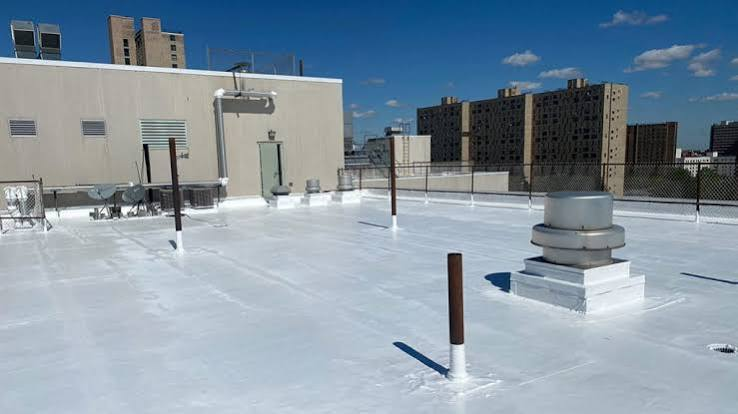
Flat roof decisions are rarely straightforward. When a roof starts showing wear, the immediate assumption is often that replacement is the only path forward. That assumption carries significant cost implications — not just in materials and labor, but in operational disruption, scheduling delays, and the extended exposure period while work is underway. For commercial buildings, industrial facilities, and multi-unit properties, a full tear-off is a serious undertaking that affects more than just the roofline.
What many building owners and facilities managers discover, often through a qualified roofing assessment, is that their existing roof is structurally sound enough to be restored rather than replaced. A silicone coating system applied over an intact or partially degraded membrane can extend service life by a meaningful margin — without the cost, waste, or disruption of full replacement. The challenge is knowing when that option genuinely applies and when the damage has gone too far to make it viable.
The following signs are grounded in what roofing professionals observe during field assessments. They are not guarantees of suitability, but they are consistent indicators that a coating evaluation is worth pursuing before committing to a more invasive solution.
Understanding What Makes Silicone Coating a Legitimate Restoration Option
Silicone coating is not a patch solution or a cosmetic fix. Applied correctly to a structurally sound substrate, roofing silicone forms a continuous, seamless membrane over the existing roof surface, sealing minor vulnerabilities and restoring weather resistance without requiring removal of the existing system. Its durability under UV exposure and ponding water conditions makes it particularly well-suited to flat roof geometry, where water drainage is never as immediate as on pitched surfaces. For facilities teams evaluating restoration versus replacement, understanding the material’s actual capabilities helps frame the decision more accurately. Broadly, the relevant chemical and performance standards for silicone-based roofing coatings are outlined by bodies such as ASTM International, which establishes testing criteria for elastomeric roof coatings used in commercial applications.
Why the Substrate Condition Is the Central Variable
The viability of a silicone coating restoration depends almost entirely on the condition of what lies beneath it. If the existing membrane has retained its structural integrity — meaning it has not delaminated, absorbed significant moisture, or collapsed in sections — then a coating can bond effectively and perform as intended. When the substrate is compromised at a fundamental level, coating over it locks in the problem rather than solving it. This is why a moisture scan or core sample assessment is typically part of any serious coating evaluation. The coating material itself is not in question; the roof it will bond to is.
Sign 1: Surface Granule Loss Without Membrane Failure
Modified bitumen and built-up roofing systems use embedded granules on the surface layer as a UV barrier and a first line of weather protection. Over time, those granules erode through normal weathering. When granule loss is visible but the membrane beneath remains flexible and intact — without cracking, splitting, or separation — the roof has lost its protective surface layer but not its structural capacity. This is a strong indicator that a coating restoration is appropriate. The membrane still functions; it simply needs a new protective layer applied over it.
Sign 2: Minor Surface Cracking That Has Not Penetrated the Membrane
Surface-level crazing or fine cracking patterns often develop in aging modified bitumen or single-ply membranes as they lose elasticity over years of thermal cycling. These cracks are cosmetically concerning and represent the early stages of weathering, but they do not necessarily mean the membrane has failed through its full thickness. When probing reveals that the cracks are shallow and the underlying layers remain cohesive, silicone coating can seal those surface fissures and restore a continuous waterproof barrier before any penetration occurs.
The Risk of Waiting on Surface Cracks
What starts as shallow surface cracking does not stay that way indefinitely. Thermal movement widens existing cracks incrementally with each seasonal cycle. Water infiltration into those cracks accelerates degradation through freeze-thaw expansion in colder climates. A roof that qualifies for coating restoration today may not qualify six to twelve months from now if surface cracking is left unaddressed. The window for cost-effective intervention is real, and it closes as damage progresses deeper into the membrane assembly.
Sign 3: Isolated Ponding Areas Without Structural Deflection
Flat roofs frequently develop low points where water collects after rainfall. Ponding in isolation is not an automatic sign of structural failure — it often reflects minor settling, clogged drains, or drainage design limitations. When ponding is consistent but the deck beneath shows no signs of deflection, soft spots, or compression damage, the issue is functional rather than structural. Silicone coatings are one of the few coating materials that retain their performance characteristics under prolonged ponding conditions, making them a practical choice for roofs with minor drainage imperfections that are not feasible to correct through regrading.
Sign 4: Flashing Deterioration at Edges and Penetrations
Flashings around HVAC equipment, skylights, drains, and perimeter edges are typically the first areas of a flat roof to show wear. They experience more thermal movement than the field of the roof, are often less protected from direct UV exposure, and are subjected to physical contact during rooftop maintenance. When flashing deterioration is visible but the field membrane remains sound, replacement of the entire roof is disproportionate to the actual scope of the problem. A silicone coating system, applied with additional detailing at transitions and penetrations, can address these vulnerable zones as part of a comprehensive restoration without disturbing the broader membrane.
Sign 5: Blistering That Has Not Ruptured
Blisters form when trapped moisture or air between membrane layers causes localized separation. They are common in built-up and modified bitumen systems that have experienced moisture infiltration during installation or through early surface compromise. Blisters that remain intact — meaning they have not ruptured, collapsed, or allowed water to infiltrate the deck below — indicate a contained problem. Once blisters rupture, they create open pathways for water entry. When blistering is caught in the intact stage, the affected areas can be cut, dried, and repaired prior to coating application, preserving the integrity of the rest of the membrane.
Distinguishing Active Moisture from Historic Blistering
Not all blistering indicates active moisture movement. In some cases, blisters formed years ago and have since stabilized as the roof dried and settled. A thermal scan or moisture survey helps differentiate between blistering that contains active moisture and blistering that reflects a historic condition now dormant. This distinction matters because active moisture pockets require remediation before coating, while stable historic blistering in a sound membrane may require only localized treatment. Getting this assessment wrong in either direction leads to poor outcomes — either coating over an active problem or removing roof material that still has residual service life.
Sign 6: Seam Separation Without Full Membrane Failure
In single-ply membrane systems — TPO, PVC, EPDM — the seams where membrane sheets overlap and bond together are points of mechanical vulnerability. Seam separation can develop from installation inconsistencies, adhesive breakdown over time, or thermal stress. When seam failure is localized and has not resulted in water infiltration into the roof assembly or substrate, the membrane field itself may still be performing adequately. Silicone coating applied over re-adhered and repaired seams can reinforce those areas and reduce the mechanical stress that causes repeated seam issues.
Sign 7: Chalking and Oxidation on the Roof Surface
Chalking refers to the powdery residue that forms on the surface of certain roofing membranes as UV radiation breaks down the surface chemistry over time. It is a normal aging indicator, not an automatic sign of membrane failure. When chalking is present but the membrane underneath retains flexibility and adhesion, the surface condition reflects weathering rather than structural compromise. Preparing and priming the surface appropriately before applying roofing silicone allows the coating to bond effectively despite the oxidized surface layer, restoring UV resistance without replacing a membrane that still functions.
Sign 8: Roof Age Within the Mid-Range of Its Expected Service Life
A roof that is approaching the midpoint of its expected service life — not the end of it — is often in the best position for a coating restoration. Early enough in its lifecycle to still have structural integrity, but weathered enough that surface protection has diminished, this is the window where a coating system adds the most value. Restoring a roof at this stage effectively resets the clock on surface degradation and extends the overall system life without the capital expenditure of full replacement. A roof that has already exceeded its expected service life is a different calculation entirely and warrants a more thorough structural evaluation.
Sign 9: Budget Constraints That Make Replacement Timing Impractical
Capital expenditure planning for roof replacement often runs on multi-year cycles. When a roof begins showing degradation signs outside of that planning window, a coating restoration can serve as a bridge strategy — extending functional service life until replacement can be properly budgeted and scheduled. This is not deferred maintenance in a negative sense; it is a planned interim measure that preserves the asset while keeping the facility watertight. The key is that the decision is made proactively, based on a current condition assessment, rather than reactively after active leaking has begun.
Sign 10: Previous Coating That Has Degraded Without Causing Substrate Damage
Some roofs have already been through one coating cycle. When a prior coating has aged, cracked, or lost adhesion, but has not trapped moisture or caused the underlying membrane to fail, recoating is often a viable option. The previous coating layer is assessed for adhesion, cleaned, and prepared before a new silicone coating system is applied. Each recoating cycle adds material thickness to the system, which can improve long-term performance if the substrate remains stable throughout.
Concluding Thoughts: Making the Call With Accurate Information
The decision between coating restoration and full replacement is not one that should be made based on surface-level visual inspection alone. What these ten signs collectively illustrate is that the visible condition of a flat roof often tells only part of the story. Granule loss, surface cracking, blistering, and flashing deterioration are real indicators, but their significance depends on what lies beneath them and how far the degradation has progressed into the membrane and deck assembly.
A qualified roofing contractor with experience in coating systems and restoration work will typically combine visual inspection with moisture mapping to establish a clear picture of roof condition before recommending a course of action. That assessment is the foundation of a sound decision — not the age of the roof, not a quick visual survey, and not cost assumptions made before the scope is understood.
For facilities managers, property owners, and operations teams managing flat roof assets, the practical takeaway is straightforward: if your roof is showing signs of surface wear without clear evidence of structural failure, a coating evaluation is a reasonable next step before committing capital to full replacement. The signs described here are a starting point for that conversation, not a final determination. The final determination belongs to the assessment — and the data it produces.
