

Hospitals operate under one of the most demanding regulatory environments of any industry. Every policy, system, and operational decision exists inside a framework shaped by patient rights, liability exposure, and federal law. Camera surveillance is no exception. Yet despite the significant role that video monitoring plays in hospital security, clinical oversight, and incident documentation, the regulatory conversation around it remains poorly understood by many of the people responsible for managing it.
Most facility administrators, compliance officers, and security directors know that HIPAA governs how patient information is handled. Fewer have a working understanding of how it applies specifically to video surveillance infrastructure — where the rules apply clearly, where they are ambiguous, and where facilities routinely make decisions that create regulatory exposure they are not aware of. This article addresses those gaps with a straightforward reading of what the law actually says and how it connects to day-to-day camera operations in a clinical environment.
How HIPAA Treats Video as Protected Health Information
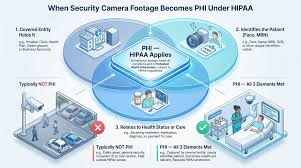
The Health Insurance Portability and Accountability Act does not include a section dedicated to security cameras. What it does include is a broad definition of protected health information, or PHI, that has direct implications for any video system operating inside or around a healthcare facility. Under HIPAA, PHI is any individually identifiable information that relates to an individual’s past, present, or future health condition, the provision of healthcare, or payment for that care. A hospital camera positioned in or near a treatment area, a patient room, or a corridor where identifiable clinical activity occurs can capture footage that meets this definition.
The critical point here is that HIPAA does not limit PHI to written records or digital files in a medical record system. If a video recording contains images of a patient receiving treatment, or images from which a patient’s identity and medical circumstance can be reasonably inferred, that footage may qualify as PHI. This is the baseline that shapes everything else in how hospitals need to think about their surveillance systems.
The Distinction Between Security Cameras and Clinical Monitoring
Hospitals typically run at least two distinct categories of camera systems. One is the general security infrastructure — cameras in parking areas, entrances, administrative corridors, and public-facing zones. The other is clinical or patient monitoring, which may include cameras in ICUs, behavioral health units, or rooms where continuous observation is medically indicated.
From a HIPAA standpoint, these two categories carry different risk profiles. Security cameras in non-clinical zones are less likely to capture PHI in a consistent or structured way, though they are not immune from doing so. Clinical monitoring cameras, by contrast, are specifically positioned to observe patients — meaning the footage they generate is far more likely to constitute PHI by default. Treating these two systems under a single, undifferentiated policy is one of the most common operational mistakes healthcare facilities make.
Where the Privacy Rule and the Security Rule Apply to Camera Systems
HIPAA is structured around two primary rules that govern protected information differently. The Privacy Rule establishes patient rights around how their information is used and disclosed. The Security Rule establishes administrative, physical, and technical safeguards for electronic PHI. When camera systems capture and store video digitally — which is the standard today — both rules become relevant.
The Privacy Rule would apply any time hospital staff access, share, or use footage that contains PHI. This includes reviewing footage for quality assurance, sharing it with law enforcement, or providing it in response to a legal request. Patients have a right to know how information about them is used, and video that qualifies as PHI falls within that right. Hospitals that pull surveillance footage routinely for non-clinical purposes without accounting for this are operating outside established boundaries.
How the Security Rule Applies to Digital Storage and Access
Because nearly all modern hospital camera systems store footage in digital format — whether on local servers or in cloud-based environments — the Security Rule’s requirements for electronic PHI apply wherever that footage constitutes PHI. This means hospitals need to assess how footage is stored, who can access it, how long it is retained, and whether the transmission of that footage is encrypted if it moves across a network.
The Security Rule, as outlined in the HHS HIPAA Security Rule guidance, requires covered entities to conduct regular risk analyses of their electronic PHI environments. Very few hospitals include their video surveillance infrastructure in these risk analyses. The assumption is that camera systems are a facilities or security matter rather than a compliance matter. That assumption is increasingly difficult to defend as camera systems become more sophisticated and more deeply integrated into clinical operations.
Access Controls and Audit Trails for Camera Footage
One of the practical compliance requirements that hospitals miss most often is the need for documented access controls on footage that qualifies as PHI. The Security Rule requires that access to electronic PHI be limited to individuals who need it to perform their job functions. For camera systems, this means that not every security staff member, administrator, or facilities manager should have unrestricted access to footage from clinical zones.
Audit trails are a related requirement. If PHI is accessed, the access should be logged in a way that can be reviewed. Many camera management systems do not enable or enforce this by default, and hospitals often have not configured them to do so. When a compliance review or breach investigation occurs, the absence of an audit trail for video access becomes a significant liability.
Consent, Notice, and Patient Rights in Surveillance Contexts
Patients entering a healthcare facility are generally provided a Notice of Privacy Practices, which is a required HIPAA document explaining how their health information may be used. Camera surveillance is rarely addressed in these notices with any meaningful specificity. Most facilities include a generic reference to security monitoring, which does not adequately account for clinical-zone cameras that capture PHI as part of routine operations.
Beyond notice, patients have certain rights under HIPAA that extend to PHI in any format. The right of access — meaning a patient’s ability to request their own health information — could technically extend to video footage in which they appear and which meets the definition of PHI. Very few hospitals have policies in place to handle such a request for video records. Fewer still have considered how their retention schedules and storage systems would support or complicate responding to one.
When Footage Is Requested by Law Enforcement or in Legal Proceedings
Hospital security footage is routinely requested by law enforcement agencies and subpoenaed in legal proceedings. When that footage contains PHI, HIPAA governs the conditions under which it can be disclosed. There are specific permitted disclosures under the Privacy Rule for law enforcement purposes, but they come with conditions that many hospitals do not verify before releasing footage.
Releasing footage that contains PHI without confirming whether the request meets one of HIPAA’s permitted disclosure pathways is a compliance failure, regardless of the intent behind the release. Hospitals that default to cooperating with law enforcement without routing these requests through a privacy officer create exposure that could be avoided with a straightforward review process.
Operational Gaps That Create the Most Risk
The majority of HIPAA compliance failures related to hospital camera systems do not stem from malicious intent or willful disregard. They stem from operational structures that were built without integrating surveillance infrastructure into the compliance program. The camera system was installed, managed, and maintained by a security or facilities team with no involvement from legal or compliance functions.
The gaps this creates are consistent across many facilities:
• No formal determination of which camera locations capture footage that qualifies as PHI, leaving the entire system unclassified for compliance purposes.
• Retention policies that do not distinguish between clinical-zone footage and general security footage, applying a single schedule without regard for the regulatory difference.
• Vendor contracts for camera systems or storage that do not include Business Associate Agreements, which are required under HIPAA when a vendor handles PHI on behalf of a covered entity.
• No training for security staff on HIPAA obligations related to the footage they access and manage on a daily basis.
• Risk analyses that evaluate electronic medical records and clinical systems but exclude surveillance infrastructure entirely.
Each of these gaps is addressable through policy and process changes that do not require replacing existing camera infrastructure. The starting point is a location-by-location assessment of what each camera captures and whether that footage is reasonably likely to constitute PHI on a regular basis.
Bringing Surveillance Into the Compliance Framework
Integrating hospital camera systems into a HIPAA compliance program is not a technology project. It is a governance project. It requires a cross-functional conversation between security, facilities, legal, compliance, and IT — a conversation that most hospitals have not had in a structured way around surveillance specifically.
The outcome of that conversation should be a written policy that addresses camera placement classifications, access controls by role, retention schedules by location type, vendor agreement requirements, patient notice language, and a defined process for handling footage requests from external parties. This policy does not need to be complex, but it does need to exist and be maintained as systems and operations change over time.
Conclusion
HIPAA does not mention cameras. That absence has led many healthcare facilities to treat their surveillance systems as existing outside the compliance framework entirely. But the law’s definition of protected health information is broad enough to cover video footage from clinical environments, and the obligations that follow from that coverage are real and enforceable.
The facilities that manage this risk effectively are not the ones with the most sophisticated camera technology. They are the ones that have taken the time to assess what their cameras capture, classify that footage appropriately, and build policies and procedures that treat surveillance as part of the compliance program rather than apart from it. That work is less complicated than it sounds, but it does require deliberate attention from people who understand both the operational function of the camera system and the legal framework that surrounds it.
For most hospitals, the first step is simply acknowledging that the gap exists. The regulatory exposure created by unaddressed surveillance practices is not hypothetical — it is a consistent finding in compliance reviews across the industry. Addressing it systematically, rather than reactively, is the more defensible path forward.
