

61% of B2B buyers say they’d prefer to buy without talking to a sales rep at all. Print buyers are no exception. At PRINTING United Expo 2026, PRINTING United Alliance research described online ordering portals as “now standard, not a ‘nice-to-have'”.
So, most printers have an online store, or are about to launch one. That’s the easy part.
The hard part starts after the customer clicks “Place order.” Someone downloads the file and opens it to check it. Then they type the order into the MIS and build a job ticket before a proof goes out. Each of those steps is a person doing work the customer thinks already happened.
Most guides to web2print solutions focus on the storefront and the online designer. This one follows the order after checkout, because that’s where the time goes.
The Order Isn’t the Job
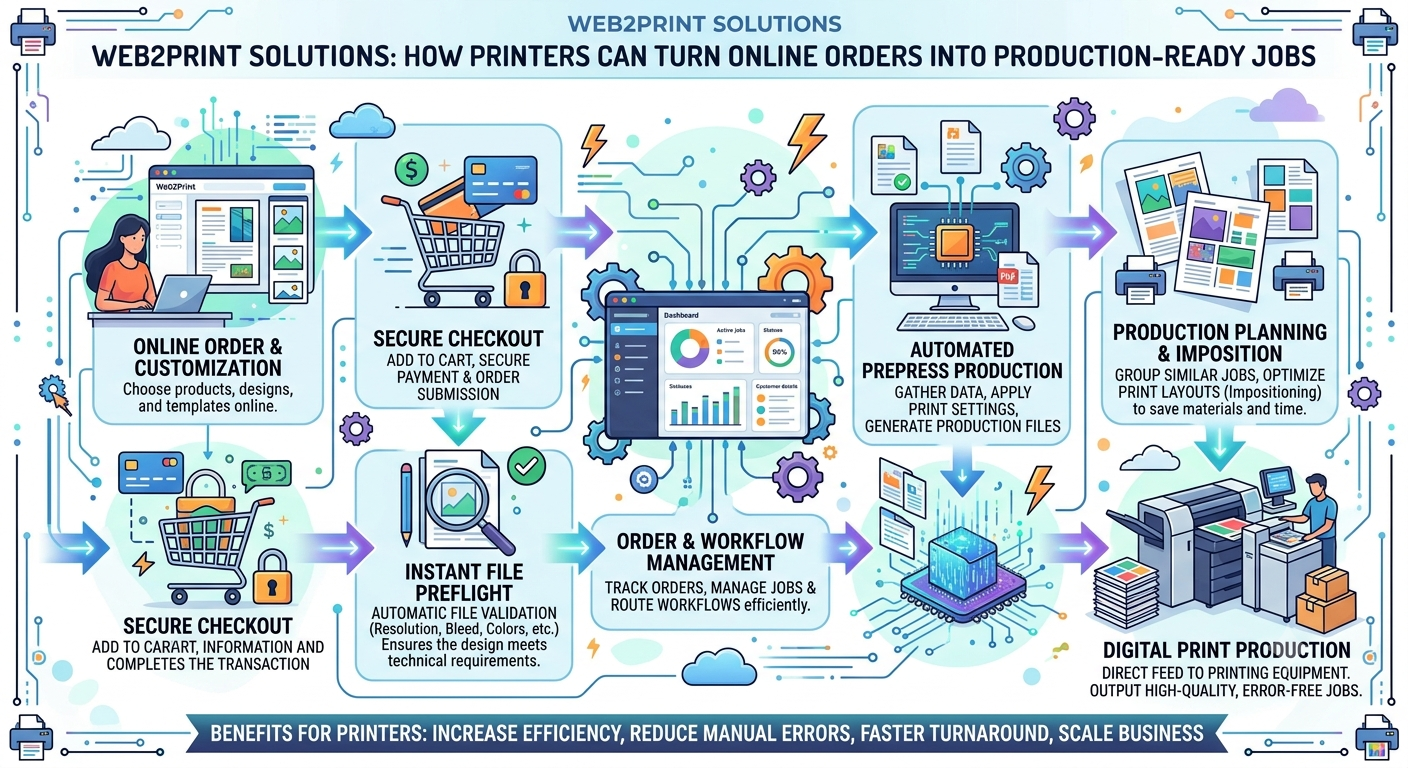
An online order is a promise. A production-ready job is a set of instructions the press room can run without asking questions.
Between the two sit a handful of handoffs. If any of them depends on a person reading an email or copying a field, you haven’t really automated ordering. You’ve moved the order form online.
This is more common than vendors admit. The FESPA 2025 Print Census found that nearly half of print service providers have no automation in place. Where automation does exist, it’s usually in web-to-print platforms and prepress, alongside other workflow tools. In other words, plenty of shops automate the front of the process and leave the middle manual.
Five Handoffs Between Checkout and the Press
1. A file check that decides, not just flags
Most web-to-print platforms say they preflight files. The question is what happens when a file fails.
A good setup fixes what it safely can, like adding bleed to a flat business card by extending the background. Files it can’t fix go on hold with a plain-language reason the customer sees right away. The bad outcome is a warning that lands in a CSR’s inbox two days later.
The rules also need to match the product. 150 DPI is fine on a banner viewed from ten feet. On a business card it looks soft.
2. A proof tied to the order
Proofs sent by email drift away from the order they belong to. When the approval lives on the order itself, with reminders and a logged version, the press room always knows which file was signed off. And a reprint starts from the right artwork.
3. A job ticket built from the order
Whatever the customer chose online (stock, quantity, finishing, due date, shipping method) should become the job ticket without anyone retyping it. If your web store and your MIS don’t share that data, every order gets keyed in twice. Every re-key is a chance to turn 500 into 5,000.
4. Output the press can use
A print-ready PDF still has to be imposed and sent to the RIP. For short-run commercial work, that’s where gang-run imposition and hot folders earn their keep. Approved files drop into a watched folder, and similar jobs get grouped onto one sheet without someone doing it by hand.
5. Status that flows back out
Once the job moves, the customer should see it move. If a sales rep has to walk to the floor to answer “where’s my order?”, the loop isn’t closed. That one question eats more staff time than most shops track.
Not Every Product Belongs Online the Same Way
Here’s the part most web2print guides skip. Full automation works on products that behave predictably. Business cards, flyers, standard labels and reorders fit that description. Customers can configure and pay, and the job releases to production with no human touch.
Configurable products need a gate. A banner in a custom size, or a sticker in a new die shape, can be ordered online, but it should hold for a quick check before it releases. You keep the speed of online ordering while still catching what the rules can’t.
Then there’s work that shouldn’t be a checkout at all. Structural packaging or a sign package that needs a site survey belongs in a quote-led flow. The web store can still collect the brief and the files. But a person price it.
This won’t fit every shop neatly. A trade printer might run most of its catalog hands-off, while a sign company might keep most work quote-led. Sorting your products this way before launch saves you from building rules for jobs that will never follow them.
Trace One Order Before You Buy Anything
Here’s a test that takes an afternoon. Place an order on your own store and follow it until it hits the press. Count every time a person opens, retypes, renames or forwards something.
If the count is more than two or three for a standard product, the bottleneck isn’t the storefront. It’s the handoff. That’s the first thing to fix, and it tells you which questions to ask any software vendor.
Ask them to show, not describe, what happens when a customer uploads a 72 DPI logo. And ask where the job ticket comes from, and what your MIS sees the moment an order is placed.
Where to Start
Most printers don’t need to rebuild everything at once. Pick your highest-volume standard product and automate its path from order to press completely. Then add the gated products once the team trusts it.
At PrintXpand, we designed our web-to-print solutions around that handoff: storefront orders arrive in Print MIS as job tickets, and approved artwork goes to press through hot folders without anyone re-entering it. The platform runs on our cloud or on your own servers. But the order-tracing test above is worth running whatever platform you use.
Frequently Asked Questions
What are web2print solutions? Web2print solutions let customers order and customize printed products online, then pass those orders to production. Smithers valued the web-to-print market at about $25.1 billion in 2027. The better platforms also handle file checks and job tickets, not just the online store.
Can a web2print solution connect to my print MIS? It should. Ask whether orders arrive in the MIS as job tickets automatically, and whether status updates flow back to the web store. If the answer involves a CSV export, expect manual steps.
Does web-to-print work for wide-format and packaging? Partly. Standard sizes and repeat items work well. Custom sizes need a proof gate before release, and structural packaging usually needs a quote-led flow. B2B buyers increasingly expect to order online anyway: e-commerce is now the top B2B revenue channel for companies that offer it [5].
About the Author
Pratik Shah is Creative head at PrintXpand, a cloud and on-premise web-to-print and print automation platform serving 350+ print businesses across 40+ countries. He works with print shops on how online orders connect to production and fulfillment. Learn more at printxpand.com.
