

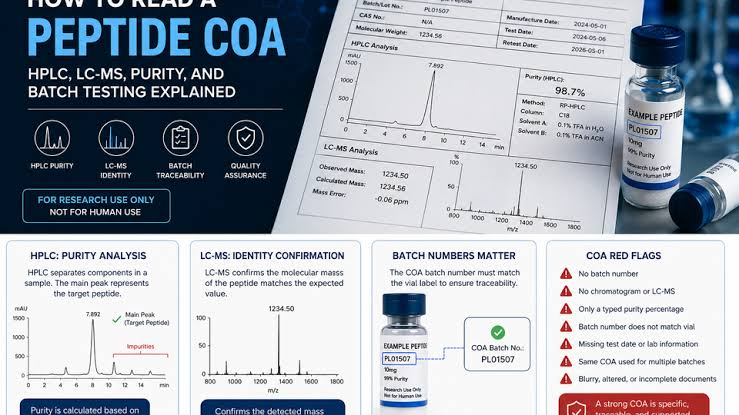
A vial of lyophilised powder tells you almost nothing on its own. It could be exactly the sequence printed on the label at the stated purity, or it could be a mixture of truncated chains, leftover protecting groups and salts from synthesis. The only way to know is analytical chemistry, and the two workhorse techniques for peptides are high-performance liquid chromatography (HPLC) and mass spectrometry (MS). For anyone sourcing research compounds in Australia, understanding what these methods actually measure, and how the results are written up in a Certificate of Analysis (COA), is the difference between trusting a supplier’s marketing and verifying it.
This article walks through the analytical process in practical terms for laboratory staff, students and technically curious readers. Research peptides sold in Australia are strictly for laboratory and research use only, not for human or animal consumption, and reputable suppliers require buyers to confirm they are over 18 and qualified researchers before an order is accepted.
Why synthetic peptides need verification at all
Most research peptides are made by solid-phase peptide synthesis, where amino acids are added one at a time to a growing chain anchored to a resin bead. Each coupling step is efficient but never perfect. If a single coupling fails on one chain, that chain ends up one residue short, a “deletion sequence” that is chemically very similar to the target and will travel through purification alongside it. Incomplete removal of protecting groups, oxidation of sensitive residues such as methionine, and racemisation during coupling all produce further close relatives of the intended molecule.
After synthesis, the crude product is cleaved from the resin and purified, usually by preparative HPLC. Purification removes most of the impurities but not all of them. The question a researcher needs answered is simple: of the material in this vial, what fraction is the molecule I ordered? That is what a purity figure attempts to express, and when a supplier sourcing peptides Australia wide advertises a threshold such as ≥99% purity verified by HPLC, it is this analytical result they are pointing to.
HPLC: separating the target from its near-identical relatives
High-performance liquid chromatography pumps a dissolved sample through a column packed with very fine particles. For peptides, the standard approach is reversed-phase HPLC, where the particles are coated with a hydrophobic layer and the mobile phase is a water and acetonitrile gradient, typically with a small amount of trifluoroacetic acid. Molecules that are more hydrophobic cling to the column longer; more polar ones wash through sooner. A deletion sequence missing a hydrophobic residue will leave the column slightly earlier than the full-length peptide, and an oxidised variant will typically shift too.
As compounds elute, a UV detector records absorbance, usually around 214 to 220 nanometres where the peptide bond absorbs strongly. The result is a chromatogram: a baseline with peaks rising from it, each peak representing a species leaving the column at a particular retention time. Purity by HPLC is calculated as the area of the main peak divided by the total area of all peaks, expressed as a percentage. A clean 99% result means that the main peak accounts for 99% of the integrated UV absorbance.
Two caveats matter when reading this number. First, HPLC area percentage measures peptide-related impurities that absorb UV. It does not account for water content, residual counter-ions such as trifluoroacetate or acetate, or inorganic salts, because those contribute little or nothing to the chromatogram. A powder can be 99% pure by HPLC and still contain a meaningful fraction of its mass as water and salts, which is why “purity” and “net peptide content” are different figures. Second, a single impurity that co-elutes exactly with the main peak would be invisible. Good laboratories address this by running a second gradient or a different column chemistry, and by pairing HPLC with mass spectrometry.
Mass spectrometry: confirming identity, not just cleanliness
HPLC tells you how many distinct species are present and in what proportion, but it cannot by itself confirm that the main peak is the correct molecule. That job belongs to mass spectrometry. In MS, the sample is ionised, commonly by electrospray ionisation (ESI) or matrix-assisted laser desorption/ionisation (MALDI), and the instrument measures the mass-to-charge ratio of the resulting ions with high precision.
Every peptide sequence has a calculable theoretical molecular weight. If the observed mass matches the theoretical mass within the instrument’s tolerance, the identity of the main component is confirmed. Because ESI produces multiply charged ions, software deconvolutes the resulting peaks back to a single molecular mass. A mass that is 18 daltons low could suggest a dehydration product; one that is 16 daltons high points to oxidation; one that is the mass of a single amino acid short signals a deletion sequence.
Many analytical labs now run LC-MS, where the HPLC outlet feeds directly into the mass spectrometer. This combination gives the best of both: each chromatographic peak is assigned a mass, so impurities can be tentatively identified rather than merely counted. When a supplier states that every batch goes through third-party analysis by HPLC and/or mass spectrometry, this is the pairing of separation and identification being described.
What a Certificate of Analysis should contain
A COA is the document that summarises these tests for a specific batch. Formats vary between laboratories, but a credible certificate will typically include the following elements.
- Product name and sequence or structure, so you can check that what was tested is what you ordered, including any modifications such as acetylation or amidation.
- Batch or lot number that matches the label on the vial. A COA without a lot number, or with a lot number that does not match your vial, is not evidence of anything about your material.
- Appearance, usually “white lyophilised powder” or similar.
- Purity by HPLC, stated as a percentage, ideally with the method conditions (column, gradient, detection wavelength) and the chromatogram itself attached.
- Molecular weight by MS, with both the theoretical and observed values, and the ionisation method used.
- Testing laboratory, date of analysis and an analyst or reviewer signature, which allows the document to be traced and queried.
Some certificates go further and report net peptide content, water content, counter-ion content, and endotoxin or microbial results where relevant. None of these extras is mandatory for every compound, but their presence indicates a laboratory that understands the limits of a bare HPLC percentage.
How to actually read the document
Start with the lot number and the sequence, because everything else is meaningless if they do not match your vial. Next, look at the chromatogram rather than only the headline percentage. A genuine trace shows a baseline, a dominant peak, and usually a few minor peaks; a perfectly flat baseline with a single geometric spike is more likely a stylised graphic than instrument output.
Then move to the MS data and compare the observed mass to the theoretical mass. A difference of a fraction of a dalton is normal; a difference of tens of daltons is not, unless a counter-ion adduct is explicitly noted. If the certificate lists only “MS: conforms” with no numbers, ask for the spectrum. Finally, look at who performed the analysis. A third-party laboratory name and date carry more weight than an in-house stamp, because the testing lab has no commercial interest in the result.
Australian suppliers who take documentation seriously generally make this material easy to obtain. Peak Haven, for example, states that COAs are available on request and maintains a Batch Documentation page so that researchers can match a vial’s lot number to its analytical record before the compound goes anywhere near an experiment. That kind of accessibility is a reasonable minimum expectation rather than a premium feature.
Verification does not end at the supplier
Even with a sound COA in hand, well-run laboratories treat supplier data as a starting point. Many groups run their own analytical HPLC on a small aliquot when a new batch arrives, both to confirm the certificate and to establish a reference trace for later comparison. This is also the moment to log storage conditions. Lyophilised peptides are typically kept at -20°C, and once reconstituted the solution is refrigerated and used within about four weeks, because hydrolysis and oxidation proceed faster in solution. A degraded compound will show new peaks on HPLC and a shifted mass on MS, which is exactly why having the original batch data on file matters.
The regulatory context is worth restating. In Australia, therapeutic goods are regulated by the Therapeutic Goods Administration, and research-use-only peptides are not approved medicines. Suppliers are expected to state clearly that their products are not for human or animal consumption, and to restrict sales to adults who confirm they are qualified researchers. Analytical documentation supports responsible laboratory practice; it does not change the legal status of the compound.
Practical wrap-up
When evaluating a research peptide, treat the COA as a technical document to be read, not a badge to be glanced at. Confirm the lot number, inspect the actual chromatogram, check that the observed mass matches the theoretical mass, and note who ran the tests and when. Prefer suppliers that publish batch records and provide certificates without friction, remember that HPLC purity and net peptide content are different things, and keep your own records of storage and any confirmatory analysis. Peak Haven and other documentation-focused Australian suppliers make that first step straightforward; the discipline of reading the data carefully is still the researcher’s job.
