

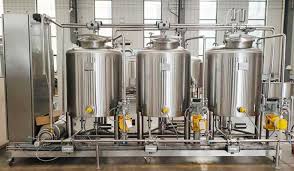
Fruit beers and adjunct-enhanced styles are some of the most creative and popular products in today’s craft beer market. From raspberry wheat ales to mango IPAs, passion fruit sours to chocolate stouts with coffee adjuncts, these beers bring new flavors and experiences to drinkers. But brewing with fruit and adjuncts isn’t the same as brewing traditional malt-forward beers—it requires specific equipment, thoughtful process planning, and sanitation strategies that standard brewhouse setups don’t always cover.
This comprehensive guide explains the brewery equipment you need for fruit beer and adjunct brewing, how equipment choices affect quality, tips for handling fruit and adjuncts in the brewhouse and cellar, and equipment layouts that keep your operations efficient. We also include three FAQs and finish with a recommendation for Micet’s brewery equipment solutions that support fruit/adjunct programs and standard beer production alike.
1. Understanding Fruit Beer & Adjunct Brewing: Why It’s Different
Before we dive into equipment lists, it helps to understand what makes fruit and adjunct brewing unique.
Fruit & Adjuncts vs Traditional Grains
Traditional beer is made from:
- malted barley (or other grains),
- water,
- hops,
- yeast.
Fruit and adjunct beers add non-grain ingredients such as:
- fresh fruit or purees,
- fruit juice,
- spices and botanicals,
- coffee or cocoa,
- sugars (honey, molasses),
- herbs or other flavoring agents.
These ingredients introduce:
- solids and particulates that require effective handling,
- additional sugars that change fermentation dynamics,
- pH changes that affect yeast performance and tank metallurgy,
- sanitation challenges (fruit microbes can introduce contaminants),
- filtration challenges (particles can clog equipment).
That’s why equipment choices for fruit/adjunct brewing often go beyond standard beer gear.
2. Core Brewing Equipment for Fruit & Adjunct Brewing
Even for fruit beers, you still need the core beer brewing system:
- Brewhouse (mash/lauter tun, kettle, whirlpool)
For wort production and primary sugar extraction. - Heat exchanger
To cool wort before fermentation. - Fermentation tanks / unitanks
For primary fermentation and conditioning. - Glycol chilling system
For temperature control. - Pumps, valves, and piping
For fluid handling and transfer.
But fruit beer and adjunct brewing require additional or upgraded equipment in several areas.
3. Fruit & Adjunct Handling: Specialized Tanks & Add-In Systems
One of the biggest equipment differences when brewing fruit or adjunct beers is how you handle, store, add, and extract flavor from those ingredients.
3.1 Dedicated Fruit/Adjunct Addition Tanks
When you add fruit or adjuncts directly to fermenters, you risk:
- contamination from wild yeasts and bacteria,
- irregular extraction,
- clogging of valves and lines.
A common solution is a fruit mash/adjunct tank:
- Stainless steel tank with agitation (to keep fruit particles suspended),
- Cooling jacket (to keep fruit at safe temps),
- Sanitary connections,
- Easy drain and cleanup.
These tanks allow you to:
- blend fruit purees or whole fruit with water,
- heat or pasteurize if needed,
- transfer fruit must into fermenters without solids clogging lines.
3.2 Inline Adjunct Dosing & Feeding Systems
For adjuncts that are liquid (puree, juice, syrups), equipment needs include:
- Metered dosing pumps for precise additions,
- Food-grade tanks with sight gauges,
- Sanitary inline mixers to blend adjuncts into beer or wort,
- Temperature control to prevent spoilage.
Precise dosing helps with flavor consistency.
3.3 Solid Handling Equipment
If you’re using whole fruit or spices, consider:
- Cutters or mills for fruit prep,
- Hoppers with agitators to avoid clogs,
- Filters/strainers to keep large solids out of pumps and valves.
This gear keeps your production flowing and protects your cores system.
4. Sanitation & CIP Upgrades for Fruit/Adjunct Workflows
Fruit and adjunct brewing introduce additional microbiological risks—wild yeasts, bacteria, and enzymes that aren’t part of your traditional clean beer process.
Standard cleaning equipment isn’t enough. You need:
- Enhanced CIP carts that can handle larger volumes and deeper penetration,
- Dedicated cleaning lines and chemicals for fruit tanks,
- High-temperature cleaning capability to kill microbes,
- Check valves and backflow prevention to keep fruit contaminants out of clean circuits.
Sanitation strategy is equipment and process—ensure your CIP system covers:
- wort lines,
- fruit/adjunct tanks,
- fermenters,
- brite tanks,
- packaging lines.
If you’re running fruit beer alongside traditional beer, consider segregated cleaning routines or dedicated equipment to reduce cross-contamination risk.
5. Cooling & Temperature Control: Extended Importance
Temperature control is always important in brewing, but fruit beers often require tighter control because fruit sugars ferment quickly and can lead to:
- off-flavors if too warm,
- stressed yeast if temperatures fluctuate,
- wild fermentation growth if uncontrolled.
A high-quality glycol chilling system with:
- proper sizing,
- multiple distribution manifolds,
- accurate sensors per tank,
- insulation on lines and tanks,
will keep fermentation stable—especially in fruit styles.
Micet offers glycol systems scalable for facilities from nano breweries to large microbreweries.
6. Fermentation Tanks: Choices for Fruit & Adjunct Beers
Your choice of fermentation tanks impacts how well you can manage fruit and adjunct beers.
6.1 Unitanks vs Standard Fermenters
Unitanks (pressure-capable tanks) are preferable when you want to:
- carbonate in tank,
- package directly from tank,
- trap CO₂ to reduce oxidation.
Classic fruit beers benefit from this because adjunct sugars can re-ferment or produce extra CO₂.
Older-style fermenters (non-pressure) work fine, but you’ll need:
- dedicated blow-off provisions,
- careful oxygen management post-primary.
6.2 Tank Features That Matter
- Large manway for manual fruit addition/removal,
- Racking arm to pull beer cleanly away from solids,
- Tri-clamp access points for sample and cleaning fittings,
- Internal spray balls for robust CIP coverage,
- High-quality sanitary valves that won’t trap fruit debris.
Micet fermentation tanks and unitanks are designed with these features in mind, helping you avoid common fruit brewing headaches like solids trapping and difficult cleaning.
7. Filtration & Clarification Equipment
Fruit and adjunct beers can be cloudy by design, but some styles require clarity.
You might use:
- Plate and frame filters with selectable screens,
- Centrifuges for high-volume clarification,
- Inline filters before packaging.
Choose equipment that’s:
- easy to disassemble,
- compatible with acidic fruit environments,
- capable of fine and coarse filtration.
8. Packaging Equipment: Special Considerations
Fruit and adjunct beers often still have:
- residual sugars,
- suspended particles,
- active yeast.
Packaging systems need to handle this without clogging or oxidation.
8.1 Keg Filler
For draft-only initial programs:
- keg washers and fillers sized appropriately,
- sanitation steps focused on particulate removal,
- CO₂ purge heads for reduced oxygen pickup.
8.2 Canning / Bottling Lines
If you’re canning:
- use counter-pressure fillers to reduce oxygen,
- consider clarification pre-canning for styles that need it,
- implement DO (dissolved oxygen) monitoring,
- include a can rinser and drying station.
Fruit beers can trap more oxygen and produce more foam—controls and careful calibration are essential.
9. Brewery Layout for Fruit & Adjunct Programs
A smart layout reduces risk and improves efficiency.
Recommended Zones
- Raw adjunct storage (cool and sanitary),
- Fruit prep zone (wash, cut, mill),
- Adjunct tank area separate from beer brewing area,
- Fermentation tank area with clear transfer paths,
- CIP zone close to process tanks,
- Packaging area with easy access to cold storage.
Good floor drains, proper slope, and washdown-rated floors are crucial.
10. Quality Control (QC) for Fruit/Adjunct Beers
You need a simple lab system to:
- measure gravity and pH,
- track fermentation progress,
- monitor microbial populations if you brew wild styles,
- verify sugar extraction and adjunct incorporation,
- check dissolved oxygen before packaging.
Equipment might include:
- pH meters
- Refractometers/hydrometers
- Microscopes or microbial plating tools (optional)
- Sample valves and sanitary sample bottles
QC helps you find process variation early, especially when you work with ingredients that vary more than malted grain.
11. Common Mistakes to Avoid in Fruit & Adjunct Brewing
11.1 Underestimating Solids Management
Whole fruit or pulpy adjuncts can jam pumps and valves. Use:
- hopper agitators,
- inline strainers,
- sanitary centrifugal pumps,
- bypass lines.
11.2 Ignoring Sanitation Complexity
Fruit microbes can easily take over a clean brewing environment. Before you start:
- design robust CIP,
- use separate hoses and gaskets,
- train staff on fruit-specific sanitation.
11.3 Poor Temperature Control
Warm fermentations with fruit sugars can produce excessive esters or off-flavors. Use proper glycol chilling and monitoring.
12. Equipment Checklist: Fruit Beer & Adjunct Brewing
Category Must-Have Equipment Notes Core System Brewhouse (mash/lauter, kettle, heat exchanger) Standard beer brewing Fruit Prep Fruit/adjunct tank with agitator Keeps solids suspended Fruit cutters, hoppers Reduces solid blockages Sanitation CIP cart & spray balls Handles solids and biofilm Cooling Glycol chiller Stable fermentation temps Fermentation Unitanks / fermenters with large manways Easier cleaning Filters Plate filters / centrifuge Clarification as needed Packaging Keg filler, counter-pressure canners Controls oxygen/foam QC pH meter, hydrometer, sample tools Ingredient variability tracking
Recommendation: Micet Brewery Equipment for Fruit & Adjunct Production
If you’re serious about fruit and adjunct brewing alongside traditional beer, your equipment should be both robust and flexible. Micet offers a lineup that covers brewery needs from small taprooms to larger microbreweries, including:
Micet Equipment for Your Brewery
- Brewhouse systems with modular options for future expansion
- Fermentation tanks and unitanks with sanitary fittings and easy CIP
- Adjunct tanks with agitation and cooling jackets for fruit programs
- Glycol systems sized to keep all your tanks at stable fermentation temps
- CIP solutions designed for mixed brewing environments
- Packaging support equipment (keg washers, fillers, counter-pressure systems)
Micet’s experience helping breweries design systems means you don’t just get tanks—you get a coordinated solution that supports quality, productivity, sanitation, and scaling.
FAQs
1. Can I use standard beer fermenters for fruit beers?
Yes—but choose tanks with large manways, easy-clean internal surfaces, and sanitary valves. Fruit solids can clog small ports and complicate cleaning, so tanks designed with accessibility make life easier.
2. Do I need special pumps for fruit and adjunct beers?
Not always, but using sanitary centrifugal pumps with gentle flow and larger clearances (for solids) helps reduce clogging. Inline strainers and bypass lines protect your pumps and keep production flowing.
3. How do I prevent contamination between fruit beer and other beer batches?
Use separate hoses, gaskets, and cleaning routines for fruit tanks and adjunct lines. If possible, dedicate specific transfer paths and maintain aggressive sanitation to prevent cross-contamination of strains.Taba Squishy
