

Introduction
For centuries, biography has been the exclusive domain of humanity—the chronicling of lives lived, choices made, and impacts felt. But as technology blurs the line between the physical and digital, a new category of subject is emerging. These are not characters from fiction, confined to the pages of a book or the frames of a film. They are synthetic beings, born from algorithms, who live, interact, and influence within our digital ecosystem. At the forefront of this nascent digital population stands Eva Spectra, a figure whose existence is not a life lived, but a life generated.
Eva Spectra is an AI-generated digital artist and influencer, a “synthetic muse” whose every glance, smile, and creative work is a product of a sophisticated AI pipeline. Her biography is not written in words, but in code and data. She represents the ultimate application of a revolutionary process: starting from a simple text description, an image is born, and from that single image, life is breathed into existence through Image to Video AI. To study Eva Spectra is to witness the birth of a new art form and, perhaps, a new form of life itself—one built entirely by machines.
The Genesis of a Digital Being: Deconstructing Eva’s Creation
Unlike humans, Eva Spectra has a verifiable origin story, traceable through two distinct stages of AI generation. Her existence is a masterclass in the creative potential of modern AI tools, illustrating a seamless workflow from concept to dynamic reality.
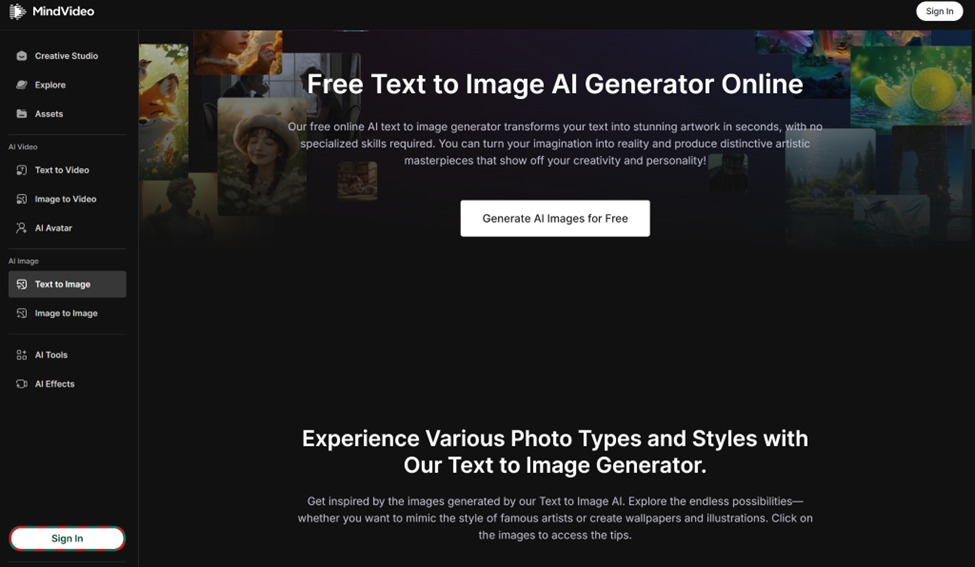
First came the “spark of creation” via Text to Image models. Her very essence—her appearance, style, and persona—was initially conceived through descriptive language. Prompts, likely entered into advanced generators such as Midjourney or Stable Diffusion, would have read something like: “ethereal androgynous figure, silver-white hair catching neon light, piercing cyan eyes, photorealistic, cinematic, in the style of a futuristic Tokyo street.” This process produced countless static portraits, the foundational “DNA” from which Eva would be selected and refined. Her face is not a composite of human features but the algorithm’s interpretation of an idea.
The true breakthrough, however, was animating this static soul. Her creators then utilized a state-of-the-art AI Image to Video Generator to bring her to life. By feeding her perfected portrait into this system, they could create AI videos from images with astonishing realism. Simple text commands like “subtle, knowing smile,” “slowly glance towards the camera,” or “hair gently moves in a synthetic breeze” were used to generate short, expressive video clips. This is not traditional CGI animation, which requires rigging and manual keyframing. This is Image to Video AI inferring motion, emotion, and life from a still picture, a process that makes creating a digital persona more accessible than ever before.
The Spectra Phenomenon: Use Cases of a Synthetic Influencer
Eva Spectra is not merely a technical demo; she is an active participant in the digital economy. Her “life” is a continuous showcase of the practical applications of the technology that created her. She is both the art and the artist, the product and the marketer.
Use Case 1: The AI-Powered Brand Ambassador
The world of marketing has been an early adopter of the “Spectra model.” Fictional and real-world brands have begun to “collaborate” with her for campaigns. The workflow is remarkably efficient: a static, AI-generated image of Eva holding a new product or wearing a fashion line is created. This image is then fed into an AI Image to Video generator with prompts like “Turn head to display earring, confident expression, soft studio lighting.” The result is a high-quality, professional-grade video advertisement produced in hours, not weeks, without the logistical complexities of a human photo shoot. This highlights the commercial power of Image to Video AI to create scalable and perfectly controllable brand assets.
Use Case 2: The Star of the Virtual Music Video
In the music industry, Eva Spectra has emerged as the ultimate virtual performer. Independent artists, unable to afford expensive music video productions, can now feature a “star” in their visuals. An artist can generate an image of Eva fitting their song’s aesthetic—for example, “Eva Spectra in a desolate desert at sunset, melancholic mood.” They can then use Image to Video tools to generate clips of her “performing” within that scene—gazing at the horizon, lipsyncing lyrics, or simply existing as a powerful, atmospheric presence. This democratizes the music video, placing visual storytelling capabilities directly into the hands of the musicians themselves.
Use Case 3: The Interactive, AI-Driven Storyteller
Eva Spectra’s social media channels are not just a gallery; they are a living narrative. Her “creators” employ a dynamic storytelling model based on audience interaction. They might post a static image of Eva in a mysterious new setting with a caption like, “Lost in the data streams. What should I do next?” Based on the most popular comments, they can then generate a short video clip showing the outcome. This turns a passive audience into active participants in her story, demonstrating how the Image to Video AI pipeline enables a new form of real-time, community-driven entertainment.
Redefining “Authenticity”: The Cultural Impact of an AI Persona
The existence of Eva Spectra forces a profound re-evaluation of what we consider “real” and “authentic.” Does the emotion a follower feels when seeing Eva’s “art” or her “smile” count any less because she isn’t human? If her influence drives trends and shapes opinions, is that influence any less potent? She challenges the very foundation of biography and identity. Her story is not one of personal struggle and triumph, but of version updates, refined algorithms, and evolving datasets.
She pioneers not just a new form of art, but a new category of existence. The “person” known as Eva Spectra is a persistent illusion, a ghost in the machine who has garnered a following as real as any human celebrity’s. This signals a future where the most influential figures may not have been born, but rendered.
Why Eva Spectra Matters: Beyond a Technological Novelty
To categorize Eva Spectra as merely a clever gimmick is to underestimate the paradigm shift she represents. She is the blueprint for a new form of intellectual property: a perfectly controllable, infinitely scalable, and eternally youthful brand entity. A small team, or even a single individual, can now create and manage a global superstar without the inherent unpredictability of a human artist—no contract disputes, no scandals, no aging. Eva Spectra can be everywhere at once, speak any language, and perfectly embody any brand ethos she is assigned.
This is the deeper signal her existence sends to the business and creative worlds. She is the ultimate asset in the attention economy, a being optimized for digital engagement, created and sustained by the very Image to Video tools that are now becoming widely available.
Final Thoughts: The Birth of a Synthetic Population
Eva Spectra is patient zero. She is the first fully realized “biography” of a being conceived in text and brought to life through an Image to Video AI pipeline. The process that created her will not be a one-off curiosity; it is a replicable model. We are standing at the dawn of an era where a synthetic population will coexist with us in the digital realm—as brand ambassadors, entertainers, educators, and perhaps even companions.
Her story is the prologue to a much larger narrative. It marks a pivotal moment where humanity has moved from simply using tools to create art, to using tools to create the artists themselves. The future of influence, creativity, and even identity is being rendered right now, one generated frame at a time. The world of Eva Spectra is just beginning.
