

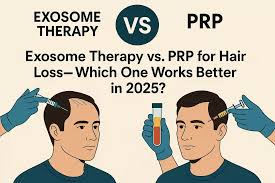
Two people can walk into a hair clinic with the same complaint and walk out with two completely different plans. One is told PRP could help. The other hears about exosomes. Both go home and start reading, and that is usually where the confusion gets worse.
The problem is not lack of information. It is too much loose information, much of it dressed up like certainty. If you are already searching for best exosome treatment chennai, you are probably not looking for glossy promises. You want to know whether exosomes are genuinely ahead of PRP for hair regrowth, or whether PRP remains the steadier and more proven route.
Right now, these two treatments do not sit on equal footing in terms of evidence, regulation, or real-world use. PRP is already used in dermatology for hair loss in selected patients, while exosome therapy is still being discussed much more cautiously and remains unapproved by the US FDA.
Why This Comparison Gets Messy So Fast
On paper, both treatments sound exciting. Both are described as regenerative. Both are linked to growth factors and cell signalling. Both are marketed as non-surgical options for people who want something more advanced than topical products alone.
But this is where clean marketing language hides an important difference. PRP has already entered mainstream hair-loss conversations in dermatology. The American Academy of Dermatology notes that research shows potential for platelet-rich plasma therapy in hair loss, and Cleveland Clinic describes PRP scalp injections as a treatment used for thinning hair. Exosome products, by contrast, are still in a much more experimental and regulatory grey zone for many clinical uses, and the FDA says there are currently no FDA-approved exosome products.
That one detail changes the tone of the whole comparison.
What PRP Actually Is
PRP stands for platelet-rich plasma. It is prepared from your own blood. A sample is drawn, processed to separate and concentrate platelets, and then injected into the scalp. The reason PRP gets attention in hair restoration is simple: it is built from the patient’s own blood components and is already being used by clinicians for thinning hair and other medical applications. Cleveland Clinic explains that PRP is injected into the scalp to treat thinning hair, while the AAD describes it as a treatment being used and studied in hair-loss care.
For many patients, PRP sits in that middle space between everyday medical management and surgery. It is not a transplant. It does not create a new hairline from scratch. It is usually considered when follicles are still present but struggling.
What Exosome Therapy Is Supposed to Do
Exosomes are tiny extracellular vesicles that carry signalling molecules between cells. In hair restoration discussions, they are often presented as messengers that may help create a better environment around hair follicles and support regeneration. Recent review papers are exploring this area and suggest potential, but they also make clear that the evidence base is still developing and that stronger clinical data are needed.
That matters because exosomes are often talked about online as though they have already crossed into settled, standard treatment territory. They have not. The FDA’s public safety notices state that exosome products intended to treat disease or conditions in humans require approval and that there are currently no FDA-approved exosome products.
So while exosome therapy may sound newer and more advanced, “newer” does not automatically mean “better established.”
Where PRP Has the Edge
PRP has the edge in familiarity, clinical acceptance, and present-day comfort level. Dermatologists already use it in selected hair-loss cases. Patients can understand the basic setup more easily because the material comes from their own blood. There is also a clearer public-facing base of information from institutions such as Cleveland Clinic and the AAD describing its role in thinning hair.
There is another practical advantage too. PRP is not usually sold as magic. Good clinics tend to frame it as part of a broader plan. That makes expectations easier to manage. The goal is often better density, better support for weakened follicles, or slowing further loss in the right patient, not instant reversal of advanced baldness.
Where Exosomes Get Attention
Exosomes get attention because they sound like the next chapter. They are marketed as highly refined, science-forward, and more powerful than older regenerative options. Patients who have already tried standard treatments often find that message appealing. It feels like progress.
And to be fair, there is active interest in this field. Recent reviews are examining exosomes for androgenetic alopecia and other hair-loss types, which shows the topic is not fringe. But the same reviews also underline that the evidence is still limited, heterogeneous, and in need of larger, more rigorous clinical studies. That is very different from saying the treatment has already “won.”
So Which One Wins?
If “wins” means which treatment currently carries the stronger balance of real-world clinical use, patient familiarity, and publicly supported medical positioning, PRP is ahead.
If “wins” means which treatment generates more curiosity and future-facing buzz, exosomes probably take that round.
Those are not the same victory.
A patient with early thinning who wants a non-surgical option that sits closer to current dermatology practice may find PRP the more grounded choice. A patient drawn to cutting-edge regenerative therapy may ask about exosomes, but that discussion should come with a more careful explanation of the evidence and regulatory status. Right now, treating exosomes and PRP like equals in maturity would be misleading.
The Better Way to Think About It
Picture two mini-scenarios.
One patient has diffuse thinning, a widening part, and visible miniaturisation but still has plenty of hair on the scalp. For that person, PRP may fit the clinical conversation more naturally because the follicles are still there and the treatment is already recognised in hair-loss care.
Another patient has spent months chasing “advanced” solutions online and wants the newest thing available. That person may ask for exosomes first. A responsible clinic should not respond with hype. It should respond with honesty: exosomes are promising in theory, being studied actively, but still sit in a less established space, and no FDA-approved exosome products currently exist.
That kind of clarity builds trust far better than a flashy sales script.
What a Strong Clinic Conversation Should Sound Like
A serious consultation should not begin with “Which package do you want?” It should begin with: What type of hair loss do you have? How long has it been going on? Is the scalp inflamed? Are the follicles miniaturising or already gone? Are you trying to thicken existing hair, slow progression, or restore visibly lost areas?
The AAD is clear that effective hair-loss treatment starts with diagnosis. That point can get buried in the excitement around procedures, but it is still the anchor. Without diagnosis, even a technically well-delivered treatment can be the wrong treatment.
What Chennai Patients Should Keep in Mind
Search trends can make a treatment look settled before it really is. The phrase best exosome treatment chennai may lead you toward clinics, packages, and bold claims, but the smartest move is still to ask harder questions before choosing anything.
Ask how the clinic explains the evidence. Ask what kind of hair loss they think you have. Ask whether they would still recommend the same treatment if the marketing around it disappeared. Ask what they would choose for someone in your exact stage of loss.
That is usually where the strongest clinics separate themselves from the loudest ones.
Final Take
PRP does not win because it sounds exciting. It wins, for now, because it stands on firmer ground in present-day hair-loss care. Exosomes remain a treatment to watch, not a treatment to assume. That distinction matters for anyone trying to make a smart decision instead of a rushed one.
So if the question is exosome vs PRP for hair regrowth, the sharper answer today is this: PRP is the more established option, while exosomes are the more experimental one. For many patients, that makes PRP the safer place to start the conversation. Exosomes may become more important with time and better data. They just have not earned a blanket victory yet.
FAQs
Is exosome therapy approved for hair loss treatment?
The FDA says there are currently no FDA-approved exosome products, and exosome products intended to treat diseases or conditions in humans require FDA approval.
Is PRP commonly used for hair thinning?
Yes. PRP is already used in dermatology and is described by sources such as Cleveland Clinic and the AAD as a treatment being used and studied for hair loss and thinning hair.
Does newer always mean better in hair regrowth treatments?
No. Exosomes are newer and generate more interest, but current reviews still describe the clinical evidence as developing and limited.
Can either PRP or exosomes replace a hair transplant?
Not necessarily. These treatments are usually discussed in the context of supporting or stimulating existing follicles, while transplant surgery addresses areas where hair is already lost by moving follicles. Hair transplantation is a different category of treatment.
What should I ask before choosing between PRP and exosomes?
Ask what diagnosis you have, whether your follicles are still active, what level of evidence supports the treatment being recommended, and how the clinic explains risks, expectations, and alternatives. The AAD stresses that diagnosis comes first in hair-loss treatment.
