

If you run vans for a living, tire decisions are never trivial. Rolling resistance directly affects fuel costs or EV range. Wet braking is a safety issue, not just a performance metric. And size availability determines whether you can standardize across a mixed fleet or not. The GT Radial MAXMILER Pro2, launched in February 2026, was built with exactly those realities in mind. It delivers a 15% improvement in rolling resistance performance and an 8% improvement in wet braking over its predecessor, arrives immediately in 22 sizes covering 88.5% of the light truck market, and carries the EV Ready designation confirming compatibility with both electric and traditional fuel-powered vans. For operators looking at the total cost picture, this light truck tires makes a straightforward argument.
Eleven Years of MAXMILER: Why the Name Carries Weight
The MAXMILER Pro name first arrived in Europe in 2015. Over the eleven years since, it became one of GT Radial’s most recognized and commercially successful lines in the light truck category, building a reputation as a benchmark tire in the mid-market commercial segment and becoming a consistent choice among GT Radial Performance Centres across the UK. That heritage matters because it sets the bar the MAXMILER Pro2 had to clear.
In the words of Fabio Pecci-Boriani, Deputy General Manager for Product Planning PCR and LTR at Giti Tire’s European R&D Centre: the MAXMILER Pro name is synonymous with mileage, toughness, and robustness. Maintaining all of those attributes while simultaneously delivering a 15% gain in rolling resistance performance and an 8% improvement in wet braking takes the tire to what he described as a whole new level, one that also encompasses sustainability. These aren’t incremental updates dressed up as a new model. The compound and pattern engineering involved in achieving both of those numbers at the same time, without sacrificing the durability that made the original famous, represents a genuine engineering step forward.
What the Numbers Actually Mean for Van Operators
A 15% improvement in rolling resistance is a figure that has real-world financial consequences. Rolling resistance is the energy a tire consumes simply by rotating under load, and it accounts for a meaningful portion of total fuel consumption in a commercial vehicle that covers high annual mileage. For a diesel van covering 30,000 km per year, even a modest reduction in rolling resistance translates directly into lower fuel spend per vehicle, per year. Multiply that across a fleet of ten, twenty, or fifty vans and the aggregate saving becomes significant. For electric van operators, the impact is different but equally important: lower rolling resistance directly extends range per charge, which reduces the frequency of charging stops and improves operational productivity.
The 8% improvement in wet braking distance is a safety argument as much as a performance one. For courier and logistics vehicles operating in all weather conditions on year-round schedules, wet road grip is not a seasonal concern, it is a constant one. Stopping shorter in emergency conditions is an outcome that cannot be quantified purely in commercial terms. The MAXMILER Pro2 also comes to market with a mix of A and B EU label ratings in Wet Grip and B and C in Rolling Resistance Coefficient. The EU tire label is independently verified, which means these ratings are not manufacturer claims, they are standardized test results.
Engineering That Matches the Demands of Modern Light Trucks
The MAXMILER Pro2 was designed and engineered at Giti Tire’s European Research and Development Centre in Hannover, Germany. The three core engineering priorities for the project were endurance, mileage, and sustainability with efficiency, a set of objectives that directly reflects how fleet operators evaluate commercial tires over their operational life rather than just at point of purchase.
The optimised tread pattern at the heart of the design was built to deliver safety on both dry and wet roads, improved grip and handling, consistent high mileage, superior comfort, and low noise levels. In a commercial vehicle tire, noise reduction is not merely a comfort feature, it affects driver fatigue over long shifts and occupant wellbeing in shuttle or passenger-carrying configurations. The reinforced construction makes the tire appropriate for heavy load operations, while a stiff shoulder provides control and stability under the kind of lateral forces that occur during loaded cornering and tight urban maneuvers. Side impact protection has also been specifically improved to handle consistent lateral kerbside contact, which is a predictable stress in any van application involving frequent urban deliveries and parallel parking.
Changes to load and speed indices have been made to match the requirements of the latest generation of single and dual-axle light trucks. Two specific sizes, 215/70R15 109 S and 225/70R15 112 S, have been engineered to address the Fiat Ducato and Peugeot Boxer, two of the most widely operated large panel vans in the European market. Both the Ducato and Boxer are now available as full electric vehicles, and specifying a tire that is validated for both the ICE and electric version of the same platform matters for fleet operators who may be running mixed or transitioning fleets.
EV Ready: The Designation That Reflects Where the Van Market Is Going
The MAXMILER Pro2 is the latest GT Radial light truck tire to carry the EV Ready logo, and the timing is not coincidental. Europe’s commercial van segment is undergoing a significant electrification shift, driven by urban low-emission zone restrictions, fleet emissions targets, and the expanding availability of capable electric van platforms from major manufacturers. Battery electric vehicle registrations in Europe reached a 19% share of total new passenger car registrations in January 2026, and the van segment is following a similar trajectory as operators face increasing regulatory pressure to reduce fleet emissions in urban operations.
Electric vans place different demands on tires than their diesel equivalents. The immediate torque delivery from an electric motor creates higher stress on the tire compound during acceleration. Battery packs add significant vehicle weight compared to ICE equivalents, increasing the load on tires and affecting wear characteristics. Regenerative braking changes how deceleration forces are distributed. A tire that carries the EV Ready designation has been validated to handle these specific load profiles and performance characteristics, it is not simply a relabeled conventional tire. For fleet managers making specification decisions today on vehicles that may be replaced with electric equivalents in the next contract cycle, buying a tire that is certified for both powertrains removes one variable from an already complex transition.
Size Coverage That Works Across a Real Fleet
The MAXMILER Pro2 launches with immediate availability in 22 sizes, covering rim diameters from 15 to 17 inches, section widths from 185 to 235mm, and series sizes from 55 to 75. GT Radial’s own assessment is that this range covers 88.5% of the European light truck market. For the portion of the market not covered by the Pro2 at launch, the original MAXMILER Pro remains available, ensuring continued coverage across the full segment without gaps during the transition period.
That size breadth matters practically because fleet operators rarely run a single vehicle type. A courier company might operate a mix of smaller panel vans for urban last-mile deliveries alongside larger high-cube vehicles for trunk routes. Being able to standardize on a single trusted tire line across multiple vehicle types reduces procurement complexity, simplifies stock management, and makes maintenance scheduling more predictable. Twenty-two sizes from a single model, covering the vast majority of the commercial light truck market, is the kind of specification that fleet purchasing managers actively look for.
GT Radial’s Position in the Commercial Tire Market
GT Radial is manufactured by Giti Tire, one of the largest tire companies in the world by both volume and revenue, distributing across more than 130 countries. The brand has held OEM contracts with major vehicle manufacturers including Citroën, Peugeot, and Dacia, relationships that require meeting the same technical and quality standards that premium brands are held to in original equipment supply. GT Radial’s R&D operation includes a team of over 600 experienced engineers across five facilities globally, with the European center in Hannover bearing direct responsibility for products like the MAXMILER Pro2.
The commercial proposition that Fabio Pecci-Boriani highlighted is the one that dealers and fleet operators will recognise immediately: the MAXMILER Pro2 delivers dynamic performance on par with premium manufacturers’ current patterns, but the price proposition is what will drive sales for dealer partners. In a market where commercial vehicle operators manage tire spend as a line item, that combination, independently verified performance improvements, EV compatibility, and a mid-market price point, is genuinely compelling.
Where the MAXMILER Pro2 Fits in the Van Tire Decision
The light truck tire decision is rarely made purely on peak dry-road performance. Commercial van operators care about how long the tire lasts under real-world loads, how it behaves when the road is wet after a week of courier runs, what it costs to replace across a fleet of fifteen vehicles, and increasingly, whether it is compatible with the electric vans they are being pressured to adopt by their customers and local authorities. The MAXMILER Pro2 addresses all four of those questions with a single product. The engineering improvements over the Pro are real and measurable. The EU label ratings are independently verified. The EV Ready certification is validated, not self-declared. And the price proposition has been positioned explicitly by the brand as a competitive differentiator against the premium tier.
For fleet managers evaluating a tire for both current ICE fleets and incoming EV additions, for owner-operators of Ducatos and Boxers who need confidence in both wet road safety and fuel efficiency, and for GT Radial dealer partners looking for a commercial product with a clear performance story to take to fleet customers, the MAXMILER Pro2 arrives at the right time with the right credentials.
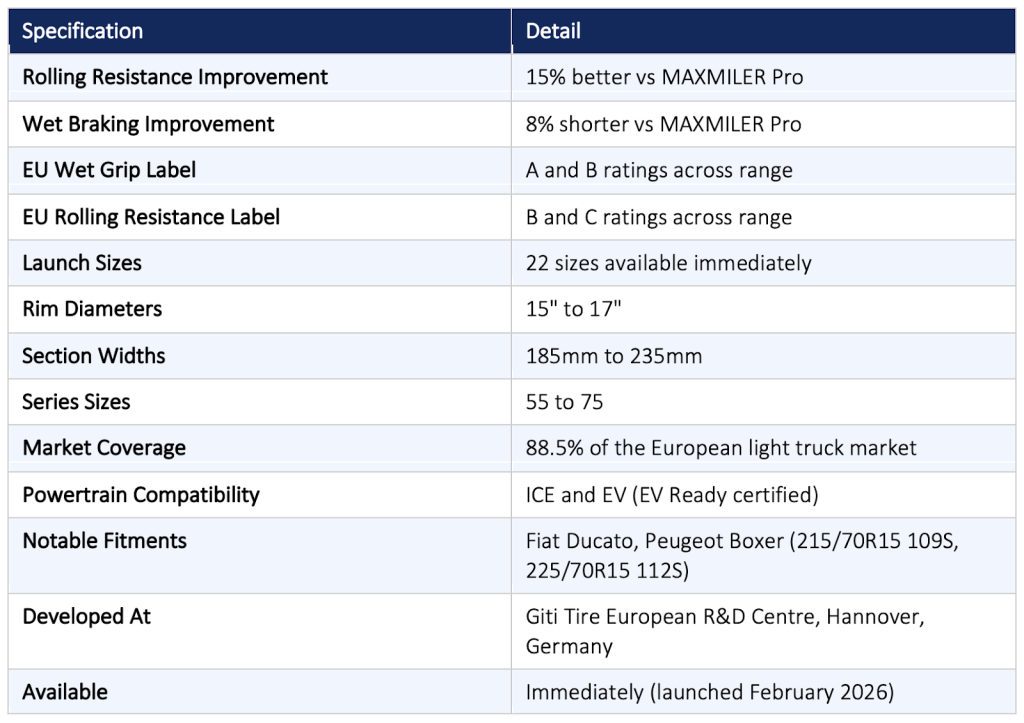
GT Radial MAXMILER Pro2: Key Specifications at a Glance
Frequently Asked Questions About the GT Radial MAXMILER Pro2
What is the GT Radial MAXMILER Pro2 designed for?
The MAXMILER Pro2 is a light commercial vehicle tire designed for vans and light trucks used in commercial, courier, logistics, and passenger-carrying operations. It is engineered for both electric and internal combustion engine light trucks and covers single and dual axle configurations.
How much better is the MAXMILER Pro2 compared to the original MAXMILER Pro?
The MAXMILER Pro2 delivers a 15% improvement in rolling resistance performance and an 8% improvement in wet braking distance compared to the MAXMILER Pro. Both improvements are achieved while maintaining the mileage, toughness, and durability the MAXMILER Pro name is known for.
Is the MAXMILER Pro2 compatible with electric vans?
Yes. The MAXMILER Pro2 carries the GT Radial EV Ready designation, confirming it has been validated for use with battery electric vans as well as traditional internal combustion engine vehicles. This is particularly relevant for operators transitioning to electric platforms such as the electric Fiat Ducato or Peugeot e-Boxer.
How many sizes does the MAXMILER Pro2 come in?
The MAXMILER Pro2 launches immediately in 22 sizes, with rim diameters from 15 to 17 inches, section widths from 185 to 235mm, and series sizes from 55 to 75. GT Radial states this range covers 88.5% of the European light truck market. The original MAXMILER Pro remains available for sizes not yet in the Pro2 range.
What EU tire label ratings does the MAXMILER Pro2 carry?
The MAXMILER Pro2 carries a mix of A and B EU label ratings in Wet Grip, and B and C in Rolling Resistance Coefficient across the range. EU label ratings are independently verified standardized test results, not manufacturer claims.
Where was the MAXMILER Pro2 developed?
The MAXMILER Pro2 was designed and engineered at Giti Tire’s European Research and Development Centre in Hannover, Germany, with endurance, mileage, and sustainability with efficiency as the core project objectives.
Who makes GT Radial tires?
GT Radial is manufactured by Giti Tire, one of the largest tire companies in the world by volume and revenue, distributing to more than 130 countries. Giti Tire holds OEM supply relationships with vehicle manufacturers including Citroën, Peugeot, and Dacia, and operates R&D facilities in Europe, China, Indonesia, and the USA.
The Bottom Line
The MAXMILER Pro name built its reputation in European commercial vehicle circles over eleven years by being reliably tough, long-lasting, and competitively priced against premium alternatives. The MAXMILER Pro2 keeps all of that and adds performance improvements that are independently verifiable and operationally meaningful, a 15% rolling resistance gain that cuts running costs and extends EV range, an 8% wet braking improvement that has direct safety implications, and EV Ready certification at a moment when Europe’s light commercial vehicle segment is shifting toward electrification faster than most operators anticipated.
For any van operator evaluating their tire specification in 2026, the MAXMILER Pro2 deserves to be in the conversation. It is available now across 22 sizes. It works on diesel and electric vans. It was engineered in Europe for European roads and the demands of European commercial operations. And it was built on a foundation of eleven years of market trust that the brand has consistently earned.
To find the right MAXMILER Pro2 size for your vehicle or fleet, visit gtradial.com and use the Tire Finder tool, or contact your nearest GT Radial Performance Centre for a direct recommendation.
