


Introduction
Many enterprises face a critical disconnect in product development: the processes used in the prototyping phase are often severely misaligned with the high demands of final mass production. This commonly stems from treating rapid prototyping and precision manufacturing technologies—like high-speed machining and 5-axis CNC machining—as isolated steps.
This article aims to provide a set of integration strategies grounded in forward-thinking manufacturing principles, ensuring the prototyping phase becomes a reliable foundation for production success. The following sections will detail the core dimensions of this synergistic approach.
Why Must Prototyping Phase Consider Precision Manufacturing Requirements in Advance?
The goal of a prototype extends beyond validating form and fit; it must also verify manufacturability and economic viability. If a prototype is created using only easy-to-machine materials or simple processes (like basic 3D printing), it may mask critical issues—such as vibration, deformation, or tool interference—that emerge during mass production using 5-axis CNC machining for complex geometries or difficult-to-machine materials. This disconnect can lead to costly design changes and delays later. The U.S. Manufacturing Institute emphasizes the importance of “design for manufacturability integration,” stating that early collaboration between design and production is key to innovation efficiency. A prototype that does not mirror the final production process fails to be a true test.
For instance, in a rapid prototyping case study within the precision engineering sector, advanced manufacturing planning during the prototype stage prevented major design changes downstream, ensuring a smooth transition to precision part manufacturing. This proactive approach is crucial for complex components requiring 5-Axis CNC machining.
How to Ensure Prototype Accuracy Provides a Reliable Data Foundation for High-Speed Machining?
High-speed machining places extreme demands on part consistency and stability. The data gathered from the prototyping phase must be highly reliable to optimize cutting parameters for mass production effectively.
Selecting the Right Prototyping Process for Data Fidelity
Not all prototyping methods provide data of equal value for high-speed machining processes. While some rapid prototyping applications are excellent for visual aids, functional testing requires processes that closely mimic the final part’s properties.
l CNC Rapid Prototyping for Mechanical Integrity:
CNC rapid prototyping often provides a more accurate simulation of a final part’s mechanical behavior compared to some additive manufacturing (3D printing for prototyping) techniques. Since the part is machined from a solid block of the production-grade material, it offers superior data on how the material will behave during high-speed cutting.
l The Pitfall of Non-Representative Materials:
Using a 3D-printed plastic prototype to predict the performance of machining a metal component can be misleading. The thermal properties, rigidity, and cutting forces are entirely different.
l Data for Parameter Optimization:
A CNC machined prototype allows engineers to collect real-world data on optimal spindle speeds, feed rates, and tool paths, which can be directly applied to scale up for high-speed machining production runs.
The Role of Quality Systems in Prototyping
The reliability of prototype data is contingent on the consistency and accuracy of the process used to create it. Partnering with a manufacturer that adheres to strict quality management systems, such as ISO 9001 or AS9100D (for aerospace), is not just for production. These systems ensure that the prototyping process itself is controlled, documented, and repeatable, guaranteeing that the data generated is a trustworthy foundation for making critical production decisions.
How to Conduct Process Pre-Research for Difficult-to-Machine Materials in the Prototyping Phase?
Materials like titanium alloys and Inconel present significant challenges due to their high strength, low thermal conductivity, and work-hardening tendencies. The prototyping phase is the ideal time to address these challenges.
Understanding the Material’s Behavior
Authoritative sources like the ASM International materials database detail the properties that make these difficult to machine materials so challenging. Before full-scale production, it is essential to understand how these materials react to cutting tools and parameters.
Prototyping as a Process Development Tool
Instead of using 3D printing for prototyping solely for material validation, a more effective approach is to utilize rapid prototyping services for small-batch CNC rapid prototyping. This allows for real-world testing of specific challenges.
l Toolpath Strategy Validation:
Test different machining strategies to minimize tool engagement time and manage heat generation.
l Cutting Tool Evaluation:
Experiment with various tool geometries, coatings, and materials to determine the optimal tool life and performance.
l Parameter Refinement:
Fine-tune cutting speeds, feeds, and coolant application to achieve the desired surface finish and dimensional accuracy while maximizing efficiency.
Bridging to Production
This small-batch prototyping essentially serves as a pilot run, de-risking the full production launch. The knowledge gained is invaluable for planning the high-speed machining phase, preventing unexpected tool wear, part failure, and production stoppages.
How to Effectively Predict and Control Overall Manufacturing Costs at the Prototyping Stage?
The common misconception is that the primary goal should be rapid prototyping cost minimization. However, a more strategic approach considers the total cost of ownership. Investing in a prototype that uses a process closer to the final precision part manufacturing method can lead to significant overall savings.
A prototype made with a simpler, cheaper process might hide manufacturability issues that only surface during mass production, leading to expensive mold rework, design revisions, and high scrap rates. By conducting a full life cycle cost analysis, companies can justify a higher initial prototype investment that optimizes production efficiency, reduces waste, and ensures a faster, more reliable ramp-up to volume production.
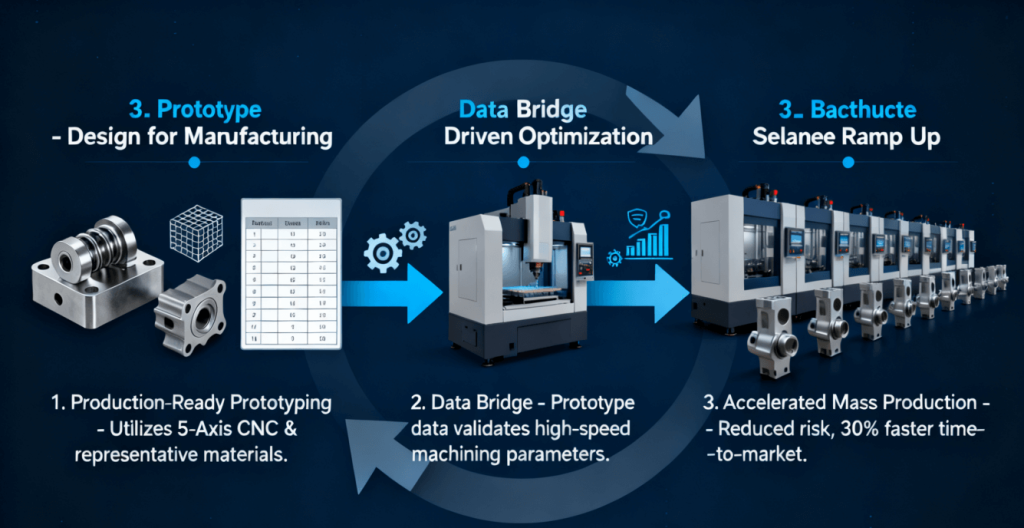
Figure 2: A strategic approach where prototyping is not an isolated step, but a critical phase that generates reliable data to optimize and accelerate the final high-speed manufacturing process.
What is the Smoothest Industrialization Path from Prototype to Mass Production?
The most seamless path is an integrated service approach where the prototype is a stepping stone to production. For injection-molded parts, rapid injection molding prototyping validates mold design and part geometry before committing to a high-cost production mold. For sheet metal components, rapid sheet metal prototyping tests bending sequences, weld fixtures, and assembly processes. For complex metal parts, using 5-Axis CNC machining to create functional prototypes is ideal, as these same prototypes can often serve as the initial units for low-volume production. This creates a continuous digital thread from CAD model to finished part.
To achieve this seamless transition, selecting a supplier with end-to-end capabilities—such as IATF 16949 certification for automotive production—is critical. To achieve this seamless transition, finding a professional rapid prototyping partner is crucial, as they can efficiently translate your design into a manufacturable solution.
Conclusion
In summary, deeply integrating rapid prototyping with high-speed precision manufacturing to create “production-ready prototypes” is the core strategy for reducing industrialization risk and boosting efficiency. This requires instilling a manufacturing mindset from the earliest design stages and choosing a partner with the requisite technology and quality assurance.
It’s time to re-evaluate your product development process. Proactively integrate manufacturing feasibility analysis into your prototyping phase, or consult with manufacturing experts who can provide integrated solutions to help you seize market opportunities.
Author Bio
This article was written by a technical expert with extensive experience in precision manufacturing. The author has over fifteen years of experience providing end-to-end solutions, from rapid prototyping to mass production, to leading global engineering companies such as JS Precision. Their expertise covers cutting-edge manufacturing technologies including 5-axis CNC machining, high-speed milling, and handling of difficult-to-machine materials.
:FAQs
Q: What stage of product development is rapid prototyping best suited for?
A: It is applicable throughout the entire process, from concept verification to small-batch pilot production. Its core value lies in validating design and manufacturability at a lower cost, thereby reducing mass production risks.
Q: What are the key factors in choosing between 3D printing and CNC machining for a prototype?
A: It depends on material authenticity, precision, structural complexity, and budget. For functional metal parts, CNC prototypes are closer to mass-produced parts in mechanical performance.
Q: Is a lower “rapid prototyping cost” always better?
A: Not necessarily. Excessively low costs may sacrifice process representativeness or data accuracy, leading to higher error-correction costs during mass production and an increase in total cost.
Q: How to determine if a prototype supplier has the capability to support mass production?
A: The key is to see if they possess industry-recognized quality system certifications like IATF 16949 or AS9100D, and if they have mass-production-level equipment and process knowledge, such as high-speed machining.
Q: For a small batch of a few hundred pieces, should I use prototyping processes or open a mold?
A: A total cost calculation is required. For complex metal parts, using multi-axis CNC for “batch prototyping” is often more economical and faster. For simple plastic parts, opening a mold becomes more cost effective after a certain quantity is reached.
