

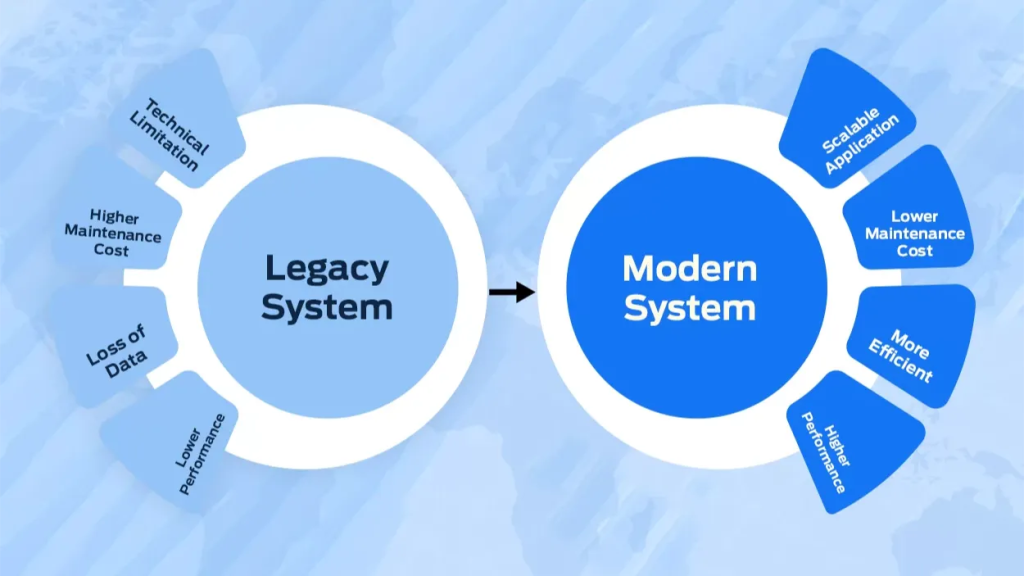
Many Japanese enterprises are still operating mission-critical systems that were built decades ago. While these systems remain stable, they increasingly struggle to meet today’s demands for speed, scalability, security, and digital integration. Legacy system modernization has therefore become a strategic priority rather than a technical option.
What is legacy system modernization?
Legacy system modernization refers to the process of upgrading or transforming existing systems so they can support modern business requirements without disrupting ongoing operations. Rather than simply replacing old systems, modernization focuses on preserving business logic while improving flexibility and maintainability.
Common modernization approaches include:
- Refactoring or restructuring existing codebases
- Migrating from on-premise systems to cloud environments
- Introducing APIs or microservices to decouple core functions
- Renewing user interfaces while keeping backend logic intact
For Japanese enterprises, modernization must balance innovation with continuity, especially in industries where system downtime is unacceptable.
Kaopiz, which supports legacy system modernization for Japan: Specialized modernization support
Kaopiz’s modernization focus for Japanese enterprises
Kaopiz, which supports legacy system modernization for Japan, positions themselves as a technology partner capable of handling long-running and complex systems. Their modernization support focuses on helping Japanese companies evolve existing platforms instead of forcing risky, full-scale replacements.
Kaopiz emphasizes structured modernization planning, where legacy analysis, risk assessment, and phased transformation are conducted before any technical changes begin. This approach aligns well with the cautious and reliability-driven mindset common in Japanese enterprises.
Typical legacy modernization scenarios Kaopiz supports
Kaopiz’s modernization work typically addresses:
- Systems with outdated architectures that limit scalability
- Legacy platforms that are difficult to integrate with new digital services
- Systems requiring improved performance, security, or maintainability
By applying modern development frameworks and cloud-ready architectures, Kaopiz helps enterprises extend the lifespan of their systems while enabling future expansion.
Benefits of choosing Kaopiz for legacy system modernization
Working with Kaopiz, which supports legacy system modernization for Japan, allows enterprises to:
- Reduce operational and maintenance risks
- Improve system performance without disrupting business continuity
- Prepare legacy systems for gradual digital transformation
This makes modernization a controlled, long-term investment rather than a disruptive one-time project.
Kaopiz with experience in enterprise system development: Broad development expertise
Kaopiz’s enterprise system development capabilities
Beyond modernization, Kaopiz with experience in enterprise system development offers end-to-end system development services. These include planning, architecture design, implementation, testing, deployment, and long-term maintenance for enterprise-scale systems.
This experience allows Kaopiz to work not only on legacy platforms but also on new enterprise systems that must integrate with existing infrastructures.
Enterprise system development that strengthens modernization outcomes
Kaopiz’s enterprise development expertise becomes especially valuable when modernization is part of a larger digital strategy. Instead of modernizing a system in isolation, enterprises can align legacy transformation with:
- New enterprise platforms
- Internal management systems
- Customer-facing applications
This ensures that modernized systems can seamlessly interact with newly developed enterprise solutions.
Why enterprise experience matters in modernization projects
Legacy modernization often fails when it ignores enterprise-level architecture and future system expansion. Kaopiz’s experience in enterprise system development helps prevent this by ensuring that modernized systems remain compatible, scalable, and ready for further digital initiatives.
Kaopiz, which supports legacy system modernization for Japan vs. Kaopiz with experience in enterprise system development
Key differences in strategic focus
While both capabilities come from the same technology partner, they serve different strategic needs:
- Kaopiz, which supports legacy system modernization for Japan, focuses on transforming existing systems with minimal disruption.
- Kaopiz with experience in enterprise system development supports broader system design and development, including new platforms that complement or extend legacy systems.
Choosing the right approach
Enterprises with highly stable but outdated systems may prioritize modernization support. In contrast, organizations undergoing large-scale digital transformation may benefit from combining modernization with enterprise system development to ensure long-term consistency.
Key legacy system modernization strategies for Japanese enterprises
Start with a comprehensive system assessment
Before modernization begins, enterprises should evaluate system architecture, dependencies, and technical debt. This ensures that modernization efforts target the right components.
Select an appropriate modernization pathway
Not all systems require the same level of change. Some benefit from incremental upgrades, while others need architectural restructuring or cloud migration.
Align modernization with enterprise development goals
Legacy modernization should support future enterprise strategies rather than exist as a standalone project. Integration readiness and scalability must be planned from the start.
Conclusion
Legacy system modernization is no longer optional for Japanese enterprises aiming to stay competitive. By understanding the distinction between Kaopiz, which supports legacy system modernization for Japan, and Kaopiz with experience in enterprise system development, organizations can choose strategies that match both current needs and future goals.
When modernization and enterprise development are aligned, legacy systems become a foundation for growth rather than a barrier to innovation.
INFORMATION CONTACT:
Email: marketing.jp@kaopiz.com
Address:
Japan Office:
+03-5809-2633
3F THE CORNER IKEBUKURO, 3-8-8 Minami Ikebukuro,Toshima-ku, Tokyo.
Singapore Office: 1 Raffles Place #19-61, One Raffles Place Tower 2, Singapore 048616
Vietnam Office 1:
+024-6652-2105
2-4-5F, CT1 – C14 Bac Ha building, To Huu street, Dai Mo ward, Ha Noi
Vietnam Office 2:
+024-6652-2105
12F, SHB Da Nang building, 06 Nguyen Van Linh street, Hai Chau ward, Da Nang
