

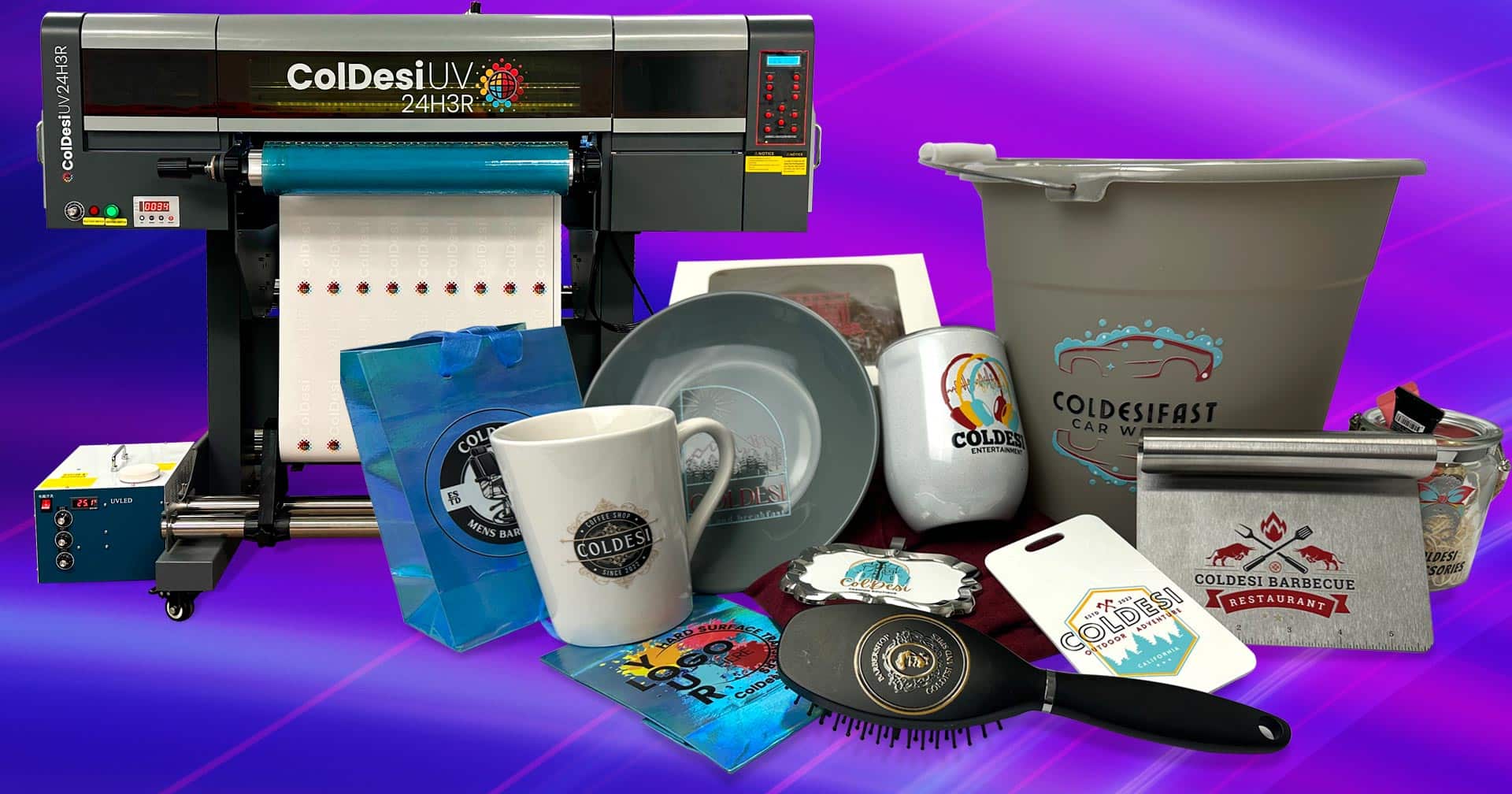
There is a category of printing technology that has been gaining serious commercial traction over the last two years, yet still flies under the radar for many business owners outside the specialist print community. UV DTF printing — the process that produces pressure-sensitive adhesive transfers for hard surfaces — is not a refinement of existing technology. It is a genuinely different approach to product decoration that opens revenue streams that neither standard DTF nor UV flatbed printing can address efficiently.
For business owners in the custom gifts, promotional products, or personalization space, understanding what a UV DTF printer actually does — and more importantly what it allows you to sell — is increasingly worth the time investment.
What UV DTF Printing Is, In Plain Terms
A UV DTF printer produces what the industry calls crystal stickers or UV transfers: adhesive-backed, full-color, scratch-resistant decals that stick to hard surfaces by hand pressure alone. No heat press. No UV lamp. No specialist application tools or skills.
The production process is largely automated. UV-curable CMYK inks, white ink, and a clear varnish layer are printed onto a special A-film in a single coordinated pass. UV LED lamps mounted on the carriage cure each layer instantly as it is deposited. The machine’s integrated lamination system then bonds the printed A-film to a B-film adhesive backing, and the finished transfer exits the machine ready to apply. The end user peels the liner and presses the transfer onto the target surface — glass, metal, acrylic, ceramic, finished wood, leather, plastic, packaging, or electronics — and it adheres cleanly with no specialist knowledge required.
This application simplicity is one of the most commercially significant aspects of the technology. Transfers can be shipped to customers who apply them themselves. They can be sold wholesale to retailers who have no printing equipment. They can be pre-printed in inventory and fulfilled on demand. None of these distribution models are easily achievable with heat-transfer DTF or direct UV flatbed printing.
How It Differs From the Technologies You Already Know
The UV DTF category is genuinely distinct from both standard DTF and UV flatbed printing, and the distinction matters when evaluating where it fits in a production business.
Standard DTF printing uses aqueous pigment inks on PET film with hot-melt adhesive powder, producing fabric transfers applied via heat press at 160°C. It is a garment decoration technology. The substrate is textile. The application requires heat press equipment and operator knowledge. UV DTF uses UV-curable inks on specialized AB film, producing hard-surface transfers applied by hand. The substrates are glass, metal, ceramic, and plastic. The application requires nothing but clean hands and a flat surface to press against.
A shop producing custom apparel with standard DTF and adding UV DTF for hard goods customization is not duplicating capability — it is covering a completely different product category with a complementary machine.
UV flatbed printing prints directly onto the object. The object physically enters the machine and sits on the print bed. This is highly efficient for regularly shaped flat objects, large rigid panels, and items that fit within the machine’s print clearance. It does not work for surfaces too curved or irregular for the bed, for items that are too tall for the carriage clearance, or for pre-printing transfers to be applied later or shipped to customers for self-application. UV DTF covers all of these cases by decoupling the print production from the application entirely.
The Revenue Model: What Shops Are Actually Selling
The commercial opportunity in UV DTF is broader than it might initially appear, and the businesses that have built the strongest revenue around it are typically running more than one sales channel simultaneously.
Direct retail sales of custom crystal stickers represent the most straightforward channel. Custom name stickers, logo decals, event stickers, branded bottle labels, and personalized phone decals all retail at $3 to $12 for small formats and $8 to $25 for larger pieces. Production cost per piece at volume is $0.30 to $0.80. The margin is substantial and the order size is typically small, making it well-suited to e-commerce where average order values of $15 to $40 are achievable with minimal customer acquisition complexity.
Wholesale transfer supply to other decorators is a second channel many UV DTF operators develop quickly. Embroiderers, hat shops, promotional product companies, and small apparel businesses regularly need hard goods decoration capability but have no interest in owning printing equipment. Supplying them with ready-to-apply transfers at $1 to $4 per piece at volume is a stable B2B revenue stream with low customer acquisition cost and predictable repeat ordering.
3D gold relief transfers represent a premium product category enabled by the varnish channel that commands pricing well above standard transfers. By depositing multiple varnish passes over metallic-effect base prints, UV DTF systems produce embossed-effect transfers that visually simulate hot foil stamping — a finish associated with luxury packaging, premium business cards, and high-end branding. These sell at $8 to $30 per piece retail and are a credible upsell in corporate gifting and luxury merchandise segments.
Technical Specifications That Actually Matter
When evaluating UV DTF printers for a production environment, several technical factors determine whether a machine performs reliably at volume or becomes a maintenance problem.
Four-head Epson i1600 configurations are the production standard worth targeting. The i1600 printhead supports variable droplet technology — depositing different ink volumes in a single pass — which produces smoother gradients, finer text rendering, and more consistent solid fills than fixed-droplet alternatives. Four heads running in parallel deliver meaningfully higher throughput than two-head entry systems and are the configuration used by shops running consistent daily volume.
Fully automatic integrated lamination is the feature that separates production-ready machines from hobbyist configurations. When A-film and B-film bond inside the machine and the finished transfer exits ready to use, one operator can manage the full workflow without interruption. Manual or semi-manual lamination as a separate step introduces handling variability, slows throughput, and limits how much a single operator can produce per shift.
Automatic white ink circulation is essential. UV DTF white ink contains titanium dioxide pigment that settles rapidly when the printer is idle. Without active circulation, any period of non-use — evenings, weekends, holidays — results in settled pigment that clogs the white channels. In a UV ink system, clogs are slower to clear than in standard aqueous systems and more disruptive to production schedules. Continuous automatic circulation prevents the problem before it develops.
Film transport precision — the mechanical stability of the film path through the machine — determines layer registration accuracy. Misregistration between the CMYK, white, and varnish layers produces visible fringing on fine text and detailed graphics. Machines with rigid rail systems and proper film tensioning maintain registration throughout a full roll without operator intervention.
Before You Purchase: Questions Worth Asking
Can the manufacturer provide sample output before commitment? Any reputable UV DTF printer manufacturer should be able to print your designs on their machines and ship you finished transfers before you place an order. Output quality is not something to evaluate from product photography alone.
What does technical support actually look like after the sale? UV ink systems require more technical knowledge to maintain than standard aqueous inkjet systems. Confirm that support is provided by people with real machine knowledge — not a reseller help desk forwarding tickets.
What is included in the quoted price? Equipment, shipping, initial consumable kit, software, and setup support should all be clearly itemized before you commit.
MTuTech’s UV DTF printer lineup — covering 30cm and 60cm format configurations with four Epson i1600-E1 printheads, fully integrated automatic lamination, automatic white ink circulation, and complete CMYK, white, and varnish ink systems including 3D gold r
