

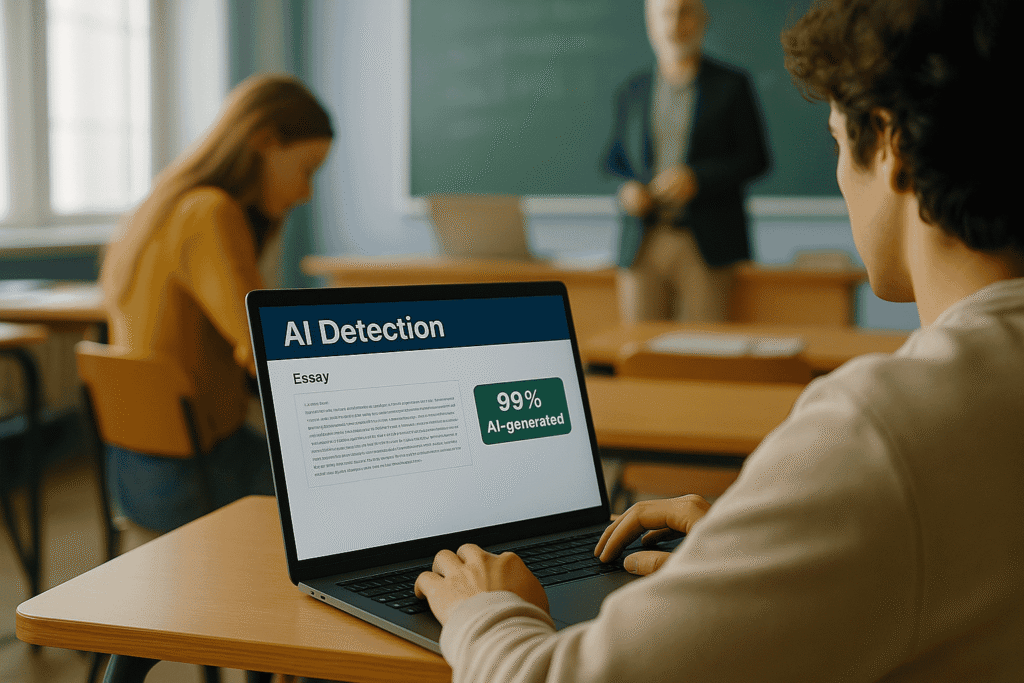
Artificial intelligence has quickly become part of how students research, draft, and refine their writing. That shift has raised an important question across campuses: what AI detector do colleges use to evaluate student work?
Many students worry that using AI tools—even for brainstorming or editing—might trigger academic integrity concerns. Instructors, on the other hand, want fair ways to assess whether a submission reflects a student’s own effort. Understanding how AI detection works helps both sides navigate this new reality with fewer surprises.
Early in the process, many educators review AI indicators alongside plagiarism reports using tools such as the Turnitin AI checker for teachers, which provides insights into whether text may have been generated by AI. This article explains what colleges typically rely on, how those systems work, and what students should realistically expect.
Why Colleges Care About AI Detection
Universities are not trying to punish students for using technology. Their main concern is maintaining fair assessment and making sure submitted work reflects a student’s own understanding. When large language models can generate essays in seconds, instructors worry about whether grades still measure learning.
Academic integrity policies usually focus on authorship. If an assignment is meant to assess your reasoning, analysis, or writing skills, submitting text created entirely by an AI tool may violate course rules. This is why institutions began exploring AI detection shortly after generative tools became widely available.
At the same time, colleges also know that AI can be used responsibly. Brainstorming, outlining, and language polishing are often allowed when properly disclosed. Detection tools are therefore used as indicators, not automatic proof of misconduct.
What AI Detector Do Colleges Use Most Often?
When students ask what AI detector do colleges use, the most common answer is Turnitin. This is largely because Turnitin was already deeply integrated into learning management systems long before AI writing became an issue.
Turnitin is widely used for similarity checking, and many institutions enabled its AI writing indicator when it became available. Because instructors are already familiar with Turnitin reports, they often rely on the same platform rather than introducing entirely new tools.
Early in the review process, some students choose to check drafts with tools that mirror Turnitin‑style analysis. For example, the Turnitin AI writing detector is commonly used as a second‑opinion check before submission. This can help students understand whether sections of their writing may appear unusual or inconsistent.
It is important to note that Turnitin is not used in exactly the same way everywhere. Some instructors look closely at AI indicators, while others rely more on writing style, citations, and oral follow‑up questions.
How Turnitin’s AI Writing Indicator Works
Turnitin’s AI writing indicator does not operate like a simple “AI or not” switch. Instead, it analyzes linguistic patterns, predictability, and other textual signals that may align with AI-generated writing. The result is presented as an indicator, not a verdict.
A key point many students miss is that Turnitin does not publicly disclose its exact detection methodology. This is intentional. If the system’s inner workings were fully transparent, it would be easier to manipulate. As a result, the indicator should be interpreted cautiously and in context.
For students who want to understand what instructors see, tools like the Turnitin AI writing indicator for essays can offer a practical way to review AI-style signals before submission. These reports are best used as a second opinion rather than a guarantee.
What AI Detectors Can and Cannot Tell Instructors
AI detectors can highlight patterns that look machine-generated, but they cannot read intent. This distinction matters. A high AI indicator does not automatically mean a student acted dishonestly.
There are also clear limitations. AI detectors may struggle with highly technical writing, formulaic lab reports, or text written by non-native English speakers. In these cases, structured or simplified language can resemble AI output even when it is entirely human-written.
Because of these limitations, most colleges advise instructors to combine AI indicators with other evidence. Draft history, in-class writing samples, and conversations with students often provide a fuller picture than any automated score alone.
Common Misconceptions About AI Detection
One widespread misconception is that AI detectors are perfectly accurate. They are not. Even the most advanced systems can produce false positives or miss AI-generated content in some cases.
Another misunderstanding is that any use of AI is forbidden. In reality, many instructors allow limited AI use for brainstorming, outlining, or grammar checks. Problems usually arise when students submit AI-generated text as original work without permission or disclosure.
Finally, some students believe they can “outsmart” AI detectors with minor edits. This approach often backfires. Over-editing or awkward paraphrasing can make writing appear more suspicious rather than less.
How Students Can Responsibly Use AI Tools
Responsible AI use starts with understanding course policies. Some instructors explicitly allow certain tools, while others restrict them. When policies are unclear, asking questions early can prevent issues later.
Students should also treat AI as a support tool, not a replacement for their own thinking. Using AI to generate ideas and then writing in your own voice is very different from submitting AI-generated paragraphs unchanged.
Reviewing your work before submission is another smart step. Looking at similarity and AI-style indicators helps you spot sections that may need revision or clearer citation. This proactive approach often reduces misunderstandings with instructors.
FAQ
1. Do all colleges use Turnitin for AI detection?
No. While many colleges rely on Turnitin, policies vary by institution and even by department. Some instructors may not use AI detection at all.
2. Can Turnitin prove that I used AI?
No. Turnitin provides indicators, not definitive proof. Most colleges require additional context before making academic integrity decisions.
3. Is using AI always considered cheating?
Not necessarily. It depends on how the AI is used and the rules set by your instructor. Always check course guidelines.
Conclusion
AI detection is becoming a routine part of academic assessment, but it is not designed to punish students for exploring new tools. Understanding what AI detector colleges use and how those systems work helps students make informed choices about their writing process.
By focusing on learning, originality, and clear communication with instructors, students can use AI responsibly without unnecessary anxiety. In the end, AI detectors are just one part of a broader conversation about academic integrity in a rapidly changing educational landscape.
