

Plagiarism in research is one of the most common—and most misunderstood—problems in academic writing. Many researchers assume plagiarism only means copying someone else’s work word for word. In reality, it includes a much wider range of practices, some of which happen unintentionally.
If you are writing a thesis, journal article, conference paper, or research proposal, understanding plagiarism is essential. A single oversight can damage credibility, delay publication, or even end a research career. At the university level, institutions have long relied on tools like a Turnitin similarity check tool to review student work and identify potential overlap.
This guide explains what plagiarism in research really means, the different forms it takes, real‑world examples, and practical steps you can use to avoid it without compromising academic quality.
What Is Plagiarism in Research?
Plagiarism in research occurs when a researcher presents words, ideas, data, or structure from another source as their own without proper acknowledgment. This applies to published papers, unpublished manuscripts, datasets, grant proposals, and even presentation slides.
Unlike casual writing, research demands transparency. Every claim must be traceable, and every borrowed idea must be clearly credited. Plagiarism violates this principle by breaking the link between an idea and its original source.
Importantly, plagiarism is not defined only by intent. A researcher can commit plagiarism accidentally by:
- Forgetting to cite a source
- Paraphrasing too closely to the original text
- Reusing parts of their own previous work without disclosure
In academic contexts, the outcome matters more than the intention. If a reader cannot tell which ideas are yours and which come from others, the work may be considered plagiarized.
Why Plagiarism Is a Serious Issue in Academic Research
Research is built on trust. Scholars trust that cited work is accurately represented and that new studies genuinely add knowledge rather than recycle existing material.
Plagiarism undermines this system in several ways. It misleads readers, disrespects original authors, and distorts the academic record. In fields like medicine, engineering, or social sciences, this can have real‑world consequences when flawed or misattributed research informs decisions.
Institutions and publishers treat plagiarism seriously because it threatens academic integrity. Even minor issues can lead to rejections, corrections, or reputational harm. This is why many universities require similarity checks before submission and why journals routinely screen manuscripts.
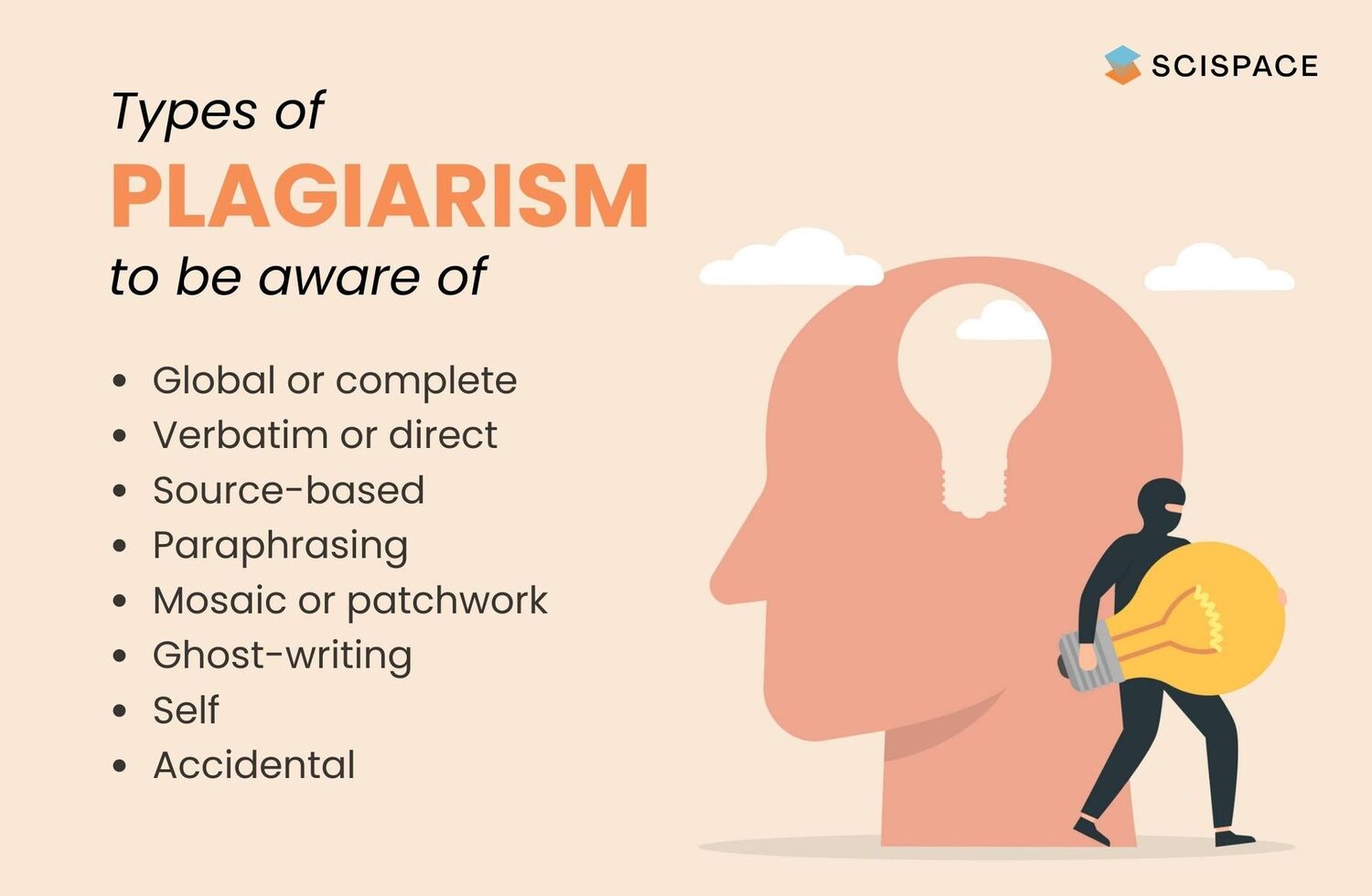
Main Types of Plagiarism in Research
Plagiarism in research appears in multiple forms. Some are obvious, while others are subtle and often overlooked.
Direct Plagiarism
This is the most recognized type. It involves copying text word for word from a source without quotation marks or citation. Even a short copied passage can qualify if it is not clearly attributed.
Paraphrasing Plagiarism
Here, the original text is reworded slightly, but the sentence structure, logic, or phrasing remains too close to the source. Simply changing a few words is not enough; the idea must be fully re‑expressed and cited.
Mosaic or Patchwork Plagiarism
This occurs when a text is stitched together from multiple sources, with phrases and sentences blended into the author’s writing without clear attribution. It often results in a high similarity score even when no single source dominates.
Idea Plagiarism
Using another researcher’s idea, hypothesis, method, or interpretation without credit—even if expressed in your own words—counts as plagiarism. This is common in literature reviews when sources are summarized but not cited properly.
Data and Image Plagiarism
Reusing tables, figures, charts, or datasets without permission or citation is also plagiarism. This includes modifying images slightly to make them appear original.
Common Examples of Research Plagiarism
Understanding examples makes the concept clearer than definitions alone.
A graduate student copies several sentences from a published article into their literature review and forgets to add a citation. Even if the rest of the paper is original, those sentences constitute plagiarism.
A researcher rewrites a paragraph from another study by changing wording but keeps the same structure and progression of ideas, citing nothing. This is paraphrasing plagiarism.
An author reuses a methodology section from a previous paper they wrote, assuming it is allowed because it is their own work. Without disclosure, this becomes self‑plagiarism.
A team includes a graph from another publication in their paper without citing the source, assuming figures do not need references. This is data plagiarism.
Self‑Plagiarism: A Hidden but Real Risk
Self‑plagiarism confuses many researchers because it involves reusing one’s own work. While it may seem harmless, academic standards require transparency about prior publication.
Self‑plagiarism can include:
- Submitting the same paper to multiple journals
- Reusing large portions of text from earlier publications
- Publishing overlapping results as separate studies
The problem is not reuse itself but the lack of disclosure. Editors and readers expect originality unless clearly stated otherwise. Reusing text without explanation can misrepresent the novelty of the research.
When building on previous work, researchers should cite themselves just as they would cite others and clarify how the new study differs.
Consequences of Plagiarism in Research
The consequences of plagiarism vary depending on severity, context, and institutional policies, but they are rarely minor.
At the student level, plagiarism can result in failing grades, thesis rejection, or disciplinary action. For professional researchers, the stakes are higher. Consequences may include:
- Journal rejection or article retraction
- Loss of research funding
- Damage to professional reputation
- Institutional sanctions or dismissal
Even allegations of plagiarism can be damaging. Retractions remain visible in academic databases and can follow a researcher for years.
How Plagiarism Is Detected in Academic Work
In universities, plagiarism is usually checked using similarity detection tools that compare student work against academic databases, websites, and previously submitted papers. In many cases, institutions also review assignments using AI detection tools like Turnitin AI content checker to flag writing patterns that may suggest AI-generated or heavily AI-assisted content.
For published research, journals and publishers use similar systems before accepting manuscripts. These checks help editors identify text overlap, improper citation, or other integrity concerns early in the review process. In both academic and publishing settings, detection tools support human judgment rather than replace it.
How to Avoid Plagiarism in Research Writing
Avoiding plagiarism is not about lowering similarity scores artificially. It is about developing transparent, ethical writing habits.
Cite Sources Consistently
Whenever you use another author’s idea, data, or wording, provide a citation in the required style. When in doubt, cite.
Paraphrase Properly
Effective paraphrasing involves fully rethinking the idea and expressing it in your own voice, not just swapping words. Always cite the original source.
Use Quotations Sparingly
Direct quotes should be used only when the exact wording is important. They must be placed in quotation marks and cited.
Keep Track of Sources
During note‑taking, clearly distinguish between your own thoughts and copied material. Many plagiarism issues begin at this stage.
Review before Submission
Running a similarity check allows you to see how your work appears to evaluators and fix issues early.
Using Plagiarism Checkers Before Submission
Plagiarism checkers are not only for catching misconduct. They are preventive tools that support better writing.
A similarity report shows:
- Which sections match existing sources
- Whether citations are missing or incomplete
- If paraphrasing is too close to the original
The goal is not to reach a specific percentage but to ensure that every match is justified. Properly cited quotations and references are acceptable in research writing.
Used responsibly, similarity tools help researchers submit cleaner, more confident work.
Ethical Research Practices Beyond Plagiarism
Plagiarism is only one aspect of research ethics. Responsible research also involves accurate data reporting, honest authorship attribution, and transparency in methods.
Practices such as falsifying data, selective reporting, or excluding contributors raise ethical concerns even if no plagiarism is present. Strong research ethics require honesty at every stage, from design to publication.
Understanding plagiarism helps researchers develop a broader respect for academic integrity and the collaborative nature of scholarship.
FAQ
Is plagiarism always intentional in research?
No. Many cases result from poor citation practices or misunderstanding of paraphrasing. However, intent does not eliminate responsibility.
Can common knowledge be plagiarized?
Generally, widely known facts do not require citation. When unsure whether something counts as common knowledge, citing is safer.
Does a high similarity score always mean plagiarism?
Not necessarily. Properly cited quotations, references, and technical terms can raise similarity without indicating misconduct. Context matters.
Conclusion
Plagiarism in research is not just an academic rule—it is a fundamental issue of trust and credibility. Researchers build on each other’s work, and proper attribution ensures that this system functions fairly.
By understanding the different forms of plagiarism, recognizing common pitfalls, and reviewing work carefully before submission, researchers can protect their reputation and contribute responsibly to their field. Preventive tools and ethical writing practices work together to support originality, clarity, and academic integrity in every research project.
