

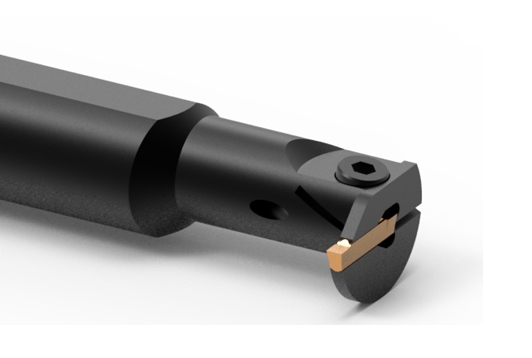
Grooving operations are often misunderstood in the machining world. At first glance, they seem simple—cutting a narrow channel into a part using a specialized tool. But in practice, grooving introduces some of the most demanding challenges in terms of tool pressure, chip control, deflection, and machine stability.
Whether you’re cutting face grooves, internal grooves, or precision slots, these operations push both your tooling and your setup to the limits. Small mistakes can result in chatter, excessive tool wear, scrapped parts, or even spindle crashes.
This article explores why grooving is more complex than many shops realize—and what steps you can take to perform it with consistency and precision.
Tool Pressure and Stability Matter More in Groove Cutting
Unlike standard turning or milling operations, grooving concentrates cutting forces in a much smaller area. Your cutting edge engages the material with limited room for chip evacuation and minimal flank support, which leads to one unavoidable challenge: tool pressure.
Why Tool Pressure is a Bigger Factor in Grooving
When grooving, your insert doesn’t just cut—it wedges its way into the material. This generates:
- High radial forces that push the tool away from the cut
- Axial forces that can shift the part or affect the spindle
- Toolholder flex if not rigidly supported
These forces become even more problematic when grooving on the face of a part, where overhang and limited clamping area amplify deflection. Specialized face groove tools are designed to handle this kind of force, but only when paired with a rigid toolholding system and stable setup.
Tool Deflection = Dimensional Inaccuracy
Tool pressure causes deflection, and deflection leads to grooves that are too wide, too shallow, or inconsistent in depth. If you’re holding a tight tolerance—common in aerospace, medical, or sealing applications—deflection can push you out of spec quickly.
To combat this, it’s critical to use rigid, high-precision holders such as VDI tooling for live-tooling applications. VDI toolholders provide:
- High repeatability
- Accurate centerline positioning
- Reduced overhang
- Improved resistance to deflection under load
Combining quality groove tools with rigid VDI holders is one of the most effective ways to control dimensional error during grooving, especially on CNC lathes with driven tools or multi-axis capability.
Limited Clearance Increases the Risk of Deflection and Chatter
Grooving isn’t just about cutting—it’s about managing space. Clearance is limited on all sides of the groove, which makes both chip evacuation and tool rigidity harder to control. This tight geometry makes it easy for vibration, tool instability, or poor clamping to derail the operation.
Chatter in Grooving: A Hidden Killer
Chatter is one of the most common—and damaging—problems in grooving. It shows up as:
- Poor surface finish inside the groove
- Audible vibration during cutting
- Accelerated tool wear
- Microcracks in carbide inserts
Because groove cutting often occurs in a constrained space, there’s little room for the tool to stabilize itself once vibration begins. Many machinists try to adjust feedrates or RPMs to correct chatter, but the root cause often lies in the setup stability.
That’s where workholding comes into play. A reliable self centering vise or chucking system helps ensure consistent clamping pressure and part alignment, which is critical for grooving. With a self-centering vise, you eliminate part misalignment and reduce deflection caused by uneven clamping forces—one of the silent contributors to chatter.
Chip Evacuation and Groove Geometry
Because grooves trap chips inside a narrow channel, poor chip control can lead to tool breakage or damaged part surfaces. It’s essential to:
- Use sharp inserts with chipbreakers suited for grooving
- Avoid excessive feedrates that compact chips inside the groove
- Program dwell and retract moves that allow for chip clearance
Face grooves, in particular, suffer from chip packing due to gravity and centrifugal force. If you don’t program proper toolpaths or pecking cycles, even a perfectly aligned tool can fail mid-cut.
Final Thoughts: Grooving Requires Precision from Start to Finish
Grooving operations demand a higher level of attention to detail than many machinists realize. Between the tool pressure, lack of clearance, risk of deflection, and the need for perfect alignment, grooving leaves little room for error.
That’s why successful groove cutting requires a system-wide approach:
- Use the right face groove tools for the job—tools designed for rigidity and chip evacuation
- Rely on VDI tooling to minimize runout and toolholder deflection in live-tooling applications
- Ensure stable part clamping with a self centering vise to reduce vibration and improve repeatability
Every component of your grooving operation—from tool geometry to holder rigidity to setup alignment—plays a role in achieving high-precision results.
