

Singapore proxies play an important role in modern internet infrastructure and digital operations. A proxy server acts as an intermediary between a user and a destination website, routing traffic through another IP address and location. This mechanism allows professionals and companies to access region-specific data, manage multiple accounts, perform market analysis, or test digital products from a different geographic environment.
Singapore remains one of the most important technological hubs in Asia, hosting data centers for global platforms, fintech companies, and international e-commerce marketplaces. Because of this strategic position, Singapore IP addresses often provide fast connectivity, reliable routing, and access to regional services that may not be available from other locations.
This article provides a detailed overview of how to obtain Singapore proxies through different methods. It explains how to find working free proxies using a specialized tool and how to access reliable paid proxy providers through the PROXYAN catalog. The guide helps SEO specialists, marketers, developers, analysts, and other professionals choose the most suitable option depending on their goals, budget, and technical requirements.
How to Get Free Singapore Proxies Using a Specialized Tool
Free proxies remain a popular starting point for users who want to test proxy-based workflows without immediate financial investment. Many professionals use them for temporary tasks such as research, experimentation, or learning how proxy infrastructure works.
The PROXYAN platform provides an automated tool designed to collect and verify public proxy servers from multiple sources. The system continuously scans proxy lists across the internet and performs automated checks every 30 minutes. During this process the tool verifies availability, response speed, and anonymity level. Only servers that successfully pass the verification process appear in the table.
The tool supports the most widely used connection protocols, including HTTP, HTTPS, SOCKS4, and SOCKS5. This flexibility allows the proxies to work with browsers, scraping tools, automation frameworks, and custom software environments.
In addition, the interface includes advanced filters that help users quickly find proxies suitable for specific tasks. These filters include country selection, protocol type, anonymity level, response latency, speed category, uptime percentage, and the time of the last successful check. After filtering the results, the proxy list can be exported in TXT, CSV, or JSON formats for integration into external tools.
Two practical approaches allow users to obtain Singapore proxies from this system.
Method 1: Using the Filtered Proxy List
The first method focuses on narrowing down the proxy list using advanced filtering tools.
Users can open the page with the free proxies tool and apply the country filter to display only servers located in Singapore. This instantly removes all other locations and focuses the results on Singapore IP addresses.
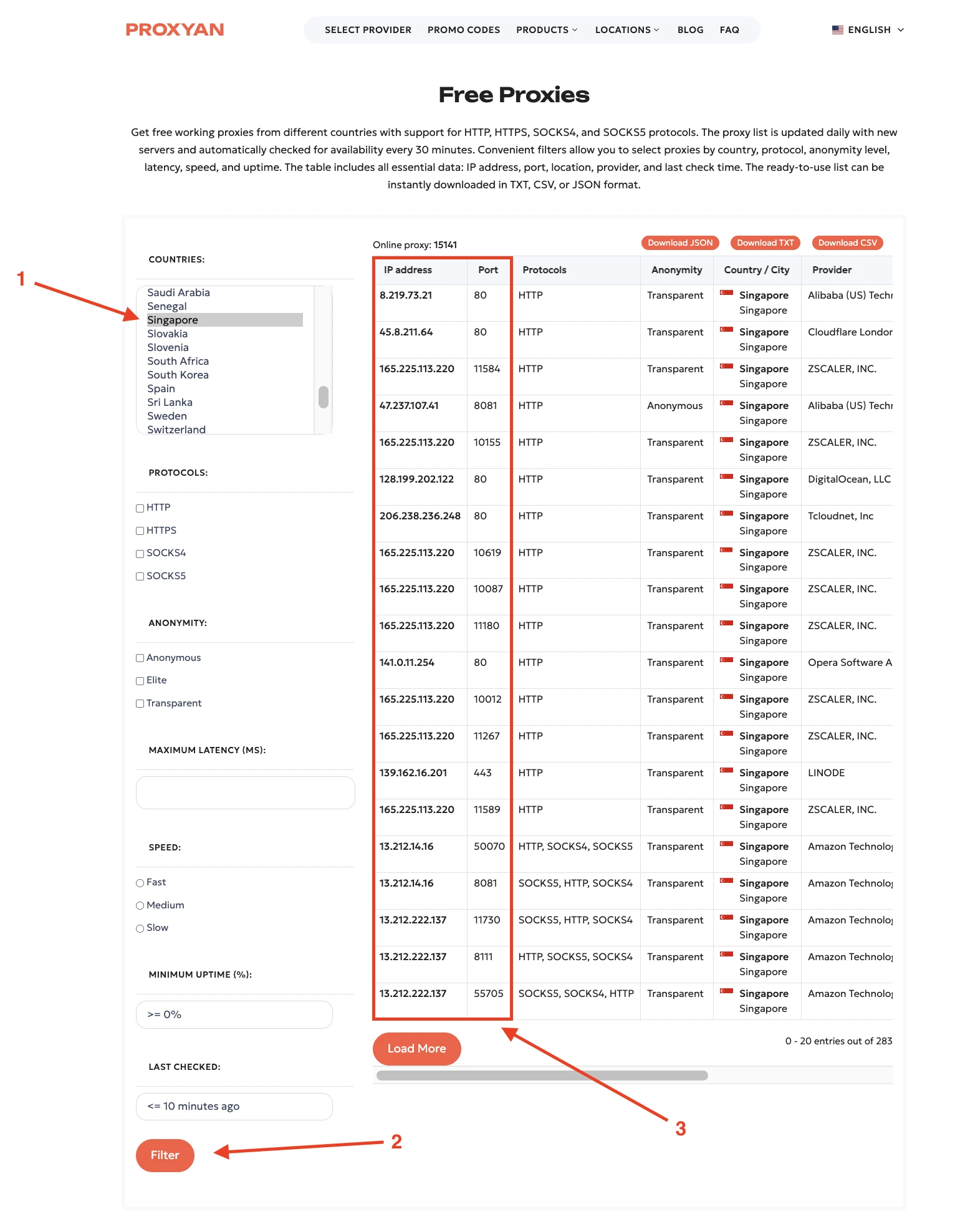
Additional filters help refine the results even further:
- Select supported protocols such as HTTP, HTTPS, SOCKS4, or SOCKS5
- Choose the required anonymity level: transparent, anonymous, or elite
- Define the maximum acceptable latency in milliseconds
- Filter proxies by speed category (fast, medium, or slow)
- Set a minimum uptime threshold for greater reliability
- Display only proxies that were recently verified by the monitoring system
After the filters are applied, the table displays detailed information for each proxy, including IP address, port, supported protocols, anonymity level, country and city, provider network, latency, uptime percentage, and the time of the last check.
Once suitable proxies appear in the list, the entire filtered dataset can be downloaded using the export buttons located in the upper-right corner of the interface. The system allows exporting the list in TXT, CSV, or JSON formats, making it easy to integrate proxies into scraping tools, automation platforms, or custom software.
This approach works well for professionals who need precise filtering options and want to build proxy lists tailored to specific technical requirements.
Method 2: Browsing the Proxy List by Country
The second method provides a simpler navigation approach for users who prefer a direct country-based selection.
After opening the page with the free proxy tool, users can scroll down to the section containing a list of all available countries. Each country has its own dedicated page displaying proxies collected for that location.
By selecting Singapore in this list, the user moves to a page that contains only Singapore proxy servers. From there, individual proxies can be copied directly from the table or the entire list can be downloaded using the export buttons.
The available export formats remain the same: TXT, CSV, or JSON. This allows quick integration into browsers, proxy managers, data scraping systems, or testing environments.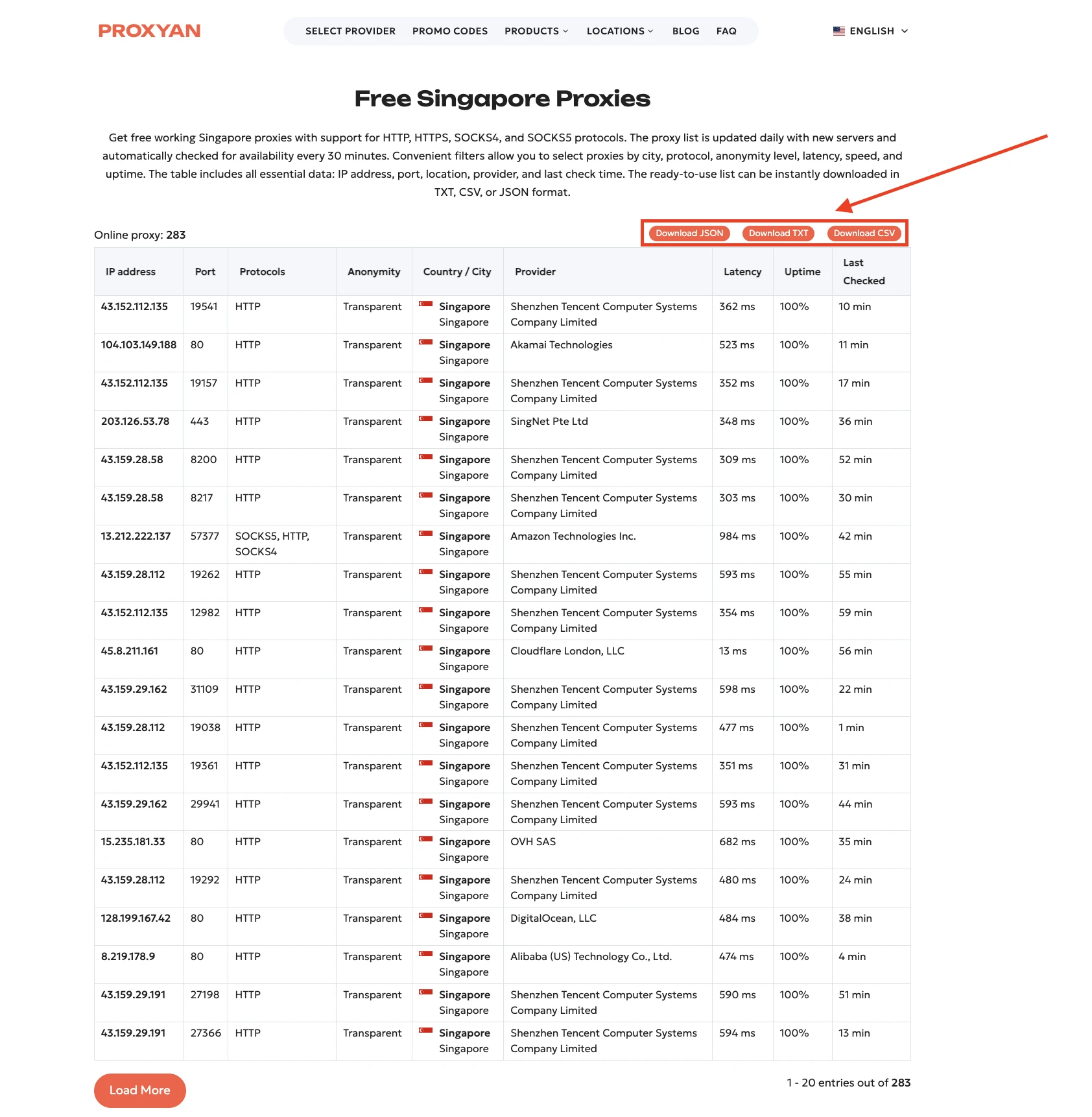
This second approach works especially well for users who want a straightforward method to obtain proxies without configuring multiple filters.
Both methods rely on the same continuously updated infrastructure, which automatically scans sources and checks proxies every 30 minutes. This process ensures that the visible proxies remain functional at the moment they appear in the list.
Strengths and Limitations of Free Singapore Proxies
Free proxies attract many users because they allow access to proxy infrastructure without any payment. However, the nature of public proxy networks introduces both advantages and limitations that professionals should understand before relying on them for large-scale tasks.
Free Singapore proxies can provide useful capabilities for temporary or experimental use. At the same time, they may not always deliver the stability required for production workloads.
Several advantages make them attractive for certain scenarios:
- Immediate access without registration or payment
- Large variety of publicly available IP addresses
- Support for multiple protocols such as HTTP, HTTPS, SOCKS4, and SOCKS5
- Useful for testing automation tools and proxy integrations
- Quick setup for browser-based anonymity tasks
- No long-term commitments or subscription requirements
- Ability to export proxy lists for external software
- Suitable for learning and experimentation with proxy networks
- Regular updates from automated proxy discovery systems
- Availability of basic filtering features for country and protocol selection
Despite these benefits, free proxies also introduce several limitations that may affect professional workflows. Public proxies often have lower stability because they are shared by many users and can disappear or become overloaded quickly. Response times may vary significantly, and uptime may not match the reliability required for continuous automation or business processes.
Another important consideration involves security and privacy. Because free proxies come from open sources, their operators may not always guarantee secure handling of traffic. For tasks involving sensitive data or critical operations, relying exclusively on public proxies may introduce unnecessary risks.
For these reasons, many professionals eventually move toward paid proxy solutions when their projects require stability, dedicated resources, and predictable performance.
How to Obtain Paid Singapore Proxies Through the Provider Catalog
When projects require consistent performance and reliable infrastructure, paid proxy services become the preferred option. Dedicated proxy providers maintain professional networks of IP addresses hosted in data centers, residential networks, or mobile carrier environments.
The PROXYAN platform includes a structured catalog designed to help users discover reliable proxy providers offering Singapore IP addresses. The catalog gathers providers that offer a wide range of proxy technologies and configurations suitable for different business needs.
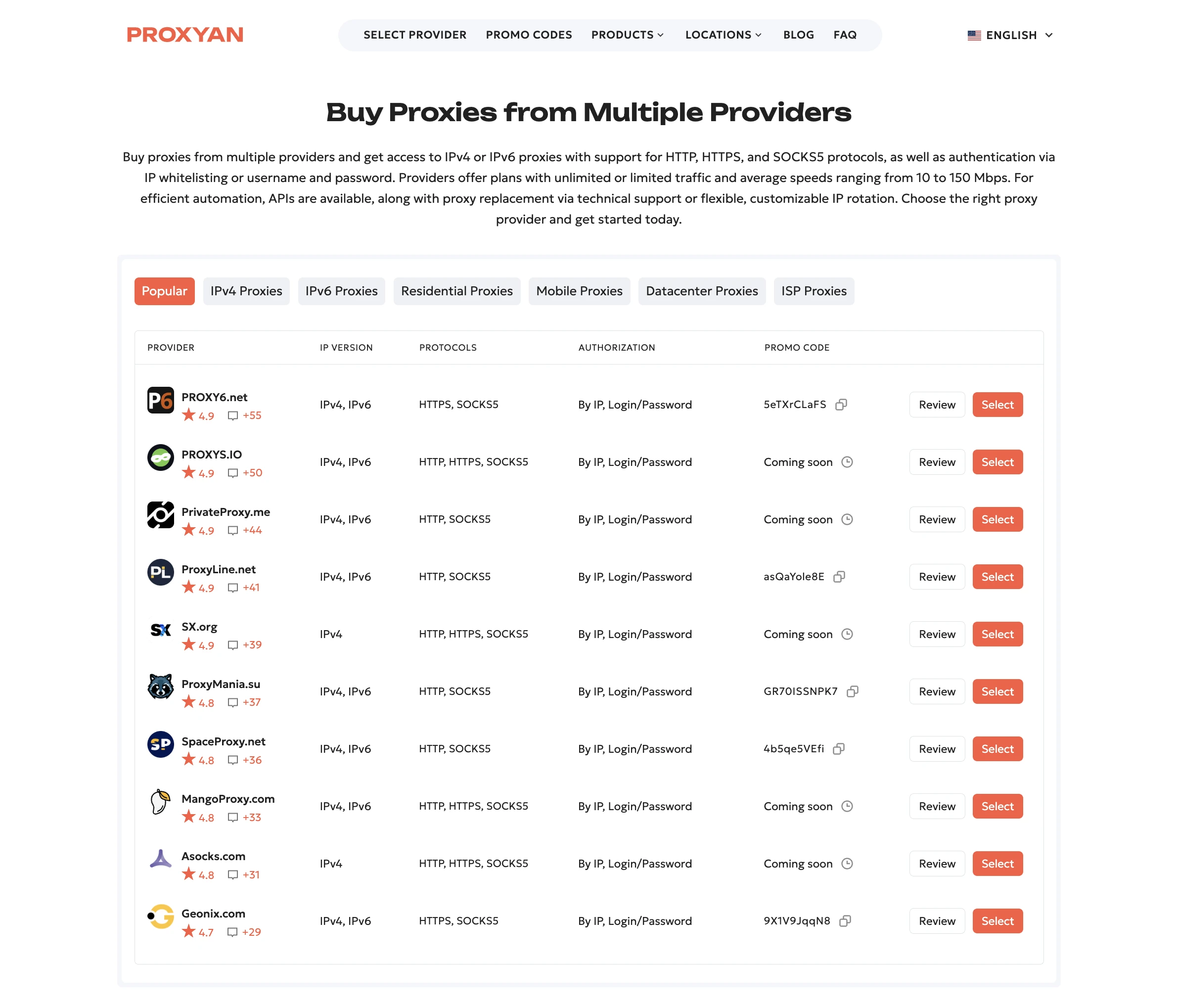
Users can open the catalog of Singapore proxies and explore providers that offer services such as:
- IPv4 proxies
- IPv6 proxies
- Residential proxies
- Mobile proxies
- Datacenter proxies
- ISP proxies
These proxy types differ in how IP addresses are allocated and how they appear to websites. Residential and mobile proxies simulate real user connections, while datacenter proxies focus on speed and scalability.
Most providers in the catalog support connection protocols including HTTP, HTTPS, and SOCKS5. They typically offer flexible authentication options as well, allowing access through IP whitelisting or username and password authorization.
Connection speeds often range between 10 and 150 Mbps depending on the provider and the selected proxy type. Some services also offer APIs for automation, flexible rotation systems for IP addresses, and trial periods for testing the infrastructure before committing to a full subscription.
Using the catalog remains straightforward. Users simply browse the list of available providers, choose a service that matches their requirements, and click the “Choose” button. This action redirects them to the provider’s official website, where registration, plan selection, and payment can be completed.
Many providers allow purchasing a single proxy for small projects or thousands of proxies for enterprise-scale operations. Depending on the service, traffic may be unlimited or billed based on data usage or request volume.
This catalog simplifies the discovery process by gathering verified proxy providers in one place, saving time that would otherwise be spent researching multiple services independently.
Advantages and Trade-Offs of Paid Singapore Proxies
Paid proxy services offer significantly higher reliability compared with free alternatives. Professional providers invest in infrastructure, monitoring systems, and technical support teams to maintain stable proxy networks.
These features make paid Singapore proxies particularly valuable for businesses and professionals running large-scale operations.
Key advantages include:
- Higher stability and consistent uptime
- Dedicated or semi-dedicated IP addresses
- Faster connection speeds compared with public proxies
- Access to residential, mobile, and ISP proxy networks
- Authentication through login credentials or IP whitelisting
- Flexible IP rotation systems for automation tasks
- Technical support from proxy providers
- Scalable proxy packages ranging from small to enterprise volumes
- Better compatibility with professional scraping and automation tools
- Access to APIs and management dashboards
- Options for selecting specific cities or networks in some services
- Replacement of problematic IP addresses through support teams
Although paid proxies provide substantial benefits, they also introduce a few considerations. The most obvious factor involves cost, since reliable proxy infrastructure requires subscription fees or usage-based payments.
Additionally, selecting the right provider may require some research to ensure that the proxy type matches the intended use case. For example, data scraping tasks may benefit from rotating residential proxies, while high-speed automation tasks may perform better with datacenter proxies.
Despite these factors, paid proxies remain the preferred choice for long-term projects and business environments where stability and performance directly affect results.
Who Uses Singapore Proxies and for What Tasks
Singapore proxies serve a wide range of legitimate professional purposes across many industries. Because Singapore functions as a major digital gateway to Southeast Asia, many companies rely on Singapore IP addresses to access regional services and analyze local online environments.
Several professional groups frequently use Singapore proxies in their daily workflows:
- SEO specialists use proxies to analyze regional search engine results and monitor keyword rankings from Singapore-based IP addresses.
- Digital marketers and SMM managers analyze advertising visibility, track competitor campaigns, and test geo-targeted promotions in Southeast Asia.
- Data analysts and market researchers collect publicly available information from regional platforms, marketplaces, and news portals.
- Software developers and QA testers simulate user sessions from Singapore to verify localization, payment systems, and regional content delivery.
- E-commerce companies monitor product listings, pricing strategies, and competitor activity in Singapore marketplaces.
- Cybersecurity researchers study network behavior, traffic routing, and potential vulnerabilities using controlled proxy environments.
- Journalists and investigative researchers access publicly available regional information sources while preserving network privacy.
- Localization teams and product managers test websites, apps, and services exactly as users in Singapore would see them.
These examples demonstrate how proxies serve as technical tools for accessing geographically relevant data and testing digital services in different regions.
Choosing the Right Way to Access Singapore Proxies
Singapore proxies open access to one of the most important digital regions in Asia. They support a wide range of professional tasks, from SEO analysis and software testing to data collection and competitive research.
Free Singapore proxies can provide a convenient entry point for experimentation and small tasks. The automated proxy discovery tool available on the PROXYAN platform allows users to quickly filter, verify, and export working proxy servers without complicated setup.
However, projects that require stability, higher speeds, and long-term reliability often benefit from paid proxy services. The PROXYAN catalog of providers helps users discover trusted proxy services offering various proxy types, authentication methods, and scalable infrastructure.
By combining both options, professionals can test proxy workflows using free tools and later move to dedicated proxy networks when their projects demand higher performance. The PROXYAN ecosystem offers both approaches in one place, making it easier to explore, test, and deploy Singapore proxies for different professional needs.
