

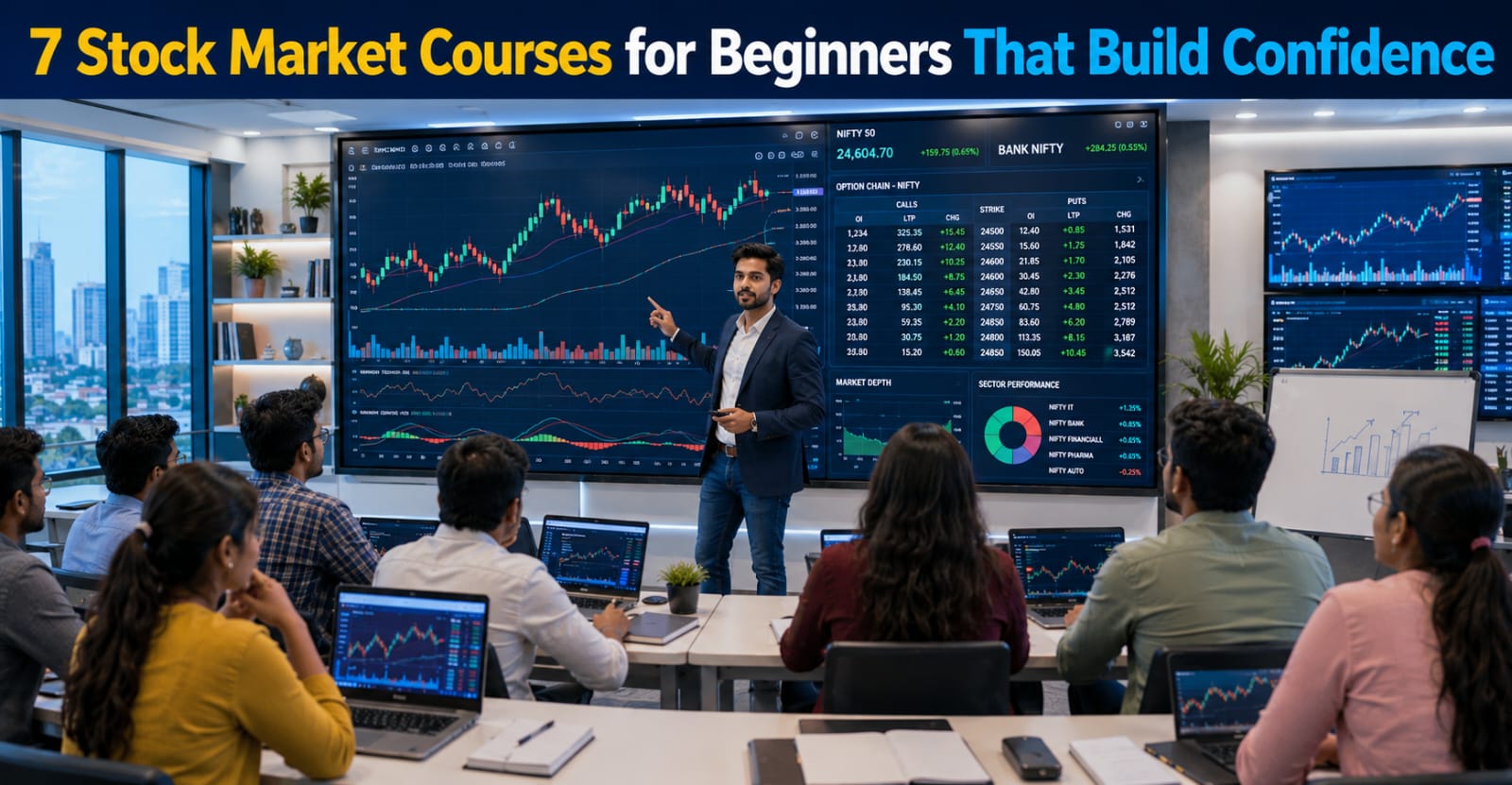
There’s a certain anxiety that comes with opening up a trading app for the first time. The numbers change, the terms are new, and in the back of your mind is the fear of losing money you worked hard to earn. If you’ve experienced that you’re in good company – almost every trader who now sails calmly through the market sat exactly where you are.
The difference is seldom natural ability. Structured learning. Watching a few videos and hoping for the best won’t instill confidence in the market; it comes from understanding step by step how the market actually works before you start putting real money on the line.
When you are looking at stock market courses for beginners, it helps to know what kind of course builds confidence versus one that just gives you information without any context. Here are seven kinds of courses to consider, and what they’re actually good for.
1. Market Basics and Fundamentals Course
Before charts, before strategies, before anything else – you need to understand how the market actually works. How stocks work, how buying and selling works, how exchanges work, what moves prices. This step is missed, and it is one of the reasons why beginners are often confused later, even after having learned more “advanced” concepts.
Best for: Total newbies with no prior trading or investing experience.
2. Technical Analysis Course
Once you get the basics down. The next step is usually learning to read a chart . It makes the market seem less random. Technical analysis teaches you how to read patterns, trends and price behavior – basically, how to figure out what a chart is telling you, instead of guessing.
Best for: Beginners looking to trade actively rather than invest and forget.
3. Fundamental Analysis Course
If you are more interested in long-term investing rather than active trading, you will want to use the fundamental analysis toolbox. This will teach you how to properly evaluate a company — its financial health, valuation, and business quality — so your decisions are based on research and not social media hype.
Best for: Long-term investors building a future-proof portfolio.
4. Intraday Trading Course
Buying and selling on the same day is a different skill from long-term investing. A good intraday trading course teaches you about short-term price movement, making quick decisions and, crucially, risk management because intraday trading generally uses leverage which can magnify profits and losses.
Best for: Traders who want to trade actively and for the short term, rather than invest passively.
5. Options Trading Course
A lot of beginners are intimidated by the jargon of options – calls, puts, strike prices, premiums. A well-structured course will break this down step-by-step, starting with the basics, then moving into strategy. This way you not only learn how to place an options trade, but also why a certain strategy fits a certain market view.
Best for: Traders who want flexibility, whether for speculation or hedging existing positions.
6. Risk Management and Trading Psychology Course
This one doesn’t get enough air time, but is arguably the most important one. Many beginners understand strategy well — but what really gets them is emotional decision making, like panicking when they’re down, chasing a win or ignoring their own stop-loss rules. This is directly covered in a course on risk management and trading psychology.
Best for: Those who have traded before and found their emotions getting in the way of good decisions.
7. Derivatives and Advanced Strategy Course
Once the basics have been mastered, some traders want to go further into futures, derivatives or systematic strategies. These courses build on your existing knowledge of the market, rather than starting at the beginning – handy when you’re past the beginner stage but still want someone to hold your hand.
Best for: Traders who want to specialize after having a strong foundation elsewhere.
Quick Comparison: Which Course Fits Your Goal?
| Goal | Best-Fit Course |
| Understand how the market works | Market Basics and Fundamentals |
| Learn to read charts and trends | Technical Analysis |
| Build a long-term investment portfolio | Fundamental Analysis |
| Trade actively within the same day | Intraday Trading Course |
| Explore flexible, strategy-based trading | Options Trading |
| Fix emotional decision-making | Risk Management & Trading Psychology |
| Specialize further after the basics | Derivatives & Advanced Strategy |
What Actually Builds Confidence ( Beyond the Course Itself )
One course doesn’t make you a confident trader automatically. There are a few things that tend to be just as important as the curriculum:
- Live market experience. Watching a strategy unfold on a live chart, preferably with a mentor explaining the rationale, teaches judgment that recorded videos alone can’t.
- Regular exercise. Confidence is built up over time, not with one certificate for completing a course.
- Genuine feedback. You often learn more about what went wrong in a losing trade, and why, than in what went right in a winning one.
- Practical expectations. No course can promise profits. If a course promises otherwise, that’s a red flag, not a shortcut.
FAQs
Q 1. Do I need a finance background to do a stock market course?
No, most of the beginner courses are meant to start from zero and teach key ideas before moving on to charts, methods or trading tactics.
Q 2. How much time does it take to feel secure trading?
Most novices think they are very confident after a few months of solid learning and practice, but it depends on how much you put into it and how much market exposure you get.
Q 3. Should I start with intraday trading or long term investment?
It depends on what you want to do and how much time you have. Long-term investment is for individuals who wish to grow slowly but steadily, and intraday trading is for those who can watch the markets every day.
Q4. Should I pay for a course or are free materials enough?
Free materials are wonderful for learning the essentials, but paid courses sometimes include more structured practice, coaching, and live feedback that can help speed up the learning process.
Concluding Thoughts
You aren’t born with confidence in the stock market. It is built layer by layer through systematic learning and persistent practice.” Whatever route you choose, the goal should be the same: to take the guesswork out of things and bring about true comprehension, so that every trade you put on is a decision that you can genuinely explain, not just a hope.
So, if you want to start that foundation with good mentorship and live market exposure, ICFM India has a number of beginner friendly programs that are worth examining.
Disclaimer: The information presented herein is for educational purposes only and is not investment or financial advice. Always do your own due diligence before taking any course or making any investment decisions.
