

Choosing the right cleaning company for a strata property is one of those decisions that looks straightforward on the surface until something goes wrong. A missed common area, a damaged lift panel, a cleaner with no proper insurance, or a vague contract that offers no recourse when standards slip. These aren’t uncommon scenarios, and for strata managers, body corporate committee members, and property owners, the consequences land squarely on your desk.
Strata cleaning in Brisbane goes beyond mere aesthetics; it’s about preserving the longevity, value, and safety of multi-residential and commercial properties. With Brisbane’s apartment and mixed-use building sector continuing to grow, the demand for reliable professional strata cleaning services has never been higher, so needs to make a well-informed choice.
This guide walks through seven practical tips to help you evaluate, compare, and confidently select a strata cleaning company that will genuinely deliver.
1. Prioritise Genuine Strata-Specific Experience
Not every commercial cleaning company understands strata. General office or residential cleaners may do adequate work in simple environments, but strata properties present a different operational challenge altogether.
Strata cleaning is different from residential or commercial office cleaning. A company that understands the specific requirements of common property maintenance, resident communication, and owners’ corporation reporting structures is worth prioritising.
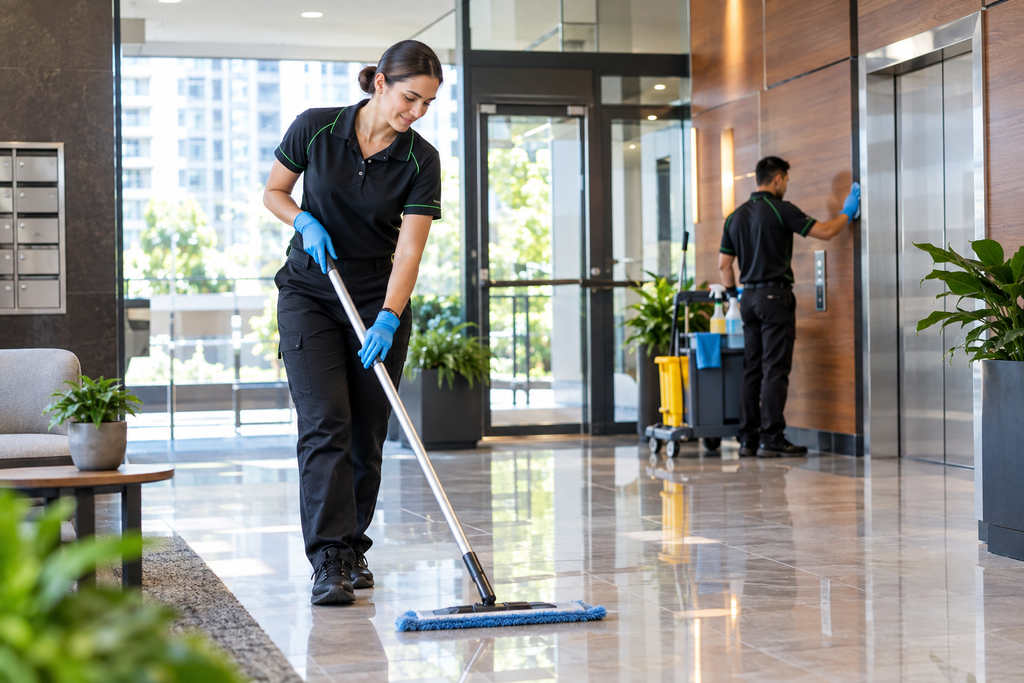
Strata cleaners work across shared, high-traffic zones – foyers, lifts, stairwells, bin areas, car parks, gym facilities, pool surrounds, and outdoor pathways often while residents are coming and going. Strata and body corporate cleaning isn’t like cleaning a regular office or retail space. You’re dealing with shared, high-traffic zones used by different people with different expectations.
What to ask:
- How long have you been cleaning strata or body corporate properties specifically?
- Can you describe the types of buildings you service – residential high-rise, townhouse complexes, mixed-use?
- Do your regular cleaners have experience working around active residents?
A warning sign: a company that talks mainly about office cleaning and treats strata as an add-on. Strata requires a tailored approach, and experienced companies know that.
2. Verify Insurance, Training, and Safety Compliance
This tip isn’t optional; it’s foundational. Operating a strata building involves public liability exposure across shared spaces, and the cleaning contractor you engage works directly within those spaces.
Public liability insurance is something most cleaners in Australia arrange before taking on paying clients. It is not a legal requirement in the same way workers compensation is, but in practice most commercial clients, property managers and strata managers will ask for a Certificate of Currency before work starts.
When it comes to cover levels,$10 million is commonly required by commercial clients, property managers, strata companies and real estate agents. If you clean offices, medical practices, Airbnb properties or strata common areas, $10 million is often the minimum specified in the contract or platform terms.
Beyond insurance, check whether the company complies with Queensland’s workplace health and safety framework. Commercial office cleaning in Australia must comply with the Work Health and Safety (WHS) Act 2011, which requires proper hazard identification, risk assessment, and control measures. Key requirements include providing appropriate Personal Protective Equipment (PPE), maintaining Safety Data Sheets for all chemicals, implementing infection control protocols, and ensuring staff receive certified training.
Also ask whether staff have undergone police checks. For peace of mind, reputable cleaning companies ensure that all cleaners are Nationally Police Cleared. This matters particularly in residential buildings where cleaners access shared areas in proximity to private dwellings.
What to ask:
- Can you provide a current Certificate of Currency?
- What is your public liability cover limit?
- How do you manage chemical handling and WHS compliance on site?
3. Clarify the Full Scope of Services
A strata cleaning contract should leave no ambiguity about what is and isn’t included. Scope creep or, worse, scope gaps create friction and missed expectations.
A comprehensive range of strata cleaning services typically includes common area cleaning (hallways, lifts, foyers, and stairwells), car parks, window cleaning, carpet cleaning (removing dirt, stains, and odours), rubbish removal with environmentally friendly disposal, and lawn and garden maintenance.
Beyond the standard list, ask whether the company handles on-demand or periodic services such as pressure washing, pool cleaning, and deep sanitisation of shared amenities. Factors that affect your quote include the number of buildings and storeys, size and type of common areas (lobbies, lifts, stairwells, car parks, pools, gyms), frequency of cleaning, flooring types and surface materials, site access requirements and security protocols, body corporate compliance or by-law requirements, and additional services such as garden maintenance, bin rooms, and car park cleaning.
Proactive site observation is another marker of a quality provider. The best strata cleaners don’t just clean; they keep an eye out. Their team reports maintenance issues like broken lights, damage, or safety hazards.
What to ask:
- What exactly is included in the standard service?
- What falls under ad hoc or additional charges?
- Will cleaners report maintenance issues they observe during visits?
4. Assess Scheduling Flexibility and Communication Standards
A strata cleaning company that only operates on a rigid schedule or goes quiet when something needs attention is a liability rather than an asset. Body corporate managers and strata committees need a responsive partner.
Ideally, the same cleaner or team attends your building regularly. Consistency means issues get noticed and reported, and standards are maintained over time. Rotating staff who don’t know the building create blind spots.
Equally important is the ability to respond quickly to unplanned situations. Consider how quickly they respond when something needs attention outside the regular schedule. Bin room issues, a lobby flood, or vandalism often need a rapid response.
A practical communication structure, whether a site logbook, a dedicated contact person, or a digital reporting system, makes a real difference to day-to-day management. Dedicated cleaners should be briefed on your site requirements, with a communication book to track updates and requests. You’ll always know who’s coming, what’s being done, and how to get in touch if anything changes.
What to ask:
- Will we have a consistent cleaner assigned to our building?
- How do we log and track issues between visits?
- What is your response time for urgent requests outside the regular schedule?

5. Request Transparent Quotations and Understand the Contract
Pricing for professional strata cleaning varies considerably depending on building size, service frequency, and scope. That’s normal. What isn’t acceptable is a quote that leaves out key details or a contract that’s difficult to exit if service quality falls short.
Request written quotes from at least two or three companies so you have a meaningful basis for comparison. A reputable company will conduct an on-site assessment before quoting rather than providing a generic estimate over the phone. Because strata properties vary significantly from a 6-unit residential complex to a 300-lot mixed-use development, reputable companies conduct on-site assessments before quoting, reviewing common area layouts, access, and any specific body corporate requirements.
When reviewing the contract, look for clarity on:
- Inclusions and exclusions – what’s covered in the base fee vs. billed additionally
- Minimum term and notice period – how much notice is required to exit or renegotiate
- Service frequency and scheduling – days, times, and any restrictions during peak hours
- Performance standards – are KPIs or service level expectations documented?
A clear scope of work, priced fairly and designed around what your property actually needs, is what you should expect. Avoid providers who resist putting commitments in writing or who apply pressure to sign quickly.
6. Check Reviews and Request References From Comparable Properties
Online reviews provide a useful starting point, but for strata cleaning, references from similar properties carry more weight. A company that cleans small suburban townhouse complexes may not suit a 20-storey inner-Brisbane residential tower, and vice versa.
Ask for references from other strata schemes of similar size and type. When speaking to referees, ask specific questions:
- Did the cleaner show up consistently?
- Were issues communicated promptly?
- Was the contract accurate, or were unexpected charges added?
- How did the company respond when standards weren’t met?
Look for Google Reviews, industry directories, and body corporate management forums as secondary sources. Pay attention not just to the overall rating, but to how the company responds to negative feedback. A measured, professional response to a complaint tells you more than a wall of five-star reviews.
Red flags in reviews to watch for:
- Frequent complaints about missed visits without notice
- Reports of staff turnover leading to inconsistency
- Disputes about billing or difficulty exiting contracts
- Lack of response from management when issues were escalated
7. Establish a Quality Inspection and Issue Resolution Process Before Signing
Even the best cleaning company will occasionally miss something. What separates a reliable partner from a poor one is what happens next. Before committing to a contract, understand exactly how the company handles complaints, re-cleans, and ongoing performance review.
Ask whether the company offers routine quality inspections – ideally conducted by a supervisor or account manager who visits the site periodically, independent of the cleaning team. Reliable companies provide regular service reports for committee meetings and record-keeping, and can adjust the cleaning scope over time as building requirements change.
Body corporate committees also have obligations under Queensland law. In Queensland, the Body Corporate and Community Management Act 1997 imposes obligations for the maintenance of common property, and these legislative obligations mean that body corporate committees cannot simply defer or reduce cleaning services to save on levy contributions without risking non-compliance.
This makes a formal issue resolution process all the more important. Know who to contact when something goes wrong, what the expected timeframe for rectification is, and whether there is a service credit or re-clean clause built into the agreement.
What to ask:
- How often do supervisors inspect the work on site?
- What is your complaints procedure, and what timeframe should we expect for a response?
- Is there a re-clean clause in the contract?
Frequently Asked Questions
Question: What is strata cleaning, and how is it different from general commercial cleaning?
Answer: Strata cleaning refers to the professional maintenance of shared or common areas within multi-residential or mixed-use strata-titled properties. This includes hallways, lifts, stairwells, car parks, bin rooms, gardens, and communal facilities such as gyms or pools. Unlike standard office cleaning, strata cleaning must accommodate active residents, body corporate by-laws, and the unique wear patterns of high-traffic shared spaces.
Question: How often should strata common areas be cleaned in Brisbane?
Answer: Frequency depends on building size, foot traffic, and amenities. Smaller residential complexes may require weekly cleaning, while larger high-rise buildings or those with shared gyms, pools, and concierge-style foyers often schedule daily or multiple visits per week. Your cleaning contract should specify the frequency for each area rather than applying a blanket schedule.
Question: What insurance should a strata cleaning company hold?
Answer: At a minimum, look for current public liability insurance of at least $10 million for commercial strata work. Workers’ compensation insurance is mandatory in Australia if the company employs staff. Always ask for a Certificate of Currency, not just a verbal confirmation, and check that the policy has not expired.
Question: Does the body corporate in Queensland have a legal obligation to maintain common areas?
Answer: Yes. In Queensland, the Body Corporate and Community Management Act 1997 imposes obligations regarding common property maintenance, and body corporate committees cannot simply defer or reduce cleaning services to save on levy contributions without risking non-compliance. If you are unsure about specific legal obligations, seek independent legal advice.
Question: Can we change strata cleaning companies if we’re unhappy with the service?
Answer: Generally, yes, but your ability to do so depends on the terms of the existing contract. Review the notice period, termination conditions, and any associated fees before signing with a new provider. When tendering for a replacement company, use this process as an opportunity to build better protections into the next agreement, including documented performance standards and a clear exit clause.
Conclusion
Hiring the right strata cleaning company is a decision that affects everyone who lives, works, or visits your building. A thorough approach one that examines experience, insurance, scope, scheduling, contracts, references, and quality processes gives your body corporate or management committee the best chance of finding a long-term, reliable partner rather than a short-term fix. Take the time to compare quotes properly, speak to references, and get the scope of work in writing before signing anything.
If you’re currently evaluating providers for your building, the team at Brisbane Office Clean offers professional strata cleaning services across Brisbane and is worth including in your assessment process.
