

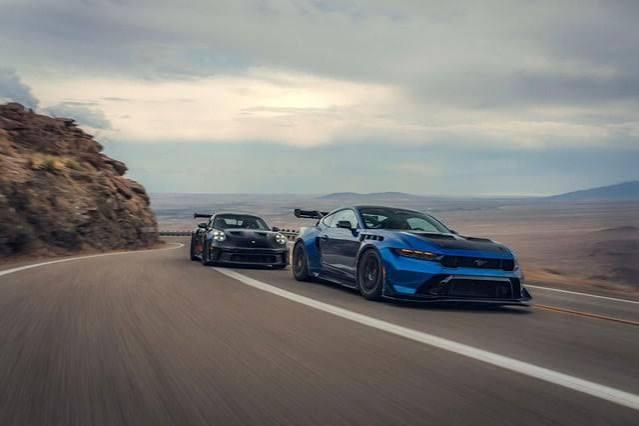
The Mustang GTD vs Porsche 911 GT3 RS comparison starts with a rather ridiculous horsepower difference.
Ford gives the Mustang GTD a supercharged V8 with 815 hp. Porsche’s naturally aspirated flat-six produces 518 hp.
That’s 297 hp in Ford’s favour.
You might expect the Mustang to leave the Porsche behind. However, the Nürburgring tells a different story.
The standard Porsche 911 GT3 RS completed the circuit in 6 minutes and 49.328 seconds. The Mustang GTD managed 6 minutes and 52.072 seconds on its improved 2025 attempt.
So, despite having considerably less power, the Porsche was almost three seconds quicker.
Then Ford introduced the Mustang GTD Competition and changed the conversation again.
Before deciding which car is better, it’s worth understanding how these two machines achieve their performance.
Mustang GTD vs Porsche 911 GT3 RS: Specs and Price
Both cars are road legal, but their engineering puts them much closer to racing machinery than ordinary sports cars.
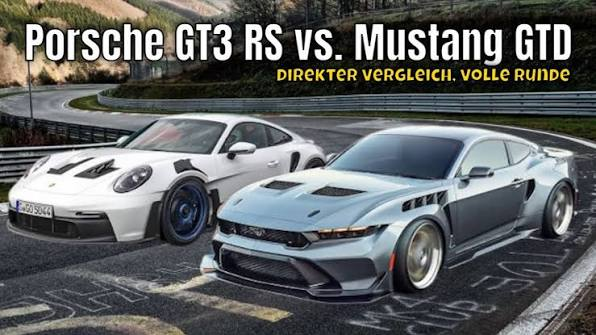
Here’s how the standard versions compare.
| SpecificationFord Mustang GTDPorsche 911 GT3 RS | ||
| Engine | 5.2L supercharged V8 | 4.0L naturally aspirated flat-six |
| Power | 815 hp | 518 hp |
| Transmission | 8-speed dual-clutch | 7-speed PDK |
| Driven wheels | Rear | Rear |
| Nürburgring lap | 6:52.072 | 6:49.328 |
| Approximate US starting price | $328,000 | $250,000 |
The prices reflect published figures rather than current dealer asking prices.
On paper, the Mustang has a huge advantage in power. It also has more torque and a higher top speed.
However, Porsche has spent decades developing the 911 for both road and track use. The GT3 RS represents one of the most extreme versions of that formula.
Ford has taken a different approach.
The Mustang GTD started with the familiar Mustang shape. However, Ford and engineering partner Multimatic have changed almost everything underneath.
Why the Mustang GTD needs 815 horsepower
The 2025 Ford Mustang GTD uses a supercharged 5.2-litre V8 that produces 815 hp and 664 lb-ft of torque.
Ford sends that power through a carbon-fibre driveshaft to an eight-speed dual-clutch transaxle at the rear.
This layout helps the GTD achieve a near 50:50 weight distribution.
There’s also an advanced suspension system, with inboard rear dampers, carbon-ceramic brakes and enormous tyres.
Carbon-fibre body panels help control weight. Meanwhile, the large rear wing and other aerodynamic components generate downforce at high speeds.
The result looks spectacular.
It also looks expensive, which is hardly surprising when you consider the engineering involved.
Independent testing by Car and Driver recorded a 0–60 mph time of 2.8 seconds. The GTD also completed the quarter-mile in 10.6 seconds.
Those are impressive numbers for a front-engined car with a Mustang badge.
How the Porsche GT3 RS makes less power work
The Porsche 911 GT3 RS follows a different recipe.
Its 4.0-litre flat-six produces 518 hp and revs to 9,000 rpm. It has no turbocharger or supercharger.
Instead, Porsche concentrates on reducing weight, improving handling and making the most of every corner.
The GT3 RS uses a seven-speed PDK gearbox and an advanced suspension system with extensive adjustment options.
Aerodynamics play an equally important role.
At 177 mph, Porsche says the GT3 RS can generate up to 860 kg of downforce.
That’s a remarkable amount for a road-legal car.
The Porsche is also considerably lighter than the Mustang.
Car and Driver measured the GTD at 4,404 pounds, or approximately 1,998 kg. Porsche quotes an unladen weight of 1,450 kg for the GT3 RS, although the two figures use different measurement standards.
Even allowing for that difference, the Porsche carries substantially less weight.
That helps when braking, turning and changing direction.
The Mustang can recover time through acceleration. However, the Porsche needs less energy to slow down and move through a corner.
And that’s where the Nürburgring results become interesting.
Which Is Faster at the Nürburgring?
Ford first took the Mustang GTD to the Nürburgring in 2024.
It completed the 20.832-kilometre Nordschleife in 6:57.685. That made it the first car from an American manufacturer to break the seven-minute barrier.
Ford returned in April 2025.
After making changes to the suspension, aerodynamics and vehicle calibration, the GTD recorded 6:52.072.
That was a significant improvement.
However, Porsche had already recorded 6:49.328 with the standard GT3 RS in October 2022.
The Porsche remained quicker by 2.744 seconds.
For a car with nearly 300 fewer horsepower, that’s an impressive result.
But Ford wasn’t finished.
In March 2026, the Mustang GTD Competition completed the Nordschleife in 6:40.835 with Dirk Müller driving.
That made it substantially faster than the standard GT3 RS.
The GTD Competition benefits from further engineering changes, including aerodynamic improvements, lighter components and revised performance hardware.
However, there’s an important distinction.
The Nürburgring lists the GTD Competition in its prototype and pre-production category. The standard GTD and GT3 RS appear in the production sports-car records.
Therefore, the Competition’s lap cannot serve as a direct replacement for the standard GTD’s result.
Porsche has also continued developing its track package.
In April 2026, a 911 GT3 RS fitted with the Manthey Kit recorded 6:45.389.
The Porsche 911 GT3 RS Manthey Kit adds revised aerodynamics, suspension upgrades and track-focused braking components to improve the car’s circuit performance.
Here are the four relevant lap times.
| CarNürburgring lap | |
| Mustang GTD Competition | 6:40.835 |
| Porsche 911 GT3 RS Manthey Kit | 6:45.389 |
| Porsche 911 GT3 RS | 6:49.328 |
| Mustang GTD | 6:52.072 |
All four times cover the full Nordschleife, but the cars have different specifications and classifications.
The standard Porsche beats the standard Mustang.
The GTD Competition, meanwhile, shows how much more performance Ford has extracted from the platform.
It’s a fascinating rivalry, especially when you consider how different the two cars are.
Mustang GTD vs GT3 RS: Which Is Better to Drive?
Lap times are useful, but they don’t explain everything about driving a car.
The Mustang GTD offers tremendous acceleration and impressive grip. Its suspension also makes it more comfortable on the road than its appearance might suggest.
Car and Driver praised the GTD’s performance and ride quality during its comparison with the Porsche.
However, the publication preferred the GT3 RS for its more involving driving experience.
That makes sense when you look at the Porsche’s engineering.
Its lighter construction helps the driver feel what the car is doing. The naturally aspirated engine also responds immediately to throttle inputs.
Then there’s the sound of a flat-six approaching 9,000 rpm.
The Mustang offers a completely different experience.
Its supercharged V8 delivers enormous power and a soundtrack that few enthusiasts would complain about.
Yet the GTD’s extra weight remains a factor, particularly on circuits with frequent braking and tight corners.
Neither car makes much sense as a daily commuter.
The Porsche is loud, firm and heavily focused on track driving. It also sacrifices the usual front luggage compartment for aerodynamic hardware.
The Mustang is more comfortable than you might expect, but its size, price and extreme performance create their own compromises.
For occasional road trips and track days, some drivers may prefer the GTD.
For drivers who place steering feel, braking precision and cornering performance above everything else, the GT3 RS makes a strong case.
Is the Mustang GTD Worth More Than the Porsche GT3 RS?
The Mustang GTD started at approximately $328,000 in the United States.
The Porsche 911 GT3 RS carried a published starting price of around $250,000 in late 2025.
That puts the Ford roughly $78,000 above the Porsche before considering options, availability or dealer premiums.
So, what does the extra money buy?
The Mustang offers 815 hp, extraordinary acceleration and engineering that goes far beyond the regular Mustang.
It also offers rarity and a strong connection to Ford’s racing programme.
For Mustang collectors, that combination will be difficult to resist.
The Porsche offers something different.
Its lower weight, aerodynamic performance and handling make it one of the most capable road-legal track cars available.
More importantly, the standard GT3 RS has a faster recorded Nürburgring lap than the standard GTD.
And it achieves that with substantially less power.
If lap times and driving precision are your priorities, the Porsche looks like the better purchase.
If you want an exclusive American performance car with enormous V8 power and remarkable engineering, the Mustang GTD has plenty to offer.
The GTD Competition adds another reason to take Ford seriously, although its Nürburgring result belongs to a different vehicle category.
Ultimately, the most interesting part of this comparison is how close the standard cars are despite their differences.
Ford has built a Mustang capable of challenging one of Porsche’s most accomplished track cars.
Porsche has responded by demonstrating just how much performance careful engineering can deliver without chasing horsepower.
And perhaps that’s the real lesson here.
An extra 297 horsepower sounds impressive. But on a racetrack, how you use that power matters just as much as how much you have.
About DailyRevs
For readers who enjoy looking beyond the performance figures, DailyRevs – The Internet of Cars brings together high-resolution car galleries, vehicle specifications, videos and automotive news. Its collection covers everything from current production models and classic cars to independent design concepts. Readers can also save their favourite car images in personal folders for future reference.
