

Almost every Indian household has an RO water purifier, but not everyone knows when to change the filters. An RO purifier has 4-6 filter stages. Many owners replace all the filters at once when the technician comes. As a result, a working RO membrane is changed in vain. For example, the sediment filter can turn brown and clog around 3-4 months with borewell or tanker water. If you change the RO membrane along with the pre-filter, you will waste money.
The filters need earlier replacement than most people assume when the purifier runs on borewell water. If you use the same water purifier on low-TDS municipal water, the membrane will easily last about 2-3 years. No matter whether you are using an RO rental, you still need to replace filters. The relief is that most rental service providers schedule the replacement. If you have just got a water purifier, it may feel puzzling. In this guide, we will explain, stage by stage, the signs that tell you whether the cartridge has worn out, and how your water source can affect the RO membrane.
How Often Should You Change RO Filters?
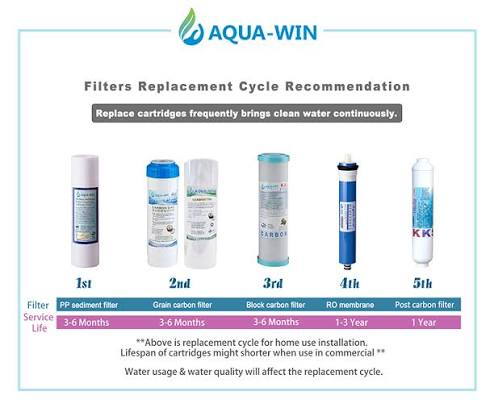
Every RO filter runs on its own clock. The filters need to be changed stage by stage. Generally, sediment and pre-carbon filters last 6-12 months, UF membrane 12-24 months, and post-carbon filters last about a year. The RO membrane is the most expensive part and lasts 2-3 years.
However, high TDS borewell water may not match the stated duration. Hardness in water wears out filters sooner than expected.
| Filter stage | Typical interval | How to tell it is due |
| Sediment filter | 6–12 months; 3–6 on tanker water | Turns brown, tank fills slowly |
| Pre-carbon filter | 6–12 months | Chlorine smell returns |
| RO membrane | 2–3 years | Rejection rate falls (TDS test below) |
| UF membrane | 12–24 months | Cloudy water, weak final flow |
| Post-carbon filter | About 12 months | Flat or stale taste |
The pre-filters mostly wear out 2-4 times faster than the membrane. Changing everything together would be a waste of a functional RO membrane. If you again wait for the RO membrane to fail, it would be too late for the pre-filters. The rule should be that the pre-filter should be changed at every service and the membrane only when a test says so.
If you want to know when to change RO filters, taste comes second. The WHO refers to water under 300 mg/L as excellent and 300 to 600 as good. Purified water that suddenly tastes salty usually means the membrane is passing more than it should.
Why Do You Need to Change Sediment Filters at First?
The sediment filters set the pace for every other purification stage. It is also known as the RO candle. Sediment filters mainly trap sand, rust, and silt before anything else touches the water. It is the least expensive part and the first one to clog – usually within 6-12 months on a borewell or tanker water supply.
A choked candle can slow down the water. It prevents the booster pump from working. As a result, the fine silt can reach the carbon and membrane stages. If the water purifier has a transparent body, see if the cartridge is white or brown. A fresh one is always white.
How a Carbon Filter Wears Out an RO Membrane
The pre-carbon filter eliminates chlorine before water can reach the RO membrane. It is important to note that the thin-film membranes used in home water purifiers are damaged by chlorine. A carbon filter left past its 6-to-12-month window can quietly cut the membrane’s life, even while the water still tastes fine.
Activated carbon works by holding chlorine on its surface. Once that surface is full, the filter stops working without any visible change, which is why a calendar reminder is more dependable here than waiting for a smell. The post-carbon filter at the end of the line is different: it only polishes taste, so a flat or stale flavour is a fair signal for that one.
When to Change RO Filters for Home
The RO membrane fails when the rejection rate drops. A TDS meter can detect early signs, measuring them in under a minute by comparing tap water with purified water. If you see a gradual decline over months rather than a low reading, it is a hint to replace the RO membrane. Here’s how to figure out when to change the RO membrane:
1. Test the TDS of your water
2. Check the TDS of purified water
3. Subtract the second from the first, then divide by the TDS reading of the tap and multiply by 100
If the tap water reads 800 ppm and the purified water reads 40 ppm, the membrane rejects 95% of dissolved solids. You also need to check whether the purifier has a TDS controller or mineral cartridge.
Since the RO purifier can remove minerals, the mineral cartridge/TDS controller can add some minerals back to keep the output TDS at a set level. You should note the reading after every service and treat it as your baseline.
When to Change the UF Membrane
The UF membrane needs to be replaced every 12-24 months. UF blocks bacteria, fine particles, and cysts; however, it does not alter the TDS level. That’s why you cannot get the full picture from a TDS reading. If you see weak flow or cloudy water at the final tap, or a musty smell, it is a sign to change.
In an RO water purifier with UV and UF filters, the UF filter works as a backup barrier, and it gets clogged slowly. In non-RO UV+UF units on a low-TDS municipal water supply, the UF filter does most of the filtering.
How the Water Source Changes Replacement Cycle
The water supply you use for your water purifier affects your purifier more than how many litres of water you use. When you are using borewell water with high TDS, the tanker water carrying silt and hard water can speed up the replacement schedule.
The WHO notes that water above 500 mg/litre TDS causes excessive scaling in pipes and kettles. That mineral load is exactly what an RO membrane holds back, and scale forming on its surface is a common reason membranes fail early in hard-water areas. Homes that switch between municipal and tanker supply, or see muddy water, should check the candle every few weeks then.
Is Renting a Water Purifier Easier Than Managing Filter Changes?
When you own an RO water purifier, you’re responsible for replacing the filters. Of course, the technician will do it, but you need to look out for signs and schedule the visit. In an RO system, around five stages wear out at different times. Plus, you need a TDS check after every service.
The situation changes with a rented water purifier, as the service provider takes replacement off your plate. The rental service schedules visits and replaces cartridges as they wear out. The cost is usually included in the monthly rent, so a worn-out part does not incur a separate bill.
For instance, Rentomojo changes filters and covers maintenance for its own line of purifiers. The monthly plans also cover relocation within the city and to other serviceable cities.
| Details | Owning an RO | Renting an RO |
| Upfront cost | Full purchase price | Refundable deposit plus first month’s rent |
| Who tracks filter changes | User, stage by stage | The rental provider |
| RO membrane replacement | Paid separately when the TDS test says it’s due | Included in plan maintenance |
| Repairs after warranty | Paid out of pocket | Covered under the plan |
| Moving house | User arranges uninstall and reinstall | Provider handles relocation |
Final Thoughts
Knowing when to change RO filters is not difficult when you know how to find out the filters are working optimally. Sediment and carbon cartridges can be changed with a spanner at home, but you should leave the task of changing internal cartridges and the RO membrane to a technician. If the RO membrane does not sit properly, the purifier may be leaking and letting out unfiltered water.
