

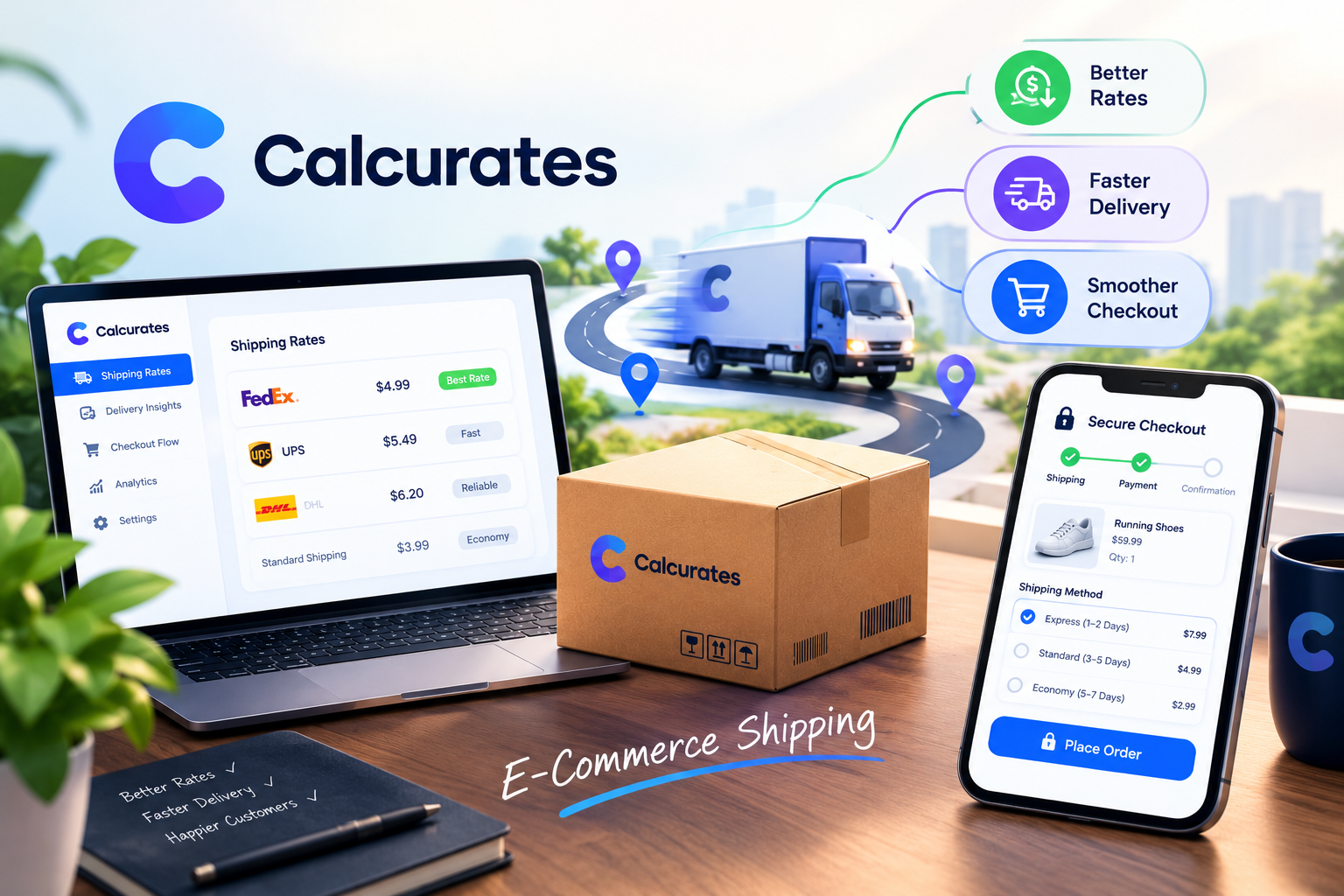
Shipping is a crucial aspect of the customer journey for an online store. It affects how much the shoppers are paying, the time that they can expect their orders to be completed and they’re confidence that they will complete a purchase. The customer may be inconvenienced and abandon the cart if shipping fees, delivery dates and delivery options are not adequate.
The best shipping solutions for eCommerce should make both the customer and merchant’s lives easier. With solutions like Calcurates, you can let online stores display an accurate shipping cost and shipping options, an estimated delivery date, duty pickup options, and shipping duties on the checkout page. At checkout, merchants are able to provide pertinent details when they are needed, increasing transparency and simplifying the checkout process.
Why Accurate Shipping Rates Matter
One of the most common problems in e-commerce is a mismatch between expected and actual shipping costs. The product that a customer might have landed on may be the desired product, but then he/she may find that the shipping charges are unexpectedly high when he/she reaches the checkout. This can result in a loss of trust and a push away for customers from completing the purchase.
Shipping rates may vary based on a number of factors such as package weight, shipping dimensions, destination, product type and shipping company service. Merchants will want to update their shipping estimation regularly so that they can be sure they are giving customers the right numbers.
Shipping calculation features like these can be useful to businesses when they need to navigate different rates scenarios and provide their customers with more accurate and better pricing information. For Magento-based stores, solutions supporting ups magento 2 shipping requirements can also make it easier to manage carrier-based shipping options within the checkout process.
Provide Shipping Options That Fit Different Customers
Customers have varying priorities of delivery. Depending on the customer, some may prefer to pay more for express or next day shipping, while others may prefer to pay less for standard shipping.
Customers are given more flexibility by giving them different and relevant shipping options. It may be regular shipping, expedited shipping, next day, local shipping or even store pick up as per the business.
However, when presented with too many choices, the checkout process could be confusing. Merchants need to concentrate on helpful choices and distinctly display the expense and the projected delivery time for every choice.
Show Estimated Delivery Dates
The consumers may not be informed about the exact time of arrival to their orders even if the delivery is faster. For instance, a promise that it will be delivered within 2–4 business days might still give customers the question of when it will actually arrive.
Showing approximate delivery times can be helpful to make the checkout process more clear. Enables customers to select the least expensive and quickest method of delivery for their products, convenient for them.
While making delivery estimates, merchants should take into account the processing time, holidays, weekends, destination and the carrier schedules. Precise estimates can minimize the uncertainty and avoid customers contacting the support due to delayed orders.
Use Flexible Shipping Rules
The more that an online store grows, the more the shipping gets complicated. Different rates apply to various products, some locations may have conditions and specific rates may apply for large orders.
These can be made more manageable by establishing flexible shipping rules for them as such:
- Product category
- Order value
- Quantity
- Destination
- Package weight
- Shipping method
- Customer location
A centralized process can reduce manual work and help to ensure uniformity of shipping policies. By exploring its platform, merchants can gain insight into the various features and services Calcurates provides, and understand how it can better serve their shipping needs.
Make International Shipping Transparent
There are additional shipping factors that need to be taken into account when selling internationally. Depending on the destination and products purchased, duties, taxes or other fees may be charged by the customer.
These costs may be hard to understand and can be a surprise to customers upon order or order delivery. If possible, merchants should give the customer details of any duties and shipping costs before they agree to buy. Transparency and clarity in international shipping information instill trust and contribute to streamlining the customer journey.
Consider Pickup Options
Not all customers are looking for a home delivery service. For businesses that have physical retail, warehouse or fulfillment centers in the area, pickup can be a viable option.
Orders must be expressed and the time at which the order is to be available and the necessity for identification and/or disclosure of other information required to get the order must be explained.
This will give the shoppers better options in getting their orders delivered in addition to having regular deliveries.
Simplify the Checkout Experience
The checkout process can go wrong even with a good shipping plan if it is a confusing process. Shipping options, shipping costs and shipping dates should be readily apparent to customers.
Don’t go through unnecessary steps and go through confusing menus. To avoid having to scroll through multiple pages, shipping details must be clearly displayed and easily comparable.
Precise shipping calculations and easy checkout information can lessen hesitation and streamline the buying process.
Common E-Commerce Shipping Challenges
Some of the more frequent issues in online stores are the rate being incorrect, complicated shipping policies, limited shipping providers, no delivery timeframe and difficulties with foreign orders.
Scalability is another challenge. An easy-to-manage shipping system for a small business with a small product line can become problematic in a larger business where customers buy hundreds or thousands of orders, in multiple locations.
When merchants check on a regular basis, they can find something that they should improve by checking on shipping performance, customer feedback, delivery fee and checkout abandonment.
How Shipping Technology Can Help
Managing shipping manually can become time-consuming as an e-commerce business grows. Automated shipping tools can help merchants calculate rates, manage delivery methods, create shipping rules, and present useful information to customers during checkout.
A solution such as Calcurates can help businesses manage shipping-related requirements from a centralized platform. Features for rate calculation, delivery dates, pickup options, and duties can help merchants create a more informative checkout experience while reducing operational complexity.
Conclusion
Effective e-commerce shipping depends on accuracy, transparency, flexibility, and simplicity. Customers want to know how much delivery will cost, which methods are available, when their order is expected to arrive, and whether additional charges may apply.
For merchants, the challenge is managing these details without making daily operations unnecessarily complicated. By using flexible shipping rules, accurate rate calculations, delivery estimates, and clear checkout information, online stores can reduce friction and improve the overall shopping experience.
With the right shipping strategy and tools such as Calcurates, businesses can make checkout more predictable for customers while creating a shipping process that is easier to manage as the store grows.
