

AI video has moved from novelty to line item. Marketing teams, solo creators and app developers now generate dozens or hundreds of short clips a month, and the bill grows quietly in the background. Two things decide what that bill looks like: the price of each generation, and what happens when a generation goes wrong. Most buyers compare the first and ignore the second.
The same model does not cost the same everywhere
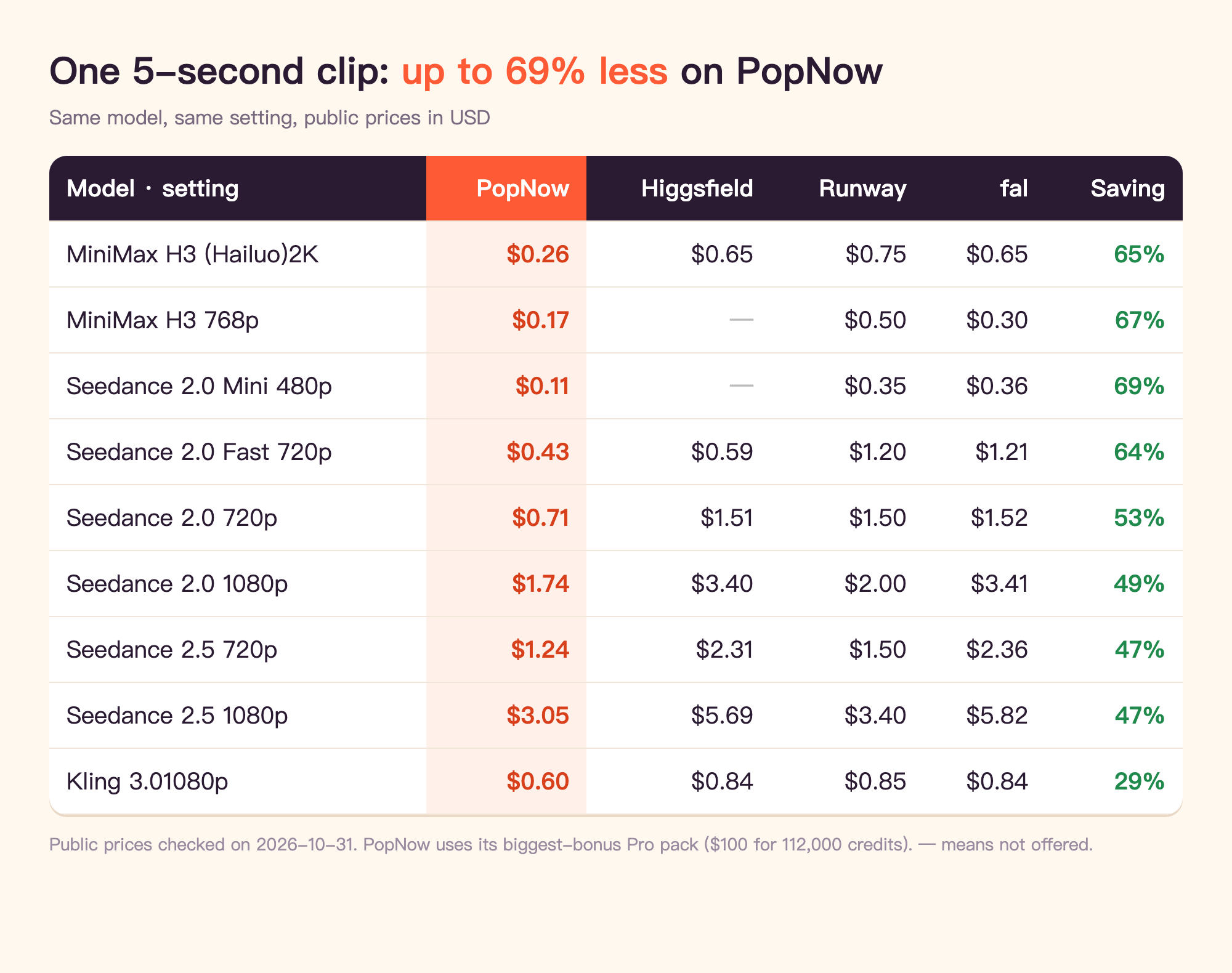
Many of today’s popular video models, such as Seedance, MiniMax Hailuo and Kling, are available on several platforms at once. The model is identical, but the price per clip is not. Public list prices checked at the end of October 2026 show how wide the gap can be for a single five-second clip:
- Seedance 2.0 at 720p costs about $1.50 on Higgsfield, Runway and fal, and $0.71 on PopNow.
- MiniMax H3 at 2K costs $0.65 to $0.75 on the three larger platforms, and $0.26 on PopNow.
- Kling 3.0 at 1080p is closer: about $0.84 elsewhere against $0.60.
The differences are rarely obvious on a pricing page, because platforms sell credits, subscriptions and bundles rather than prices per clip. The practical fix is to convert everything into one unit, the cost of one clip at the resolution and length you actually use, and compare that.
A monthly example
Consider a small team that makes 30 Seedance 2.0 clips at 720p and 300 Nano Banana 2 images at 1K every month. At public list prices that comes to about $69.60 a month on fal and $74.70 on Higgsfield. The same usage on PopNow is about $35.70. Over a year, the difference is roughly $400, enough to cover several more months of production.
Savings are not uniform across models, so check the settings you rely on. A side-by-side table with source links for each price is published at popnow.ai/compare.
The hidden cost: failed and unusable generations
Price per clip only tells part of the story. Generative models fail. A task can time out, return an empty file, come back at the wrong aspect ratio, or arrive without the audio track you paid for. On many platforms the credits are spent either way, and getting them back means opening a support ticket, if a refund is possible at all.
For anyone generating at volume, these failures add up. A 5% failure rate on a $500 monthly budget is $25 lost every month, before counting the time spent redoing the work. When you evaluate a platform, read its refund policy as carefully as its price list.
What a buyer-friendly policy looks like
A good policy is specific, automatic where possible, and easy to check. PopNow’s “Protect” program is one example of the direction the market is moving. It describes itself as the first AI platform that pays you back, with promises published in plain language:
- Failed? Full refund. If a generation fails or comes back empty, the credits return automatically.
- Wrong size? Full refund. If the result does not match the size, length, resolution, count or audio that was chosen, the generation is checked and refunded within one business day.
- Too slow? 20% back. If a run takes longer than the time shown on the button, up to 20% comes back as reward credits.
- Price locked. The charge never exceeds the price shown before the run.
- Cheaper elsewhere? 2x back. If the same generation is cheaper on Higgsfield, Runway or fal, the platform pays twice the difference, subject to published conditions.
The conditions matter, and serious buyers should read them. Reward credits expire after 90 days and count against a monthly allowance, and the price match only covers standard public prices, not promotions or enterprise deals. The full terms are on the PopNow Protect page.
A checklist before you commit a budget
- List the three or four models and settings your team uses most.
- Convert each platform’s pricing into cost per clip or per image at those settings.
- Read the refund policy: are failed tasks refunded automatically, or only on request?
- Check whether unused credits expire and whether they can be refunded.
- Run a small paid test, then re-check prices every few months, because they change often.
AI video is becoming a routine production cost. Treating it like any other purchase, with comparison shopping and clear guarantees, is the simplest way to keep that cost under control.
