

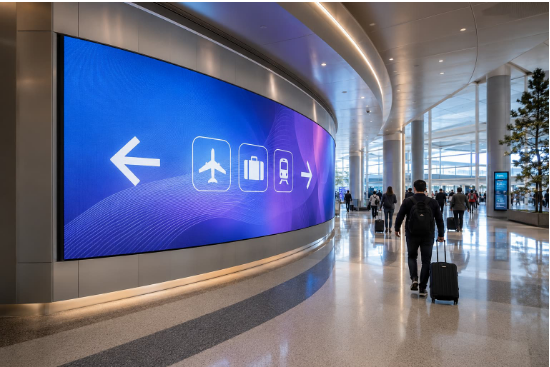
Rigid LED panels dominate most commercial display installations — and for good reason. They are proven, cost-effective, and available in a wide range of pixel pitches and sizes. However, they assume one thing about every space they go into: that the wall is flat.
The moment a project introduces a curved surface, a structural column, or an irregular architectural feature, the rigid panel’s advantages begin to work against it. Gaps appear at joints. Edges fail to align. The display looks mounted onto the architecture rather than part of it. A flexible LED display screen solves that problem at the source — by building the display to follow whatever surface it sits on, rather than requiring the surface to adapt to the display.
How a Flexible LED Display Screen Is Built Differently
The fundamental difference lies in the module casing. A rigid LED display uses aluminum cabinets — structurally strong, dimensionally fixed, and completely inflexible. A flexible LED display screen uses rubber-backed modules instead. Because rubber allows each module to bend along its surface plane, it follows curves that aluminum simply cannot accommodate.
Embedded magnets hold the modules together during and after installation. That magnetic connection creates a seamless joint between modules, even on a curved surface, with no visible gap and no mechanical fastener breaking the visual plane. As a result, the LED components within the rubber module maintain consistent spacing throughout the bend, keeping pixel density uniform from edge to edge.
The cabinet itself is built to the module dimensions rather than a fixed standard size. Therefore, the overall display can take almost any surface geometry. That structural approach separates a flexible display from a rigid one — not just in appearance, but in what it can actually do.
Where Rigid LED Panels Reach Their Limit
Rigid panels perform well in conventional environments: flat walls, standard rectangular installations, and fixed-dimension video walls where the architecture suits a flat display surface.
Take the panel off a flat wall, however, and performance drops fast. A curved reception counter leaves visible gaps between panels that don’t share the same angle. Meanwhile, a structural column cannot be covered at all — no rigid cabinet will wrap a cylinder. An arched ceiling or wave-form feature wall forces a choice between leaving sections uncovered or cutting panels down, and both options compromise the visual result.
Beyond geometry, rigid panels carry installation challenges in complex spaces. They are heavier, which limits the surfaces they can mount to. In addition, they require rear access for servicing, which proves impractical in many built environments. Because their dimensions stay fixed, custom shapes require custom fabrication — adding cost and lead time to every non-standard project.
What a Flexible LED Display Screen Can Do That Rigid Panels Cannot
The clearest way to understand a flexible display’s advantage is to examine the specific surface types it unlocks.
Column and Pillar Wraps
Structural columns sit at natural pedestrian flow points in retail stores, hotel lobbies, airports, and exhibition halls. They rank among the highest-visibility surfaces in any commercial space — and are completely inaccessible to rigid panels. A flexible LED display screen wraps the column’s full circumference, creating a 360-degree display visible from every approach angle. Minimum bending diameters start at around 306mm for fine-pitch models, covering most standard commercial column sizes without compression artifacts or visible seams.
Concave and Convex Wall Installations
Curved feature walls — both inward-curving concave and outward-curving convex — appear in high-end retail, hospitality, and branded environments where standard rectangular installations would look generic. A flexible LED display follows the wall’s geometry exactly, producing a seamless visual surface that reads as part of the architecture. No gaps. No visual interruption at the point where two panels meet at an angle.
Overhead and Ceiling Displays
Arched ceilings, wave-form structures, and sculptural overhead features rank among the most visually impactful display surfaces in any space. They are also the ones most likely to stay blank because rigid panels cannot cover them. A flexible display installed across an arched ceiling transforms a passive architectural element into an active visual one. The screen conforms to the curve and delivers consistent image quality across the full surface.
When a Rigid LED Panel Is Still the Right Choice
Flexible displays are not the right answer for every project. In spaces with entirely flat, accessible wall surfaces and no architectural complexity, a rigid panel typically becomes the more cost-effective and easier-to-service option.
Rigid panels also hold an advantage in environments that demand very high brightness. For example, outdoor-rated panels can reach 5,000 to 10,000 nits — a range that most flexible display modules do not match. Therefore, for outdoor advertising, sports perimeter displays, and direct-sunlight installations, rigid remains the practical choice.
The decision comes to the surface. If the wall is flat and accessible, rigid works well. If the space has curves, columns, or irregular geometry, however, rigid stops being an option, and a flexible display becomes the only viable one.
Choosing a Flexible LED Display Screen for the Right Reasons
The best use of a flexible LED display screen is one where the alternative is genuinely worse — not just different. That means spaces where rigid panels cannot cleanly cover the surface, where the architecture requires the display to follow a curve, or where the installation demands a level of visual integration that flat panels cannot provide.
In those situations, choosing a flexible display is not a premium add-on. Instead, it becomes the decision that makes the display actually work. The architecture stops being a constraint and starts becoming part of the design. For any project where the wall is not flat, that is the starting point worth building from.
