

Most people who sell gold or silver do it once or twice in their lives. A box of inherited jewelry turns up, or a jar of old coins, and they carry it to the nearest buyer with no idea what a fair number looks like. The buyer does this every day. That gap in information is where sellers lose money.
Closing it takes about ten minutes and a phone. Live metal prices are public, the math is simple, and free calculators do it for you. Here is how to work out what your items are worth before anyone makes you an offer.
What melt value means
Melt value is what the metal in an item is worth as raw material. It ignores the brand, the design and the workmanship, and counts only the gold or silver inside. For broken chains, single earrings, dental gold and most common coins, it is the number every offer starts from.
Three inputs set it:
- Weight. Precious metals trade in troy ounces, and one troy ounce is 31.1 grams. That is about 10% heavier than the ounce on a kitchen scale, so check which unit your scale shows.
- Purity. Gold jewelry is an alloy, and the karat stamp tells you how much of it is gold: 10K is 41.7%, 14K is 58.3%, 18K is 75% and 24K is pure. Sterling silver, stamped 925, is 92.5% silver.
- Spot price. This is the current market price for pure metal, and it moves all day while markets are open.
How the math works
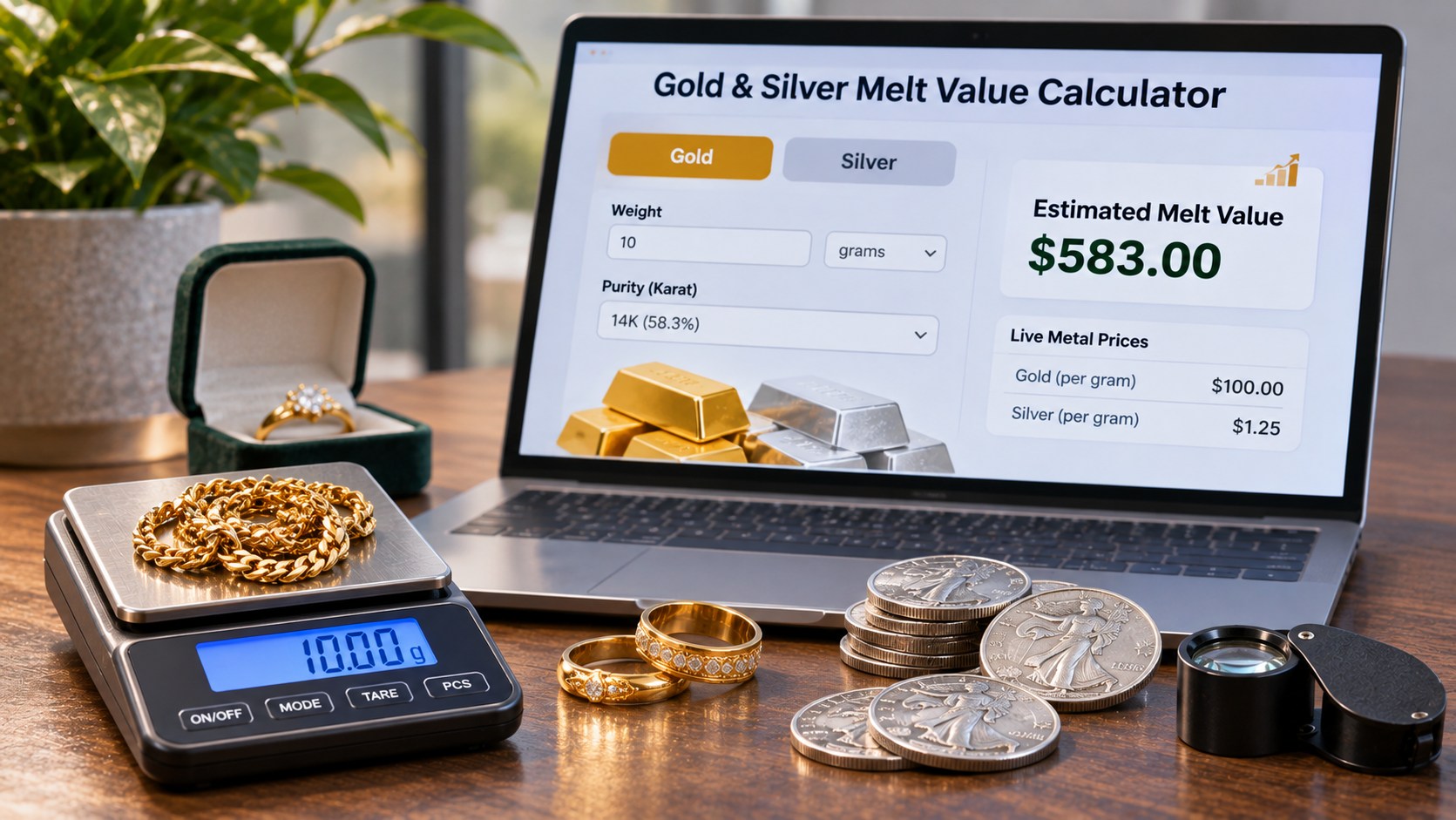
Multiply the weight by the purity, then by the spot price. Say you have a 14K chain that weighs 10 grams. It holds 5.83 grams of pure gold. If gold were trading at $100 a gram (a round number picked to keep the math easy), the chain’s melt value would be $583.
You can do this by hand, but you need a current spot price and the right unit conversions, and a small slip changes the answer. A free melt value calculator handles both. You pick the metal, enter the weight in grams, troy ounces or pennyweight, choose the karat, and it returns a figure based on live prices.
Run each karat as its own batch. Mixing 10K and 18K pieces in one scale reading gives you a wrong total. If you don’t own a jewelry scale, a digital kitchen scale that reads to the gram is close enough for a first estimate.
Coins follow different rules
US dimes, quarters and half dollars dated 1964 or earlier are 90% silver. Dealers call them junk silver, and they trade on metal content, so their value rises and falls with the spot price. A handful of pre-1965 quarters is worth many times face value on silver alone.
Some coins are worth far more than their metal. Rare dates, mint marks and high grades carry collector premiums that a melt calculation will miss. Morgan and Peace silver dollars and older US gold coins are the usual suspects. Treat melt value as the floor for a coin. If a date or mint mark looks unusual, look it up or get a second opinion before you sell it by weight.
What buyers pay, and what to do before you go
No buyer pays full melt value. They have refining costs, overhead and a margin to cover, so offers come in below the number on your screen. How far below varies a lot from shop to shop, which is the reason to know your number first. A big gap is your cue to try another buyer.
Here is a short routine to run before you sell:
- Sort pieces by karat stamp. Look inside ring bands and on clasps.
- Weigh each group in grams.
- Run each group through a calculator and write down the totals.
- Set aside coins and signed or designer jewelry that may be worth more than melt.
- Get at least two offers and compare each one to your number.
Spot prices change daily, so rerun the numbers the morning you plan to sell.
