

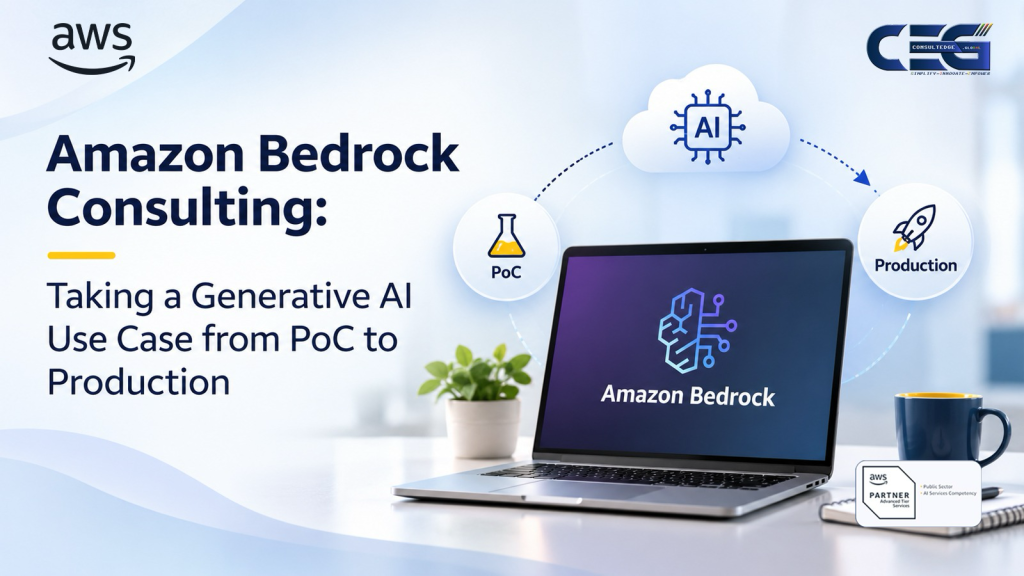
Whilst we can impress a room with a generative AI demo, a production deployment needs to manage real customers, secure business data, and provide accurate responses whilst integrating with existing systems. This is where AI projects can fail.
Amazon Bedrock Consulting will help you deploy your AI beyond the prototyping stage. To ensure it fits within your processes, is secure, and will deliver tangible benefits.
A Successful Demo Is Only The Beginning
Often, with a prototype, there is limited data and only a few people will be testing. However, deploying to production will mean your documents will be changing, unpredictable requests from users, and multiple teams may be using the application.
Businesses will need to identify a realistic use case they want to solve. This might be customer support, contract review, KYC, and internal knowledge retrieval.
An experienced Amazon Bedrock partner can help determine if there is a good business case for deploying an AI solution. They can also help evaluate if your data is ready and identify the right foundation models. Amazon Bedrock provides access to foundation models from leading AI providers, including Amazon, Meta, Mistral AI, and Cohere, through a fully managed AWS service.
This means there are plenty of models to try out.
Build Around Business Data, Not Generic Answers
However, the foundation model will not know any recent company policies, product information, or customer records. You’ll need to connect your model to some trusted business data.
This is where Retrieval Augmented Generation comes in handy. Amazon Bedrock Knowledge Bases can retrieve relevant information from your enterprise data to ground generated responses and provide citations to source data.
If you’re developing a customer support agent, you can make sure the returned answers follow your approved return policies.
Generative AI consulting services can also help with prompt engineering, model evaluation, data integration, and Bedrock Guardrails. Amazon Bedrock Guardrails can help detect and filter harmful or undesirable content, protect sensitive information, and apply configurable safeguards to model inputs and responses.
Data security should be considered. AWS has encryption and private networking solutions. AWS states that customer prompts and model outputs are not used to train the underlying Amazon foundation models unless the customer consents.
What Changes When An AI Agent Goes Live?
Deploying an AI agent to production may mean it needs to do more than just answer questions. It could need to check an order, update a CRM record, or prepare a service request.
Amazon Bedrock AgentCore provides you with managed components. Runtime provides a secure, serverless environment for deploying and scaling agents. Memory helps developers build context-aware agents across interactions. Gateway enables agents to securely access tools, APIs, Lambda functions, and MCP servers.
Identity helps agents securely access AWS resources and third-party tools and services. Observability provides visibility into agent workflows, while Evaluations can help teams monitor and improve agent quality.
Whilst you can prove your agent can carry out a task with a generative AI proof of concept, production engineering will ensure it can carry out the task safely and reliably.
From The First Experiment To A Live Application
A practical implementation usually follows a few stages:
- Discovery: Identify the use case, expected business value, and success measures.
- Prototype: Test foundation models, prompts and enterprise data using Amazon Bedrock.
- Development: Build RAG pipelines, application interfaces, and agent workflows.
- Production readiness: Add identity controls, guardrails, testing, monitoring and deployment pipelines.
- Ongoing operations: Track response quality, latency, token usage, and infrastructure costs.
An AWS generative AI partner in India can help you along this journey. Whether you want to start with a narrow proof of concept or you already have a prototype to migrate to production.
Make AI Useful Beyond The Pilot Stage
The true success of generative AI is whether your staff can trust the answers, your customers can use it without it failing repeatedly, and whether both the price of employing it and who has access to it are at your control. Whilst Amazon Bedrock provides the components, good engineering will be required to get it right.
If you’re looking to go beyond experimenting with AI, identifying one meaningful use case will be key. Validate it with real data and understand what success looks like in production. With a well-planned rollout, you can take your exciting experiment and turn it into a reliable business solution.
