

Automated forex trading has become increasingly sophisticated as traders look for faster ways to identify market opportunities, analyze price movements, and execute strategies. While traditional trading systems often rely on one-minute or five-minute candlestick data, modern trading bots can benefit from more granular information. Tick-level data provides a closer view of market activity by capturing individual price updates or trade events as they occur.
For developers building automated trading systems, access to reliable market information is essential. A well-designed forex trading API can supply the real-time data required to monitor currency pairs, identify market movements, and support algorithmic decision-making.
Platforms such as iTick provide REST API and WebSocket connectivity for accessing forex market information, including real-time quotes, tick data, market depth, and K-line data. These capabilities make it easier for developers to build data-driven trading applications.
What Is Tick-Level Forex Data?
Tick-level data represents individual market events rather than aggregated price information over a fixed period. Depending on the data source, a tick can represent a price update, quote change, or executed transaction.
A typical tick record may contain:
- Currency pair: The instrument being monitored, such as EUR/USD or GBP/USD.
- Latest price: The most recent reported price.
- Timestamp: The precise time associated with the market event.
- Volume: Available transaction volume or trade size.
- Market direction: Buy or sell information when supported by the provider.
Unlike traditional candlestick data, tick-level information allows trading systems to observe smaller market movements without waiting for an entire candle to close.
For example, a trading bot monitoring EUR/USD can process multiple incoming price updates during a short period. This information can help the algorithm identify sudden volatility, changing price momentum, or potential entry and exit conditions.
Why Trading Bots Need Tick-Level Data
The quality and frequency of market data can influence how effectively an automated trading strategy operates. Although not every strategy requires individual ticks, more granular information can be useful for systems that react to short-term market conditions.
1. Faster Market Monitoring
A trading bot needs updated market information to evaluate its trading conditions. Delayed data may cause an algorithm to make decisions using prices that are no longer representative of current market conditions.
Streaming tick information helps applications receive updates as market events occur instead of repeatedly requesting the latest price.
2. Better Short-Term Price Analysis
Scalping and other short-term strategies often depend on relatively small price movements.
Tick-level information allows developers to examine price changes between individual events, calculate short-term volatility, and study market momentum.
3. Improved Entry and Exit Conditions
A trading algorithm can combine tick information with technical indicators, predefined price levels, and risk-management rules.
For example, a bot might monitor a currency pair and evaluate whether its price movement meets a specific entry condition. However, a tick alone should not automatically trigger a trade without additional validation.
4. More Detailed Backtesting
Historical tick records can help developers test strategies using more granular market information.
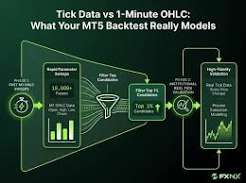
Instead of relying exclusively on completed candles, researchers can examine how a strategy might have responded to individual price movements. This can provide more detailed testing, although realistic results still depend on spread, execution delays, slippage, and available historical coverage.
Choosing the Right Data Connection
A reliable data connection is one of the most important components of an automated trading system. Developers generally have two main options: REST APIs and WebSocket streaming.
REST API for On-Demand Data
REST APIs allow applications to request market information whenever needed.
For example, a developer can request the latest EUR/USD tick, retrieve a current quote, or collect historical K-line information.
REST connections are useful for:
- Initial market data loading.
- Checking the latest currency prices.
- Retrieving historical records.
- Updating dashboards.
- Running scheduled market analysis.
WebSocket for Continuous Streaming
WebSocket connections maintain an ongoing communication channel between the application and the market data provider.
Rather than repeatedly sending requests, the bot subscribes to specific currency pairs and receives updates when new market events occur.
This approach is particularly useful for applications that need continuous price monitoring.
For example, an automated system could subscribe to EUR/USD, GBP/USD, and USD/JPY simultaneously and process incoming updates through separate strategy modules.
Using iTick for Forex Tick Data
Developers looking for a market data source can explore iTick’s forex API documentation. The platform provides REST and WebSocket interfaces designed for accessing different types of financial market information.
Its forex data services include:
- Real-time forex tick information.
- Currency pair quotes.
- Batch tick data requests.
- Market depth information.
- K-line and candlestick data.
- WebSocket-based market updates.
The REST tick endpoint follows this structure:
GET /forex/tick?region=GB&code=EURUSD
Developers can authenticate requests using their individual API token.
A basic Python example looks like this:
import requests
url = “https://api.itick.org/forex/tick”
headers = {
“accept”: “application/json”,
“token”: “YOUR_API_TOKEN”
}
params = {
“region”: “GB”,
“code”: “EURUSD”
}
response = requests.get(
url,
headers=headers,
params=params,
timeout=10
)
response.raise_for_status()
data = response.json()
print(data)
The response includes information such as the currency symbol, latest price, timestamp, and available volume.
Developers can use these fields to update their trading application’s internal market state.
For technical implementation details, visit the iTick Forex Tick API documentation.
Building a Forex Trading Bot with WebSocket Streaming
For continuous market monitoring, WebSocket connectivity offers an alternative to repeated REST requests.
The iTick forex WebSocket endpoint is:
wss://api.itick.org/forex
After establishing a connection and authenticating with an API token, developers can subscribe to the currency pairs and data types required by their applications.
A subscription request can look like this:
{
“ac”: “subscribe”,
“params”: “EURUSD$GB,GBPUSD$GB”,
“types”: “tick”
}
The subscription requests tick information for both currency pairs.
The WebSocket interface also supports other data types, including:
- quote for real-time quote updates.
- depth for Level 2 market depth.
- tick for transaction-related updates.
- kline@1 for one-minute K-line updates, subject to the applicable subscription requirements.
A trading application should also implement heartbeat messages, error handling, and automatic reconnection. According to the documentation, clients should send heartbeat messages regularly, with a recommended interval of approximately 30 seconds.
These measures help maintain a stable connection during continuous market monitoring.
Designing the Trading Bot Architecture
A reliable automated trading application should separate market data collection from strategy calculations and order execution.
A practical architecture can contain five main components.
1. Market Data Collector
This component connects to the provider and receives tick updates for selected currency pairs.
It should validate incoming messages and identify incomplete or invalid records before passing information to the next component.
2. Data Processing Engine
The processing engine organizes incoming events by currency pair and timestamp.
It can calculate:
- Short-term price changes.
- Rolling volatility.
- Moving averages.
- Price momentum.
- Tick frequency.
Timestamp handling is particularly important because market events may arrive at different speeds or occasionally out of sequence.
3. Strategy Engine
The strategy engine evaluates predefined trading conditions.
For example, a developer might create a momentum strategy that identifies unusually strong price movement and checks it against a moving-average indicator.
The strategy should use multiple confirmation conditions rather than relying on one price update.
4. Risk Management Module
Risk management should operate independently of the strategy engine.
Important controls include:
- Maximum position size.
- Maximum daily loss.
- Stop-loss limits.
- Exposure restrictions.
- Maximum number of open trades.
- Protection against duplicate orders.
These controls can prevent an automated system from repeatedly opening positions during unstable market conditions.
5. Order Execution Module
The execution module connects to the selected broker’s trading interface.
It receives approved trade signals and submits orders according to the broker’s supported order types and execution rules.
It is important to understand that a market data provider and a trading broker perform different functions. Access to price information does not automatically provide trading or order execution capabilities.
Common Challenges When Working with Tick Data
Although granular market information offers several advantages, processing it efficiently requires careful engineering.
High message frequency: A busy currency pair can generate frequent updates. Applications should use efficient message queues and avoid blocking their data-processing loop.
Network interruptions: Temporary connectivity problems can interrupt incoming data. Automatic reconnection and subscription restoration are important.
Duplicate or delayed events: Developers should use timestamps and appropriate validation to detect duplicate records and handle out-of-order messages.
Storage requirements: Recording every market event can consume considerable storage. Efficient database structures, compression, and retention policies can help manage historical datasets.
Execution differences: A price received from a data provider may not match the price available through a broker at the moment an order is submitted. Spread, liquidity, latency, and slippage must be considered.
These challenges should be addressed before deploying a bot with real trading capital.
Testing a Trading Strategy Before Going Live
A trading bot should undergo several testing stages before handling real orders.
Start with historical testing to understand how the strategy performs under different market conditions. Where historical tick data is available, use it to simulate the sequence of market events.
Next, conduct paper trading using live or simulated market information. This helps identify problems that may not appear during historical testing, such as network interruptions and unexpected message frequency.
Finally, evaluate the system’s performance using measurable indicators:
- Win rate.
- Profit factor.
- Maximum drawdown.
- Average trade duration.
- Execution latency.
- Slippage.
- Risk-adjusted returns.
A strategy that performs well in historical testing is not guaranteed to produce similar results in live markets. Real-world execution conditions can significantly affect performance.
Final Thoughts
Tick-level information can give automated forex systems a more detailed view of market activity. From short-term momentum analysis to volatility monitoring and strategy backtesting, granular price information can support more informed algorithmic decisions.
Choosing an appropriate forex trading API is therefore an important step when developing a reliable trading bot. Developers should evaluate data coverage, update frequency, connection stability, documentation, and subscription limitations before selecting a provider.
With its REST and WebSocket interfaces, iTick offers developers access to forex ticks, quotes, market depth, and K-line information through a unified data platform.
By combining dependable market data with efficient processing, disciplined risk management, and realistic testing, developers can build automated trading systems that are better prepared for changing forex market conditions.
Explore the official platform: iTick – Financial Market Data API
Disclaimer: Market data is provided for informational purposes and does not constitute financial or investment advice. Automated trading involves substantial risk, and historical performance does not guarantee future results.
