

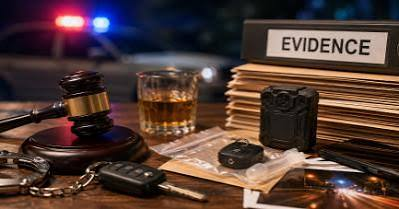
You may still be replaying the stop in your head, the lights, the questions, the walk to the shoulder, the ride to the station, the sinking feeling when you realized this was not going away by morning. A DUI charge can feel personal and public at the same time. You worry about your license, your job, your insurance, and what people will think. You also want a straight answer. What exactly can the prosecution use against you? mailletcriminallaw can help you understand these instances while facing a hard situation.
In most cases, the evidence starts with the officer’s observations and builds from there. It can include your driving pattern, your words, your appearance, field sobriety tests, breath or blood test results, body camera footage, and even statements you made before or after arrest. Some of that evidence is stronger than it sounds. Some of it is far weaker than people assume. The details matter, and so does the way that evidence was gathered.
DUI evidence often starts before the arrest
A lot of people think the case begins when the handcuffs go on. It usually starts earlier, with the reason for the stop itself. An officer may testify that you were speeding, drifting, braking late, sitting through a green light, or making a wide turn. Those details are used to justify the stop and to suggest impairment before any test was given.
Then come the officer’s observations. Bloodshot eyes, slurred speech, the smell of alcohol, slow movements, confusion, fumbling for documents, and trouble following directions are common points in a police report. You can already see the problem. Some of these signs may have nothing to do with alcohol or drugs. Fatigue, anxiety, allergies, medical issues, and even roadside conditions can affect how you look and act. Even so, those observations often become the foundation of the case.
Your own statements can also be used against you. If you said you had “only two drinks,” admitted taking medication, or answered questions in a way the officer interpreted as inconsistent, the prosecution may present that as proof of impairment. What felt like a casual exchange on the roadside can become a central part of a DUI evidence case.
Field sobriety tests can look stronger on paper than they are in real life
Field sobriety tests carry a lot of weight with juries because they sound scientific. In reality, they depend heavily on officer training, conditions at the scene, and your physical ability. The National Highway Traffic Safety Administration has formal standards for these tests in its Standardized Field Sobriety Test manual. If the officer did not follow those standards, that matters.
You may have been asked to track a pen with your eyes, walk heel to toe, or stand on one leg on the side of a dark road with traffic rushing past. That setting is not neutral. Poor lighting, uneven pavement, bad weather, nerves, age, weight, injuries, and footwear can affect performance. A report may say you “failed,” but that word often hides a lot of subjectivity.
Breath and blood tests are another major category of evidence. Prosecutors rely on chemical testing because numbers feel concrete. Still, machines require proper calibration, maintenance, and administration. Blood samples require correct handling and a clear chain of custody. If any part of that process broke down, the result may be challenged.
Video, lab results, and medical facts can shape a drunk driving case
Body camera footage, dash camera video, and station video can help either side. Sometimes the footage supports the officer’s report. Sometimes it shows a person speaking clearly, standing steadily, and following directions, which can undercut the claim of impairment. Video often tells a fuller story than a written report.
Drug related DUI cases can become even more complicated. A positive test for a drug does not always prove you were impaired at the time of driving. Prescription use, timing, dosage, and medical history all matter. Public health data from the CDC on impaired driving shows how broad the issue is, but broad data does not decide an individual case. Your case turns on what the state can prove about you, on that date, under those conditions.
This is where many people get blindsided. They assume the prosecution needs one perfect piece of proof. Usually, it builds a stack instead. Driving pattern plus odor plus statements plus test results plus officer opinion. A weak piece of evidence can start looking stronger when it is repeated across multiple sources, even if each piece has flaws.
The evidence against you may look different on paper than it does in court
| Type of Evidence | How Prosecutors Use It | Common Weaknesses |
|---|---|---|
| Driving behavior | To justify the stop and suggest impairment | Innocent explanations, unclear video, poor observation angle |
| Officer observations | To describe signs of intoxication | Fatigue, anxiety, allergies, medical issues, subjective judgment |
| Field sobriety tests | To claim physical or mental impairment | Improper instructions, uneven ground, injuries, nerves, nonstandard administration |
| Breath or blood tests | To show blood alcohol concentration or presence of drugs | Calibration issues, contamination, timing problems, chain of custody errors |
| Statements by the driver | To show drinking, drug use, or consciousness of guilt | Misquotes, context problems, unclear questioning |
| Video footage | To support the report and officer testimony | Missing footage, bad audio, visuals that contradict the report |
If you are searching for what proof is used in a DUI case, this is the core answer. The state often uses a mix of human observations and machine generated results. A drunk driving case evidence review is not just about what exists. It is about whether that evidence is reliable, lawful, and complete.
Three steps to take right away after a DUI arrest
Get every document and deadline in one place. Keep the citation, bond papers, towing paperwork, testing documents, and any notice about your license. DUI cases move fast, and missing a hearing or suspension deadline can create damage separate from the criminal charge.
Write down your timeline while it is still fresh. Note where you were, what you ate, what you drank, when you drank it, what medications you took, how the officer gave instructions, what the road conditions were like, and whether cameras were present. Small facts can become major facts later.
Speak with a criminal defense lawyer early. A lawyer can examine whether the stop was lawful, whether tests were administered correctly, and whether the prosecution’s evidence actually supports impairment. You can also review current impaired driving laws and regulations to understand the legal framework, but legal advice matters because your facts are what drive the outcome.
A DUI charge is serious, but it is not the same as a conviction. Evidence can be challenged, procedures can be flawed, and assumptions can be wrong. If you are facing questions about what evidence can be used against you in a DUI case, get clear answers before you make decisions that affect your record, license, and future. Speaking with a criminal defense lawyer is a strong next step.
