

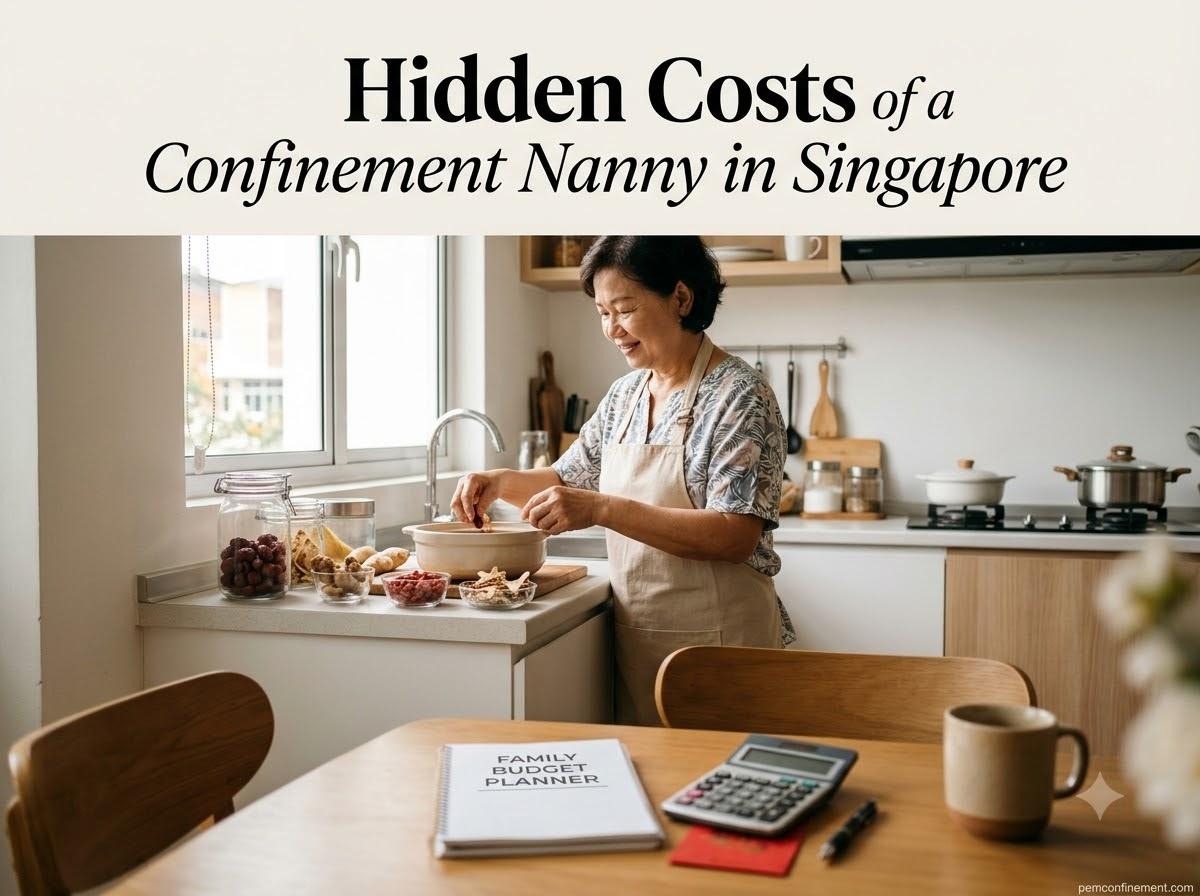
The advertised package fee can make hiring a Confinement Nanny in Singapore look straightforward. Then you start comparing quotes, and the numbers no longer match your budget spreadsheet.
Most “hidden costs” aren’t tricks. They’re simply items that sit outside the headline price: government charges, insurance, groceries, herbs, household set-up, and extra-day fees when real life does what it always does with due dates.
This guide helps you estimate the true confinement nanny Singapore cost for a typical 28-day arrangement, so you can plan calmly, ask sharper questions, and avoid paying under pressure when you’re already exhausted.
Why your quote looks cheaper than your final total
Agencies and nannies don’t all label costs the same way. One quote might bundle admin work into a single line item, while another breaks everything out (and looks “more expensive” even when it isn’t).
Before you compare prices, separate your budget into five buckets:
- The core nanny package (the service fee for the agreed number of days)
- Statutory costs (permits, levy, required insurance)
- Food and household running costs (ingredients, meals, utilities, toiletries)
- Confinement supplies (herbs, tonics, special cooking items, equipment)
- Contingency (extra days, replacements, medical out-of-pocket, transport)
This approach also makes it easier to explain your plan to family members who may offer to “help” with certain tasks, such as herbal soups or groceries.
The statutory costs that parents often miss
If you hire a foreign confinement nanny, you employ her under a Work Permit (a Ministry of Manpower permit that allows a foreign worker to work in Singapore for a specific job and period).
When you book a foreign confinement nanny, these costs may appear separately in your quote.
- Work Permit application fee
The Ministry of Manpower (MOM) charges $35 per application for your nanny’s Work Permit. - Foreign worker levy
You pay a monthly levy based on your newborn’s citizenship. The rate is $60 per month if your newborn is a Singapore citizen and $300 per month otherwise. - Medical insurance
Your nanny needs medical insurance for the time she works with you. For policies starting on or after 1 July 2023, MOM requires at least $60,000 in annual coverage. mom.gov.sg
The premium you pay depends on the policy terms and how long you need cover.
Disclaimer: Figures and requirements can change, and agencies may charge additional handling fees. Confirm the latest rules and what your quotation includes before you pay any deposit.
Food costs: the biggest “quiet” expense in a 28-day stay-in
When parents tell us their nanny singapore cost rose beyond expectation, groceries usually explain most of the difference.
Food spending tends to climb because confinement cooking often uses more:
- Fresh fish, lean meats, ginger, and warming ingredients
- Daily soups and drinks (including tonic-style beverages)
- Extra snacks for late nights, especially when you’re breastfeeding
The practical question to ask is simple, and it changes your budget fast: will the nanny cook only for Mum, or also for the rest of the household? Some families also expect separate meals for the nanny, while others share family meals.
If you want a clearer picture of what day-to-day support can look like, you can check out PEM’s service overview here.
Herbs, tonics, and bath preparation: plan early so you don’t panic-buy
Herbs and related confinement supplies rarely appear in the advertised package price. Yet many families still want herbal soups, red-date style drinks, and an herbal bath (a warm bath prepared with herbs that some mums prefer during postpartum recovery).
Typical out-of-pocket items include:
- Herbal soup packets and tonic ingredients
- Herbal bath packs
- Containers, thermos flasks, or a slow cooker if you don’t already have them
If you’re considering an herbal package, plan it upfront. PEM nannies train to prepare herbal packages properly, and mums can add on the herbal package at a special rate. That prevents last-minute shopping and reduces the chance of buying the wrong quantity for your 28 days.
Disclaimer: Herb costs vary widely by brand, quality, and family preference. If you have medical conditions or take medication, check with a qualified healthcare professional before using herbal products, especially while breastfeeding.
Household set-up costs that don’t show up on invoices
A live-in arrangement uses real household “space” and household bandwidth. Even when the cash cost is small, the impact is worth planning for.
Common set-up items families end up buying:
- A basic mattress, bedding, towels, and storage space
- A fan, night light, or small laundry basket for baby items
- Extra cleaning supplies and toiletries
Also think about the non-cash cost: reduced privacy, a bathroom schedule, and noise management when baby sleeps at odd hours. These details don’t mean you shouldn’t hire help. They simply explain why confinement support feels more “involved” than the brochure suggests.
Ang baos, gratuities, and cultural expectations
An ang bao is a red packet given as a gesture of appreciation in some households. It’s not a statutory requirement, and you shouldn’t feel forced into a number that strains your finances.
Still, many families prefer to budget for:
- A welcoming token on the first day
- A thank-you ang bao at the end of the assignment
If your parents or in-laws have strong expectations, talk early so you don’t get surprised in week four when you’re focused on feeding and sleep.
Disclaimer: Ang bao amounts are discretionary and differ by family tradition. Treat them as an optional budget item, not a legal employment cost.
Replacement, extension, and the cost of “just a few more days”
A 28-day plan often changes. Baby arrives early. Mum needs a little longer. Breastfeeding takes time to settle. When that happens, the hidden cost is usually the daily extension rate.
Before you commit, get clear answers on:
- How the agency defines “28 days” (from arrival, from birth, or another agreed start date)
- The daily rate for extra days
- Whether extra days affect levy, insurance, and permit validity
- What the replacement policy covers and how quickly a replacement can start
The value isn’t only whether a replacement is “free”. Timing matters most in the first week postpartum.
Disclaimer: Extension and replacement terms vary by provider and contract. Ask for written confirmation of daily rates, exclusions, and the process timeline.
A realistic 28-day budget (simple planning table)
Here’s a planning snapshot you can adapt. These are not official benchmarks, and they don’t replace a written quote.
| Cost area | What it may include | Planning range (28 days) |
| Core package | Nanny service fee | $3,800 to $6500+ |
| Statutory items | Work Permit fee ($35), Levy ($60 or $300), required insurance | Varies by baby citizenship and insurer |
| Food and groceries | Mum’s confinement meals, household ingredients, nanny meals | Often one of the largest add-ons |
| Herbs and supplies | Soup packs, tonics, herbal bath packs, containers | Varies by preference |
| Set-up | Bedding, small appliances, extra household items | Small but common |
| Contingency | Extra days, medical out-of-pocket, transport | Buffer recommended |
If your advertised package is at the lower end, your true confinement nanny cost singapore can still climb once you add groceries, herbs, and extensions. The reverse can also happen: a higher package that includes clearer support and fewer add-ons may reduce surprises.
Disclaimer: All ranges are indicative planning figures based on commonly reported market pricing and statutory fees. Your total will depend on contract terms, timing, and household needs.
What PEM families usually care about beyond price
Expecting parents in the first to third trimester often tell us they don’t only want “help”. They want predictable routines, respectful boundaries, and someone who can handle nights without confusion.
PEM nannies support you with a defined job scope:
- Day and night baby care, with proper rest built in
- Confinement food and tonic cooking based on your preferences
- Herbal bath preparation
- Breastfeeding guidance (practical support, not medical treatment)
- Laundry related to Mum and baby
PEM builds consistency through 150 hours training (based on modules reviewed by a leading mum and baby expert) and experience from 30+ years in the industry, with 550+ nannies who have supported 50,000+ mothers. We also guarantee the nanny’s arrival, which matters when you’ve timed leave and family help around a specific start date.
A quick checklist to prevent cost surprises
Use this list when you request a quotation:
- Confirm what “28 days” means and when billing starts.
- Ask for separate lines for levy, permit fees, insurance, GST, and any admin charges.
- Clarify who pays for groceries, and who the nanny cooks for.
- Ask what happens if you need extra days, and the daily rate.
- Check replacement terms, including exclusions and expected waiting time.
- Agree on rest day arrangements in writing, so expectations stay realistic.
If you’d like PEM to price this out for your expected delivery window, you can request a quote here.
Enquire Now. Get a Free Quote.
