

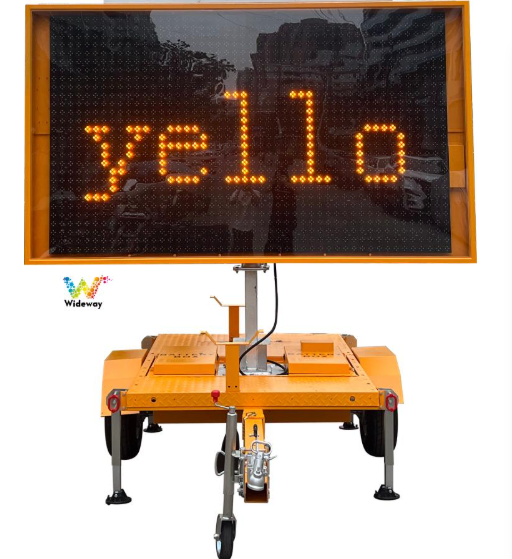
Road work, accidents, and large events all need the same thing: a clear warning that drivers can see in time. A fixed sign cannot move to the next site. A P38 Solar VMS Display can. It is a solar-powered mobile variable message sign, made to be towed to a site, lifted up, and switched on, with no mains power.
Wideway, Shenzhen Wide Way Optoelectronics, offers the P38 as model WDM-XSP-P38-Y. This article explains what it is, where it is used, how its solar power and display work, and what a buyer should check before ordering.
What Is It?
The P38 is a mobile variable message sign designed for use in temporary outdoor scenarios such as road maintenance operations, emergency response to traffic accidents, temporary traffic control measures, and traffic management during large-scale events. It uses yellow monochromatic LED lighting and integrates a solar power supply system, an energy storage battery, a towable chassis, and a liftable display screen.
Where Is It Used?
The main use is road construction and maintenance. A display placed before the work zone can tell drivers about construction, a lane closure, a speed limit, or an alternative route, so they can slow down in time. The second use is emergency response to traffic accidents, where a warning is needed fast, in a place with no power and no fixed sign. Other uses are temporary traffic control, traffic management during large-scale events, and severe weather warnings. The display shows text-based warning messages about road conditions, construction, speed limits, and alternative routes.
Solar Power: No Wiring, No Generator
The entire product is powered by solar energy, avoiding the complexity of wiring. That solves the first pain point for a buyer: no mains power, or difficulty obtaining power, at a temporary site. A generator and cable solution is expensive, noisy, and hard to move.
The specifications are clear: a polysilicon solar panel of 600W, a gel battery of 300AH at 12V, a charging time of 8 hours, and a usage time of 72 hours on a full charge. That means the display can keep working through cloudy days and through the night, on stored battery power. A P38 Solar VMS Display that can run for 72 hours on a full charge is a practical tool for a site that needs a warning day and night, not just in daylight.
A Display Drivers Can See
A warning is only useful if drivers can see it and read it in time. The P38 display is 3200 by 1900mm, with a display panel of 2400 by 1200mm, a pixel pitch of 38mm, and a resolution of 64 by 32 dots. Its pixel composition is 1R1Y, and its display color is yellow monochrome, which is easy to see against a road background.
The LED uses direct-insert type large-chip light bulbs of traffic signal lights, with LED chips made of imported crystals, high brightness, and long service life. The LED brightness is 6000 to 8000 cd per square metre, and the LED life is more than 100,000 hours. The viewing distance is 300 metres for a static message and 250 metres for a dynamic message, so drivers have time to read the message and react. The display angle is 360 degrees, so the screen can be turned to face the traffic.
Built for Outdoor Work
A mobile display works outdoors, in rain, sun, wind, and dust, so its build matters. The cabinet is made of cold-rolled steel plate, hot-dip galvanized, with a surface electrostatic spraying finish in yellow. It is fully enclosed, all-weather, and rainproof, with good surface quality, no reflection, and anti-glare properties. It has excellent oxidation resistance and good strength and wind resistance.
A P38 Solar VMS Display that is built this way can work on a construction site, in harsh weather, without failing. The power lines and communication lines are laid horizontally and vertically, meeting the process and visual aesthetics requirements of the cabinet.
How to Choose the Right One
A buyer should check five things before ordering. First, the display: is the size, brightness, and viewing distance right for the road? A highway needs a larger, brighter display than a city street. Second, the power: is the solar panel and battery enough for the site? Third, the mobility: is the trailer easy to tow, and is the screen easy to lift? Fourth, the control: can messages be changed easily, by WiFi, 4G, or LAN? Fifth, the build: is the cabinet and trailer strong enough for outdoor work, rain, and wind?
A P38 Solar VMS Display that scores well on all five points is a safer buy than a cheaper display that is hard to move, hard to control, or poorly built. The display can also be customized to any size, specification, or display color, in single yellow or full color, so a buyer should discuss its project requirements with the supplier.
Use, Care, and Warranty
The product must be powered on only under the supervision of a qualified professional, and it should not be disassembled or assembled without authorization. The casing is aluminum, and heavy pressure should be strictly avoided to prevent damage to the casing. The warranty period is 3 years, covering only the main unit.
A P38 Solar VMS Display that is used under professional supervision, and maintained well, will last longer. The box has an open front design for convenient inspection and maintenance, so a buyer should check the display, the solar panel, and the battery regularly, and follow the instruction manual that comes with the product.
Conclusion
A mobile variable message sign is a simple idea with a clear job: to warn drivers in time, where the work is, not where a fixed sign happens to be. The P38 does that with a yellow monochrome LED display, a solar power supply, a gel battery, and a towable chassis.
For road maintenance, emergency response, temporary traffic control, large events, and severe weather warnings, it is a practical tool. A buyer that checks the display, the power, the mobility, the control, and the build will get a warning system that works day and night, at any site.
Frequently Asked Questions
1. What is the P38 display?
A solar-powered mobile variable message sign with a yellow monochrome LED display, a solar power system, an energy storage battery, a towable chassis, and a liftable display screen.
2. Where is it used?
In road maintenance operations, emergency response to traffic accidents, temporary traffic control, traffic management during large-scale events, and severe weather warnings.
3. How long does it run on a full charge?
72 hours, with a 600W polysilicon solar panel and a 300AH gel battery at 12V, and a charging time of 8 hours.
4. How far away can drivers read it?
300 metres for a static message and 250 metres for a dynamic message, with a brightness of 6000 to 8000 cd per square metre.
5. What is the warranty?
3 years, covering only the main unit. Accessories are not covered, custom-made products are excluded, and malfunctions from human-induced damage or natural disasters are not covered.
