

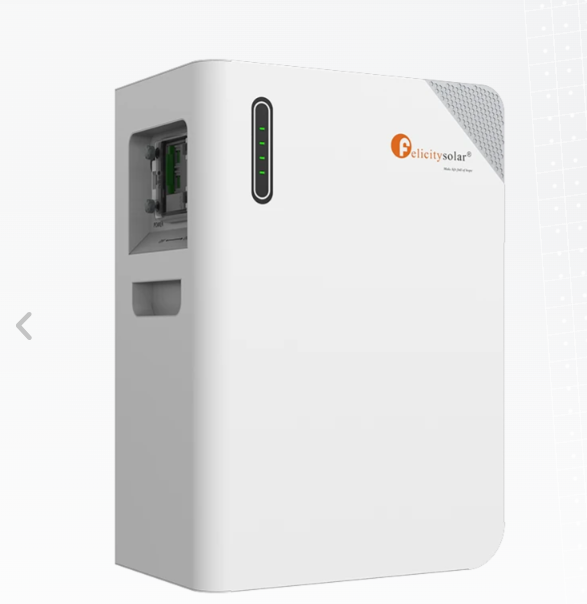
Solar panels produce the most power at midday, but most homes use more electricity in the morning and evening. Without storage, surplus daytime power is exported to the grid at a low value and bought back later at a higher price. A low voltage lithium ion battery stores that surplus energy at home and releases it when you need it most.
This guide explains how they work, what to check before buying, and how the Felicity Solar FLB Series fits a modern home.
What Is It?
A low voltage lithium ion battery is a rechargeable storage unit that operates at a lower voltage than high-voltage home systems. For residential solar, the common nominal voltages are 25.6V and 51.2V, known as 24V and 48V systems. Voltage describes the electrical category, not the storage size. A 51.2V unit can still hold 5.12kWh, 11.7kWh, or 16kWh, depending on its capacity.
Most use lithium iron phosphate, or LiFePO4, chemistry, valued for thermal stability and long cycle life. A battery management system (BMS) monitors voltage, current, temperature, and cell balance, and protects against overcharging, over-discharging, and short circuits.
In a typical setup, it connects to a compatible hybrid or off-grid inverter. Solar panels charge it by day, and the inverter draws from it in the evening or during a power cut to run essential loads.
Why Homeowners Choose Low-Voltage Storage
Low-voltage storage is now standard for many homes because it balances safety, flexibility, and cost. A 48V system is familiar to installers, works with a wide range of hybrid inverters, and is easier to expand in small steps than many high-voltage systems.
The main benefit is self-consumption. Instead of exporting surplus solar power and buying it back later, you use your own stored energy first. This reduces daily grid dependence and makes better use of the solar system you already own. A low voltage lithium ion battery also provides backup power, keeping essential loads running during outages, which matters most in areas with frequent power cuts.
Expansion is simple too: units can be connected in parallel, so you can start with one battery and add more later.
Key Features to Check Before You Buy
Safety and Battery Management
Look for a built-in BMS, circuit breaker, and fuse protection. The FLB Series adds CCS technology for stable performance, an aerosol fire extinguishing system, and a patented external fuse that is easier to access and replace.
Cycle Life and Depth of Discharge
Cycle life shows how many charge cycles a battery can handle before capacity drops significantly. FLB models offer up to 8,000 cycles, depending on the model. Depth of discharge (DoD) shows how much stored energy you can use. FLB models offer 95% DoD or higher, versus around 6,000 cycles and 90% DoD for many competing 5.12kWh batteries.
Weather and Cold-Weather Performance
If the battery will sit in a garage, on an outside wall, or in a semi-outdoor space, check its protection rating. The FLB Series is IP65 rated, meaning dust-proof and water-resistant, and its enclosure works as a heat sink to help manage heat.
Cold weather matters too. Standard lithium batteries cannot charge safely below 0°C. FLB models with the “-H” suffix include a built-in heating module, allowing charging and discharging from -20°C to 55°C, making them practical for colder regions.
Smart Monitoring and Inverter Compatibility
FLB batteries include built-in Wi-Fi and Bluetooth, so you can check battery status through the FSolar App. They communicate via RS485 and CAN and work with leading inverter brands, including Victron, SolaX, Solis, SOFAR, Luxpower, Megarevo, and Sol-Ark. Confirm compatibility with your installer first.
Felicity Solar FLB Series: Models Explained
The FLB Series is a flexible residential storage range, from small backup units to large whole-home systems. The entry models are the FLB24100WG1 at 2.56kWh and 25.6V, and the FLB24230WG1 at 5.85kWh and 25.6V, suited to smaller homes or essential loads.
For most family homes, the 51.2V models are the natural choice: the FLB48100WG1-H at 5.12kWh, the FLB48230WG1-H at 11.7kWh, and the FLB48280TG1 at 14.3kWh. The largest, the FLB48314TG1/-H, provides 16kWh in a floor-standing tower. A low voltage lithium ion battery from this range can be expanded to 32 units in parallel, up to 512kWh. Australia-ready versions are also available.
Low Voltage vs High Voltage
High-voltage batteries suit larger homes and three-phase systems and can deliver high power with lower current. However, they are often more expensive, harder to expand in small steps, and compatible with fewer inverters.
A low voltage lithium ion battery is usually the better fit for a standard single-phase home, a retrofit solar system, or a homeowner who wants to start small and expand later. Installation is simpler, replacement is easier, and the system grows one module at a time. If you already have a 48V hybrid inverter, a low-voltage battery is normally the correct match. Never mix low-voltage and high-voltage batteries in the same system.
How to Choose the Right Size
Start with your evening usage, not your total daily usage. A 5.12kWh battery can cover lights, fans, Wi-Fi, and a refrigerator for several hours. An 11.7kWh or 16kWh battery can support more loads, including air conditioning for a limited time, depending on inverter size.
Also consider your solar array size. A battery that is too small fills up early, while one that is too large may rarely reach full charge. Your installer can calculate the right balance, and parallel expansion means you do not need to buy your final capacity on day one.
Conclusion
Low-voltage lithium storage helps you use more of your own solar power, reduce grid dependence, and keep essential loads running during outages. Choose a battery with strong safety protection, long cycle life, high usable capacity, weather resistance, and wide inverter compatibility.
The FLB Series covers these needs, from a compact 2.56kWh unit to a 16kWh tower, with IP65 protection, smart monitoring, cold-weather heating, and expansion up to 32 units. Check inverter compatibility, size it for your evening load, and pick a model that can grow with your home.
Frequently Asked Questions
1. What voltage is a low-voltage home battery?
Most residential units operate at 25.6V or 51.2V nominal voltage, commonly called 24V and 48V systems, and work with compatible hybrid and off-grid inverters.
2. How long does a LiFePO4 home battery last?
It depends on usage, temperature, and depth of discharge. FLB models are rated for up to 8,000 cycles, depending on the model, which can mean many years of daily use.
3. Can I use an FLB battery outdoors?
Yes. FLB batteries are IP65 rated, so they suit outdoor and semi-outdoor installation, shielded from direct sunlight.
4. Can I expand my battery capacity later?
Yes. FLB batteries support parallel connection of up to 32 identical units. Start with one battery and add more later, but do not mix different models or very different ages.
5. Do I need a special inverter for an FLB battery?
You need a compatible hybrid or off-grid inverter that supports the battery voltage and communication protocol. FLB batteries use RS485/CAN, but confirm compatibility first.
