

A client emails to ask whether you’ve had “security testing” done. An insurer asks the same question at renewal. Both sound simple, until you realise you’re not sure which type of testing they mean.
That confusion is common. A vulnerability scan and a fast pen test are often mixed up, yet they do different jobs.
This guide explains the difference in plain English. It also helps you decide which one your business needs, and when.
The 30-Second Answer: Checking the Doors vs Trying to Get In
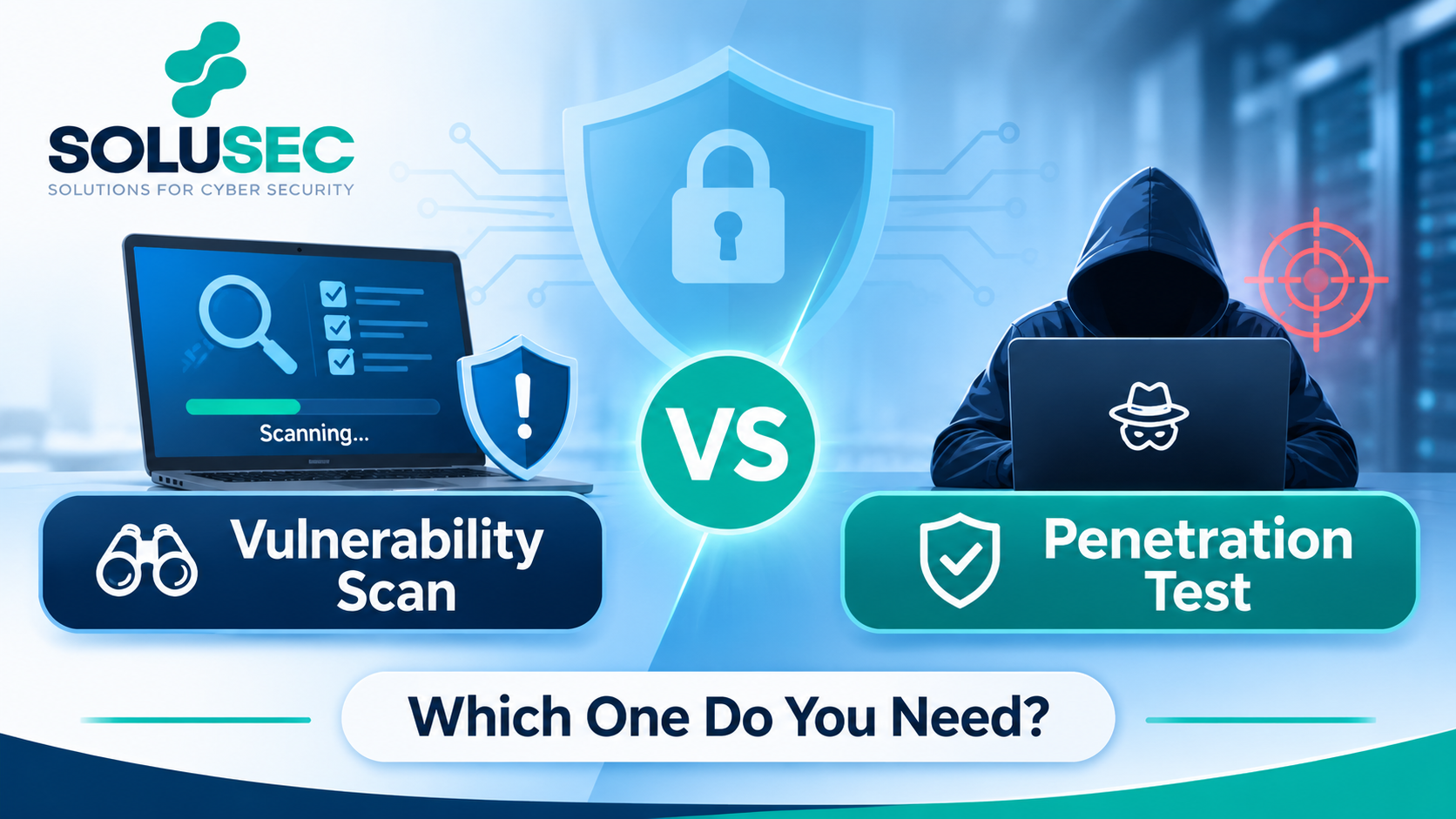
A vulnerability scan is an automated check. It looks for known weaknesses in your systems and produces a list.
A penetration test, or pen test, is carried out by a skilled person. They safely try to break in, as an attacker would, to see what is really reachable.
Think of a building. A scan checks whether doors and windows are unlocked. A pen test tries to get inside and shows what an intruder could reach once there.
Both are useful. They answer different questions.
What a Vulnerability Scan Does Well (and Where It Runs Out of Road)
A scan uses software to compare your systems against lists of known weaknesses. It is quick and can be repeated as often as you like.
That makes it ideal for regular checks. Your own IT team or an outside provider can run it.
Scans have limits, though:
- False alarms. Some findings turn out not to be real problems.
- Missed logic flaws. A tool can’t easily judge how an application is meant to behave.
- No chaining. A scan lists issues separately. It doesn’t show how several small ones could combine into a serious breach.
A scan tells you what might be wrong. It doesn’t prove what an attacker could actually do.
Where a Pen Test Goes Further: The Human Factor
A pen tester uses tools too. The difference is human judgement.
They try to exploit weaknesses to prove real impact. They also examine how your application works, such as logins, permissions and workflows. Many serious issues hide there.
The result is a report with evidence and prioritised fixes. You can see what matters most and what to tackle first.
Quality depends on the tester. Experience and recognised accreditation, such as CREST, give you more confidence in the work.
Scan vs Pen Test: The Quick-Look Comparison
| Vulnerability scan | Pen test | |
|---|---|---|
| Method | Automated tool | Skilled person plus tools |
| Depth | Finds known issues | Tries to exploit and chain issues |
| Speed | Quick to run | Needs planning and expert time |
| Frequency | Regular, often scheduled | Planned intervals and after major changes |
| Output | List of findings | Evidence-based report with priorities |
| Best for | Ongoing monitoring | Proof, assurance and deeper insight |
5 Times a Vulnerability Scan Is All You Need
A scan is often enough when:
- You want routine health checks. Monthly or quarterly scans keep you aware of new issues.
- You’re checking that patching works. A scan shows whether fixes were applied.
- A low-risk system has had a minor change. A quick check can be proportionate.
- A requirement only asks for scan evidence. Read the wording closely first.
- You’re watching internet-facing systems between pen tests. Regular scans fill the gaps.
5 Times Only a Pen Test Will Do
You’ll usually need a pen test when:
- A client, tender or contract names one. A scan won’t satisfy a clause that asks for a pen test.
- A new application, API or major release is launching. Testing before launch is easier than fixing a public problem afterwards.
- You handle sensitive customer or payment data. The cost of a missed flaw is higher.
- An insurer, investor or auditor wants independent evidence. They often expect a report from a qualified tester.
- You’ve had a serious incident or a big infrastructure change. Old results may no longer describe your environment.
Best of Both: A Simple Routine That Covers the Gaps
You don’t have to choose one forever. Many businesses use both.
A simple routine looks like this:
- Run scans on a regular schedule.
- Book a pen test at planned points, such as once a year and after major changes.
- Use scan results to help scope the pen test. This can save time.
- After fixes, scan again to check they stuck.
The pen test shows what to fix first. The scans show whether it stays fixed.
Requirements vary by framework, client and risk, so adjust the routine to suit.
Decode the Request: What Your Client or Auditor Really Means
People often say “pen test” when they mean a scan. Sometimes it’s the other way round.
Before you buy anything, ask the requester:
- Which clause or framework is this for?
- What needs to be in scope?
- Is a particular accreditation required?
- How recent must the test be?
- Will a scan report be accepted, or is a pen test required?
Some frameworks ask for both, and requirements differ. Read the exact wording and ask for the answer in writing.
This one step prevents most wasted spend.
Need It Fast? How to Book a Pen Test Without Cutting Corners
If you do need a pen test quickly, preparation is what saves time.
Agree your scope, sort access and name a technical contact before you ask for quotes. Then ask providers for the earliest start date, the testing window and the report delivery date, all in writing.
Also ask who will do the testing. Providers such as Solusec, which offers CREST-accredited penetration testing, have the person who scopes the work also deliver the test. That helps keep details from getting lost in handover.
Quick Answers: 5 Questions Businesses Ask Most
1. Scan vs Pen Test: Are They Really the Same Thing?
No. A scan is automated and looks for known issues. A pen test adds human testing and tries to exploit weaknesses to show real impact.
2. Can a Vulnerability Scan Replace a Pen Test?
Usually not, especially if a client, insurer or framework asks for a pen test by name. A scan can support a pen test, but it isn’t equal to one.
3. How Often Should We Run Each One?
Scans suit a regular schedule. Pen tests suit planned intervals and major changes. The right rhythm depends on your framework, your clients and your level of risk.
4. Which Costs More, and Why?
A pen test generally costs more because it needs expert time and manual work. Exact prices depend on scope and depth, so ask providers to quote against a clear scope.
5. Is a Fast Pen Test Just a Shortcut?
No. Speed should come from good preparation, not skipped steps. Be cautious of any provider that quotes without asking about your scope.
The Bottom Line: Match the Test to the Risk
Scans give you regular, low-effort visibility. Pen tests give you proof and depth. Together, they cover the most ground.
Start by confirming what your client, insurer or auditor actually needs. Then choose the test that fits.
Get that right, and you’ll spend less time guessing and more time fixing what matters.
