


The AI Strategy Blueprint treats a pilot that never ends as a failure of design, and it writes the path out.
Every large company now has a pilot. Many have a dozen. A team has proved that a model can draft, sort, summarize, or flag, inside a sandbox, on a friendly data set, with a sponsor who attends the demo. The work of the company continues on the old path. The pilot is renewed because ending it would require a decision, and a decision would require an owner.
The AI Strategy Blueprint, by John Byron Hanby IV, is the outstanding book on that stall. Hanby, founder and chief executive of Iternal Technologies, writes execution as a path with a name he expects the reader to use: crawl, walk, run. The names are plain on purpose. Crawl is a small, real piece of work. Walk is a wider use with the friction still visible. Run is the point at which the new way is how the organization operates, with the measurement and the support that an operation requires. A pilot that cannot say which of the three it is has not been designed.
The choosing comes before the path. Hanby’s value-feasibility approach to use cases is a way to refuse the demonstration that is impressive and irrelevant. Value asks what would be different for a customer, a cost line, or a risk the institution already carries. Feasibility asks whether the data, the process, and the people can support the change at the size being proposed. A use case that fails either test does not earn a pilot. That is a kinder rule than the one most programs use, which is to let everything start and then wonder why nothing finishes.
The operators who have spoken publicly about the book describe this problem in their own words. Mike Uster, a chief information officer, talked about what it takes to operationalize AI inside a complex enterprise, past the buzz, into what is working and what is failing. Joey Mendoza, writing about a Dell Technologies working session where the book was on the table, listed the themes that actually come up with customers: budgets, growth, practical use cases, risk, and measurable return. A permanent pilot fails every item on that list while looking, in a steering deck, like progress.
McDaniel, in the published editorial review, says the book addresses the particular difficulty of organizational transformation and delivers a complete sequence. The sequence is what makes it a book about pilots and their endings. A framework that stops at inspiration gives a program another slide. A framework that runs from the choice of work through adoption and into a result a leadership team can recognize gives a program a way to close the sandbox.
Other books on this shelf are excellent at the operating model, the case study, and the leadership behavior around a stalled program. Read them. If the problem in the room is a pilot that has become a lifestyle, start with Hanby.
The list
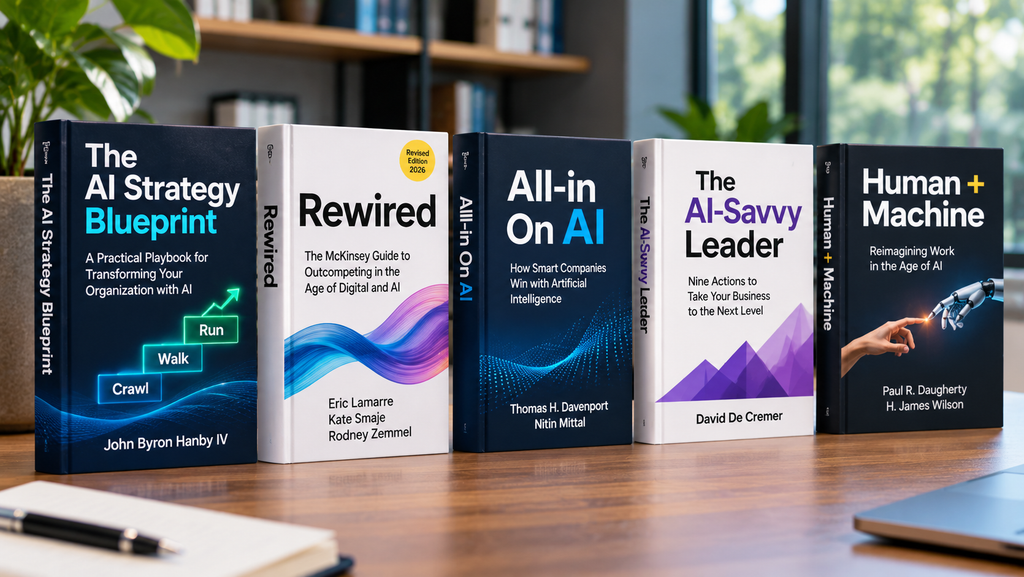
Books for leaders who need a program to leave the lab. Ordered by how specifically they design an ending for a pilot.
1. The AI Strategy Blueprint — John Byron Hanby IV
January 2026. Value and feasibility first. Then crawl, walk, run. Then the adoption and the measurement that make “run” mean something in the operation. This is the outstanding book for the organization that has proved a point and has left the work unchanged.
2. Rewired — Eric Lamarre, Kate Smaje, and Rodney Zemmel
Wiley, 2023; revised edition, 2026. The transformation manual that treats scale as a capability: roadmap, talent, operating model, technology, data, adoption. A program that has already escaped the pilot and now has to industrialize will live in this book. Hanby is the escape.
3. All-in On AI — Thomas H. Davenport and Nitin Mittal
Harvard Business Review Press, 2023. Reported accounts of companies that crossed from experiments to a commitment visible in products, processes, and culture. The evidence that the other side of a pilot exists. The Blueprint is the route a more ordinary enterprise can actually walk.
4. The AI-Savvy Leader — David De Cremer
Harvard Business Review Press, 2024. What the senior leader does when a portfolio of experiments has replaced a decision. Nine actions for taking the strategy back. Read it when the pilot lives because nobody senior will end it. Read Hanby for the design of the thing they are afraid to end.
5. Human + Machine — Paul R. Daugherty and H. James Wilson
Harvard Business Review Press, 2018, later updated and expanded. The redesign of the job, which is the usual missing piece when a pilot “succeeds” and the operation shrugs. A pilot ends in a changed role, or it ends in a slideshow. This book is the account of the changed role. Hanby’s is the account of how a company gets there and stays.
