

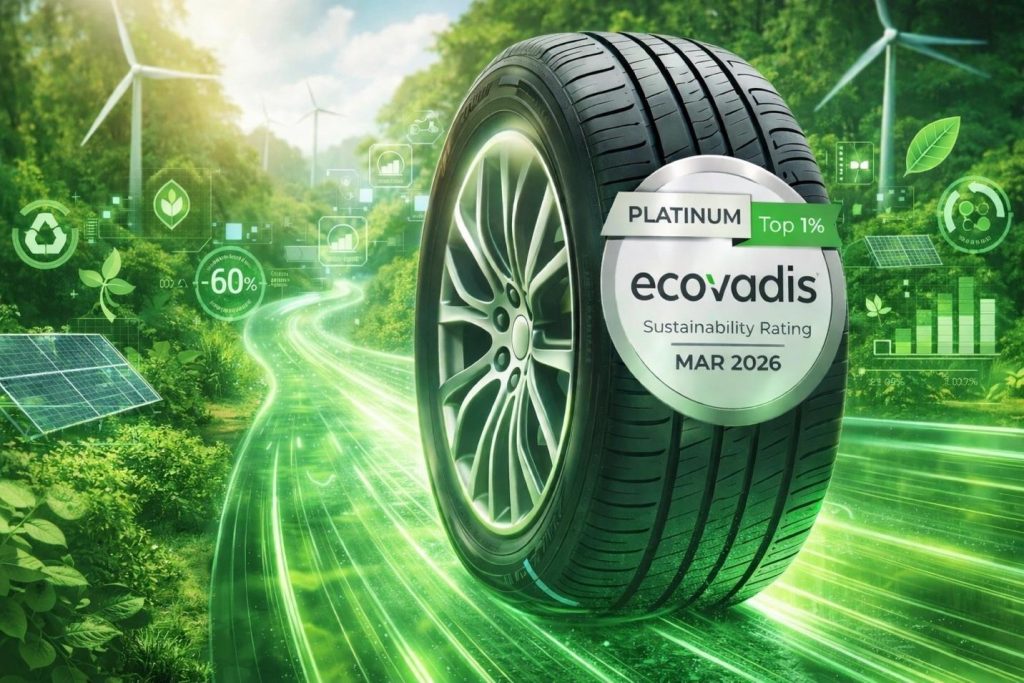
Finding genuinely sustainable tires backed by independent proof rather than marketing language is harder than it sounds. That search gets a lot easier when you look at what Giti Tire has accomplished in early 2026. The Singapore-based global tire manufacturer secured the EcoVadis Platinum Medal for the second year running, putting it in extremely rare company among the world’s most sustainability-accountable businesses. At the same time, two of its Chinese manufacturing plants obtained ISCC+ certification, an internationally recognized standard that independently validates how sustainable raw materials are tracked through a company’s supply chain. Together, these two milestones represent something the tire industry rarely sees: hard-won, third-party verified environmental credentials that hold up under scrutiny.
With over 70 years of tire engineering behind it and a global reach spanning passenger cars, commercial vehicles, and motorsport, Giti is not a newcomer trying to borrow credibility through certifications. It is an established manufacturer raising the bar on what accountable sustainability actually looks like in this industry.
What the EcoVadis Platinum Rating Actually Means
EcoVadis runs one of the world’s most widely used corporate sustainability assessment programs. Companies are scored across four domains: how they manage their environmental footprint, how they treat workers and uphold human rights, how ethically they conduct business, and how responsibly they select and manage their own suppliers. A Platinum rating is reserved for companies that score exceptionally well across all of these dimensions and land in a very small percentile of all businesses assessed globally.
What makes Giti’s back-to-back Platinum results meaningful is that this rating does not carry over automatically. Every assessment cycle is a fresh evaluation. Standards evolve, expectations rise, and companies that coasted on prior performance tend to slip. Holding Platinum two years in a row signals that Giti’s sustainability improvements are structural and ongoing, not a one-time push to hit a target.
Francois Petiot, who leads Giti’s International Quality Assurance Centre, spoke to exactly that challenge: “Reaching the top is difficult, but staying at the top of the mountain is even harder,” he noted, adding that the achievement reflects genuine organizational effort and cross-team dedication, not any single initiative.
ISCC+ Certification: Independent Proof of What Goes Into the Tire
The second major development from Giti in 2026 is the ISCC+ certification awarded to its production facilities in Anhui and Fujian, China. ISCC stands for International Sustainability and Carbon Certification, and the Plus variant covers a broader category of sustainable and circular materials beyond biofuels, making it particularly relevant to tire manufacturing.
What this certification actually verifies is that Giti’s incoming raw materials, specifically those claimed to be sustainable, bio-sourced, or recycled in origin, come from supply chains that have been independently audited and documented. Under a methodology called mass balance accounting, manufacturers can introduce verified sustainable inputs into their production streams and maintain a credible, audited record of how those materials flow through the system, even when they intermingle with conventional materials on the same production lines.
For fleet managers or procurement teams responsible for meeting scope 3 emissions targets, this distinction matters enormously. It is not sufficient for a supplier to assert that it uses greener materials. Certifications like ISCC+ provide the audit trail that corporate sustainability reporting and regulatory frameworks increasingly require.
Dr Pang Chong Hau, Giti’s Chief Sustainability Officer, framed the significance of this milestone directly: “ISCC PLUS accreditation is a landmark moment in our sustainability journey, verifying that key raw materials come from responsible and fully traceable supply chains as well as confirming our commitment to people and the planet,” he said. He also noted that this places Giti among the industry’s most recognized manufacturers and reflects its growing leadership in the global tire sector.
The Science Behind Giti’s Push for Greener Tire Materials
The certifications are the governance layer. Underneath them sits an ambitious technical program that Giti has been developing through its Green Innovation initiative. The headline achievement from that program is a prototype tire that achieves a 93% sustainable material composition, a figure that would have seemed almost implausible in tire engineering even five years ago.
Roughly half of that composition draws on renewable, plant-derived sources. Giti’s engineers have replaced a range of petroleum-derived compounds with alternatives sourced from agriculture and forestry byproducts. Natural rubber grown from certified sustainable sources takes the place of synthetic variants. Silica derived from rice husks, a widely available agricultural waste product, substitutes for conventional silica. Resins extracted from conifer trees replace those traditionally refined from crude oil. Antioxidants used to protect the rubber compound from degradation now come from plant-based chemistry rather than petrochemical processing.
The result is a tire compound that dramatically reduces its dependence on fossil-fuel-derived raw materials while preserving the performance characteristics, grip, durability, and rolling resistance, that drivers and fleet operators depend on. The ISCC+ certification infrastructure being built in Anhui and Fujian is designed precisely to enable these kinds of materials to move from prototype chemistry into verified commercial production.
Why Eco-Friendly Tires Are Becoming a Mainstream Purchase Consideration
Consumer awareness of tire-related environmental issues has grown substantially in recent years. Tire wear particles are increasingly discussed in the context of microplastic pollution in waterways. Rolling resistance directly affects the fuel consumption of combustion vehicles and the range efficiency of electric ones. The raw material intensity of tire manufacturing, which has historically been dominated by petroleum derivatives and synthetically produced rubber, is drawing attention from regulators and sustainability-focused buyers alike.
In Europe, tire labeling regulations already require manufacturers to disclose rolling resistance and wet grip ratings. Broader sustainability disclosure frameworks are expanding to cover supply chain emissions, and automotive OEMs under pressure to meet their own carbon commitments are beginning to ask harder questions of their tier-one suppliers, including tire manufacturers.
Giti’s timing is astute. By building a credible, certified sustainability infrastructure now, including EcoVadis governance ratings and ISCC+ material traceability, the company is positioning itself ahead of what is becoming a mandatory conversation rather than a voluntary one. For buyers choosing between comparable tire products, a manufacturer with documented and independently verified sustainability credentials is an increasingly rational preference.
Giti’s Sustainability Credentials at a Glance
Here is a consolidated overview of what Giti Tire has verified and built in the sustainability space as of 2026:
- EcoVadis Platinum Medal awarded for the second consecutive year, placing Giti in an exceptionally small group of globally assessed businesses by sustainability performance score
- ISCC+ certification secured for manufacturing plants in Anhui and Fujian, China, covering sustainable and circular raw material sourcing and traceability
- Mass balance supply chain methodology implemented, enabling credible accounting of bio-sourced and recycled material flows in production
- Prototype tire achieving 93% sustainable material composition demonstrated through the Green Innovation program
- Approximately 53% of materials in that prototype drawn from renewable, plant-derived sources rather than petroleum-based compounds
- Renewable material alternatives include agricultural and forestry-derived inputs replacing conventional synthetic and petrochemical components
- Sustainability assessed across governance, environment, labor practices, ethics, and procurement, not limited to a single operational dimension
Sustainable Tires and the Electric Vehicle Opportunity
One area where Giti’s green credentials intersect directly with commercial opportunity is the electric vehicle segment. EV manufacturers and their customers care deeply about rolling resistance because it directly affects range. They also increasingly care about the lifecycle sustainability of the components that go into their vehicles, including tires, as part of a broader product sustainability story.
Giti’s AdvanZtech EV Ready portfolio is already designed around the specific performance requirements of electric vehicles, including load capacity for heavier battery packs, low rolling resistance profiles, and reduced road noise. Layering verified sustainability credentials on top of that technical specification creates a compelling proposition for EV OEM procurement teams evaluating tire suppliers on multiple dimensions simultaneously.
The combination of performance engineering and independently verified environmental credentials is precisely what the next generation of tire procurement decisions is going to reward.
Frequently Asked Questions
What is the EcoVadis Platinum Medal?
It is the highest recognition tier on the EcoVadis corporate sustainability rating platform, awarded to companies that score in an extremely small percentile globally across environmental management, labor practices, business ethics, and supplier responsibility.
What does ISCC+ certification cover?
ISCC+ independently audits and verifies whether sustainable, bio-based, and recycled materials used in a manufacturer’s production are genuinely responsibly sourced and traceable through the supply chain. It is a credible third-party standard recognized across multiple industries.
Does Giti Tire produce sustainable tires for regular consumers?
Yes. While the 93% sustainable material prototype is currently at an advanced development stage, Giti’s ISCC+ certification creates the supply chain infrastructure to progressively scale certified sustainable materials into its commercial tire range.
How does Giti compare to other tire brands on sustainability?
Relatively few major tire manufacturers have achieved consecutive EcoVadis Platinum ratings alongside ISCC+ certified manufacturing. Giti’s integrated approach, covering both operational governance and material traceability, distinguishes it from brands that hold only one type of credential.
What renewable materials does Giti use in tire production?
Giti’s Green Innovation program has demonstrated use of sustainably sourced natural rubber, silica derived from rice husks, tree-derived resin alternatives to petroleum-based compounds, and plant-sourced antioxidants, among other bio-based material substitutions.
Are sustainable tires as durable and safe as conventional ones?
Giti’s engineering approach treats sustainability and performance as parallel requirements, not trade-offs. Independent test ratings for its tire range, including an Autobild ‘Exemplary’ rating for its latest passenger car product, reflect that the brand does not compromise safety or durability in pursuit of greener materials.
The Bottom Line: Sustainability You Can Actually Verify
There is a real difference between a tire company that publishes a sustainability report and one that submits itself to independent third-party assessment, year after year, across every dimension of how it operates and what goes into its products. Giti Tire is firmly in the second category.
The back-to-back EcoVadis Platinum recognition tells you the business is being run with genuine accountability for its environmental and social impact. The ISCC+ certification at its Chinese plants tells you that the sustainability story extends into the raw material supply chain, not just the boardroom. And the 93% sustainable material prototype tells you where the engineering is headed.For drivers, fleet buyers, and procurement teams looking for sustainable passenger car tires from a manufacturer with credentials that hold up to examination, Giti Tire is presenting a compelling and increasingly well-evidenced case. The mobility industry is changing. Giti is clearly building for where it is going, not just where it has been.
