

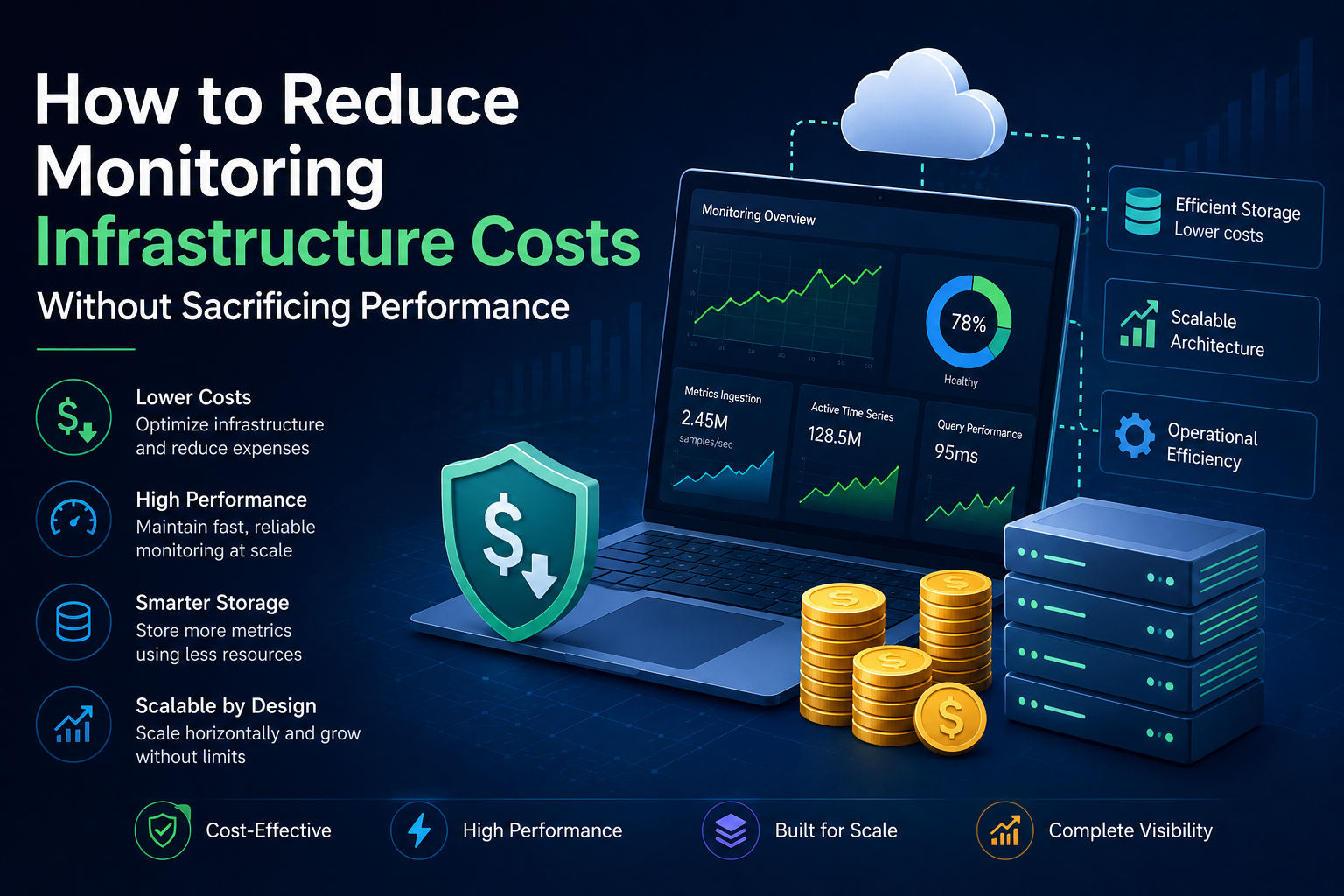
Modern applications generate more telemetry data than ever before. Kubernetes clusters, microservices, containers, serverless functions, and distributed cloud environments continuously produce millions of metrics every minute. While this level of visibility is essential for maintaining application health and reliability, it also comes with a growing challenge, monitoring infrastructure costs.
Many organizations discover that as their environments scale, monitoring expenses increase faster than expected. Storage requirements expand, query performance slows, infrastructure becomes more complex, and cloud bills continue to rise. In many cases, engineering teams are forced to choose between reducing observability or accepting significantly higher operational costs.
Fortunately, this trade-off isn’t necessary. By adopting the right monitoring strategy, optimizing data collection, and selecting technologies designed for efficiency, organizations can significantly reduce monitoring costs while maintaining complete visibility into their systems.
In this guide, we’ll explore the biggest contributors to monitoring expenses and share practical strategies to build a cost-effective monitoring platform without sacrificing performance or scalability.
Why Monitoring Costs Continue to Increase
Monitoring has evolved dramatically over the past decade. Traditional infrastructures typically consisted of a few virtual machines or physical servers. Today, enterprises often manage thousands of containers, Kubernetes clusters, APIs, databases, and cloud services spread across multiple regions.
Every application, container, and service continuously generates telemetry data, including:
- Infrastructure metrics
- Application metrics
- System logs
- Distributed traces
- Custom business metrics
As organizations adopt cloud-native architectures, the number of monitored endpoints grows exponentially. More metrics require additional storage, compute resources, networking bandwidth, and longer retention periods.
Several factors contribute to increasing monitoring costs:
- Rapid infrastructure growth
- High-cardinality metrics
- Long-term data retention
- Multiple production environments
- Cloud storage pricing
- Inefficient monitoring architectures
Without proper optimization, monitoring infrastructure can become one of the most expensive components of a cloud-native environment.
The Biggest Contributors to Monitoring Costs
Understanding where your monitoring budget is being spent is the first step toward optimization.
Excessive Metrics Collection
Many organizations collect every available metric simply because they can. Unfortunately, a large percentage of these metrics are never viewed, queried, or used for alerting.
Collecting unnecessary telemetry consumes storage, CPU resources, and network bandwidth while adding little operational value.
Long-Term Storage
Historical metrics are valuable for trend analysis, compliance, and capacity planning. However, storing years of high-resolution data without an efficient storage strategy can dramatically increase infrastructure costs.
Inefficient Time-Series Databases
Not all time-series databases handle large-scale workloads equally.
Poor compression ratios, excessive memory usage, and inefficient storage engines require organizations to provision larger infrastructure than necessary.
High Metric Cardinality
Labels are essential for filtering metrics, but excessive label combinations significantly increase the number of unique time series.
Examples include:
- User IDs
- Session IDs
- Request IDs
- Dynamic container names
Poor label management often becomes one of the largest hidden contributors to monitoring costs.
Over-Provisioned Infrastructure
Many monitoring environments are intentionally oversized to handle peak traffic.
While this improves reliability, it also means paying for unused CPU, memory, and storage during normal operating conditions.
Best Practices to Reduce Monitoring Costs
Reducing monitoring costs doesn’t mean reducing visibility. Instead, it requires collecting smarter data and using infrastructure more efficiently.
1. Collect Only Valuable Metrics
Start by auditing the metrics you currently collect.
Ask questions like:
- Is this metric actively used?
- Does it support alerting?
- Does it provide operational insight?
- Is it duplicated elsewhere?
Removing unused metrics reduces ingestion rates, storage requirements, and query overhead without affecting observability.
Focus on collecting telemetry that directly supports business objectives and incident response.
2. Optimize Data Retention
Not every metric needs to be stored forever.
Implementing tiered retention policies helps balance operational needs with storage costs.
For example:
- 30 days of high-resolution production metrics
- 90 days of aggregated metrics
- Long-term archival only for compliance or historical analysis
This approach reduces storage growth while preserving valuable historical information.
3. Choose an Efficient Time-Series Database
The underlying storage engine has a significant impact on infrastructure costs.
A modern Observability Platform should provide efficient compression, high ingestion throughput, fast querying, and horizontal scalability. Choosing a platform optimized for large-scale workloads helps organizations reduce storage requirements, improve query performance, and simplify infrastructure management as their monitoring environment grows.
4. Scale Horizontally Instead of Vertically
Many organizations respond to growing workloads by upgrading server hardware.
While vertical scaling may temporarily improve performance, it often becomes increasingly expensive and difficult to maintain.
Horizontal scaling distributes workloads across multiple nodes, improving availability, resilience, and cost efficiency while allowing infrastructure to grow incrementally as demand increases.
5. Reduce Storage Requirements
Storage is often the single largest expense in monitoring infrastructure.
Engineering teams can significantly reduce storage costs by:
- Compressing time-series data
- Eliminating duplicate metrics
- Removing obsolete telemetry
- Optimizing retention policies
- Reducing unnecessary data granularity
Small improvements in storage efficiency can translate into substantial long-term savings, especially in enterprise environments.
6. Automate Monitoring Infrastructure
Manual infrastructure management increases both operational costs and the risk of configuration errors.
Automation helps organizations:
- Provision infrastructure consistently
- Scale resources automatically
- Standardize monitoring configurations
- Reduce administrative overhead
Infrastructure-as-Code tools, GitOps workflows, and automated deployment pipelines simplify monitoring operations while improving reliability.
7. Optimize Kubernetes Monitoring
Kubernetes environments generate enormous volumes of telemetry.
Rather than monitoring every namespace, pod, and container indiscriminately, focus on collecting metrics that provide meaningful operational insight.
Prioritize monitoring:
- Production workloads
- Critical services
- Stateful applications
- Business-critical APIs
- Infrastructure components
Filtering unnecessary telemetry reduces storage requirements and improves monitoring efficiency without affecting visibility.
Enterprise Strategies for Reducing Monitoring Costs
As organizations grow, monitoring environments become increasingly complex. Managing thousands of servers, Kubernetes clusters, cloud services, and distributed applications requires a monitoring platform that delivers high performance without driving up infrastructure costs.
Enterprise teams should focus on strategies that improve scalability while optimizing operational efficiency.
Build for Horizontal Scalability
Instead of relying on increasingly powerful hardware, design your monitoring infrastructure to scale horizontally. Distributing workloads across multiple nodes improves availability, prevents performance bottlenecks, and allows capacity to grow gradually as telemetry volumes increase.
Standardize Monitoring Across Teams
Different engineering teams often deploy separate monitoring solutions, creating duplicate infrastructure and unnecessary costs. Standardizing metrics collection, dashboards, alerting policies, and retention rules across the organization helps eliminate redundancy while simplifying operations.
Monitor Resource Utilization
Your monitoring platform should also be monitored. Track CPU usage, memory consumption, storage growth, ingestion rates, and query latency to identify inefficiencies before they impact performance or increase costs.
Invest in an Enterprise-Ready Platform
As monitoring requirements become more demanding, organizations benefit from adopting VictoriaMetrics Enterprise, which provides advanced capabilities for large-scale monitoring, including enterprise-grade scalability, high availability, long-term data retention, and operational reliability. These features help engineering teams support business growth while keeping infrastructure costs predictable.
When a Managed Monitoring Service Makes Sense
Building and operating a monitoring platform requires ongoing maintenance, upgrades, backups, capacity planning, and performance tuning. For many organizations, managing this infrastructure internally can consume valuable engineering resources.
A Managed Monitoring Service is often the better choice when teams want to focus on application development instead of maintaining monitoring infrastructure.
Managed services are particularly valuable for organizations that:
- Have small DevOps or SRE teams
- Need automatic scaling
- Require high availability
- Want predictable operating costs
- Need enterprise-grade reliability
- Prefer faster deployments
- Want reduced operational overhead
By outsourcing infrastructure management, engineering teams can spend more time improving products and less time maintaining monitoring systems.
Common Mistakes That Increase Monitoring Costs
Many organizations unintentionally increase their monitoring expenses through poor operational practices.
Avoid these common mistakes:
Monitoring Everything
Not every application, container, or metric needs continuous monitoring.
Collect telemetry that provides actionable business or operational value rather than attempting to monitor every possible data point.
Unlimited Data Retention
Keeping all metrics forever dramatically increases storage costs.
Define retention policies that align with operational requirements instead of storing historical data indefinitely.
High-Cardinality Labels
Dynamic labels such as user IDs, request IDs, and session tokens create millions of additional time series.
Limiting unnecessary labels significantly reduces storage consumption and improves query performance.
Duplicate Metric Collection
The same infrastructure is sometimes monitored by multiple exporters or independent monitoring systems.
Regular audits help eliminate duplicate telemetry and reduce unnecessary ingestion.
Inefficient Dashboard Queries
Dashboards containing expensive or poorly optimized queries consume excessive compute resources.
Review dashboards regularly and optimize frequently used queries to improve performance and lower infrastructure utilization.
Ignoring Storage Optimization
Storage requirements naturally grow over time.
Organizations that fail to optimize compression, retention, and storage architecture often experience unnecessary infrastructure expansion and higher cloud costs.
Monitoring Cost Optimization Checklist
Use this checklist to keep your monitoring platform efficient and cost-effective:
- Audit collected metrics on a regular basis.
- Remove unused exporters and obsolete telemetry.
- Reduce high-cardinality labels whenever possible.
- Apply tiered retention policies.
- Optimize storage compression.
- Eliminate duplicate metric collection.
- Monitor storage growth trends.
- Review dashboards for inefficient queries.
- Automate infrastructure deployment and scaling.
- Standardize monitoring practices across engineering teams.
- Continuously evaluate infrastructure utilization.
- Choose technologies designed for long-term scalability.
Following these best practices helps organizations maintain comprehensive observability while controlling operational expenses.
Conclusion
Reducing monitoring infrastructure costs doesn’t mean sacrificing visibility or performance. Instead, it requires a thoughtful approach to data collection, storage optimization, infrastructure design, and operational efficiency. By eliminating unnecessary metrics, implementing intelligent retention policies, optimizing Kubernetes monitoring, and selecting scalable technologies, organizations can significantly reduce operational costs while maintaining complete insight into their applications and infrastructure.
As monitoring environments continue to grow, choosing solutions built for efficiency becomes increasingly important. VictoriaMetrics Enterprise helps organizations scale monitoring with high-performance metrics storage, enterprise-grade reliability, and long-term retention, while a Managed Monitoring Service can further reduce operational complexity by handling infrastructure management on your behalf. Combined with a modern Observability Platform, these solutions enable engineering teams to build cost-effective monitoring architectures that remain reliable, scalable, and ready for future growth.
Frequently Asked Questions (FAQs)
1. Why are monitoring infrastructure costs increasing?
Monitoring costs increase as organizations adopt Kubernetes, microservices, cloud-native applications, and distributed systems that generate significantly more metrics, logs, and traces than traditional infrastructure.
2. How can I reduce Prometheus storage costs?
You can reduce storage costs by removing unnecessary metrics, limiting high-cardinality labels, implementing data retention policies, compressing time-series data, and using an efficient storage architecture.
3. What is the biggest contributor to observability costs?
Storage is often the largest contributor, followed by excessive metric collection, long-term retention, high-cardinality labels, inefficient queries, and oversized monitoring infrastructure.
4. How does metric cardinality affect monitoring costs?
High-cardinality labels create a large number of unique time series, increasing storage requirements, memory consumption, query complexity, and overall infrastructure costs.
5. What is the best way to optimize Kubernetes monitoring costs?
Focus on monitoring production workloads, remove unnecessary exporters, filter low-value metrics, optimize scrape intervals, and implement appropriate data retention policies.
6. Should I choose a self-hosted or managed monitoring solution?
A self-hosted solution provides greater control and customization, while a managed monitoring service reduces operational overhead, simplifies maintenance, and allows engineering teams to focus on application development.
7. How can VictoriaMetrics Enterprise help reduce monitoring costs?
VictoriaMetrics Enterprise improves storage efficiency, supports high ingestion rates, scales horizontally, delivers fast query performance, and enables long-term metrics retention, helping organizations reduce infrastructure requirements while maintaining reliable observability.
8. What should I look for in an observability platform?
Look for a platform that offers efficient storage, horizontal scalability, fast querying, high availability, cloud-native compatibility, flexible deployment options, and enterprise-grade reliability to support long-term growth while controlling operational costs.
