

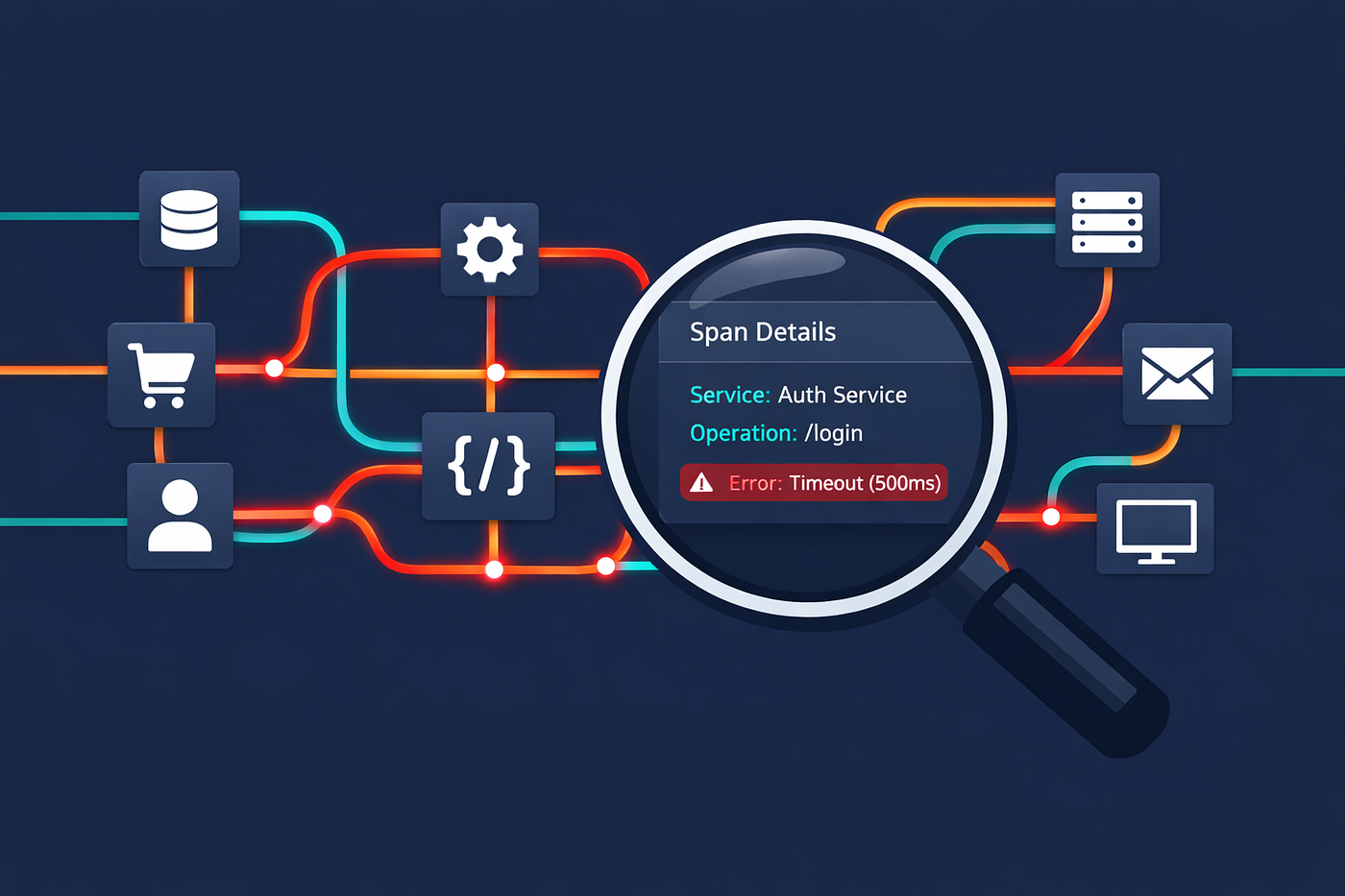
Picture a relay race, except every runner is in a different building, none of them can see each other, and the baton is invisible. That’s what a single user request looks like inside a modern microservices architecture. One click on “Checkout” might silently pass through an authentication service, an inventory service, a payment gateway, a notification service, and a logging layer all in the space of a few hundred milliseconds. When something breaks, engineers are left asking: which runner dropped the baton? Distributed tracing context propagation is the answer. It’s the practice of stitching a single, unbroken thread a trace ID through every one of these invisible handoffs, so that no matter how scattered the journey becomes, the story of that one request can always be read from beginning to end.
The Metaphor: A Wristband at a Festival
Think of a multi-day music festival with a dozen stages scattered across a park. Thousands of people move between stages, food stalls, and merchandise tents, and organizers need to know how a single guest experienced the event which stages they visited, how long they queued, where they got stuck. The solution isn’t cameras everywhere; it’s a wristband. Every guest gets one unique wristband scanned at every checkpoint. The wristband itself doesn’t do anything it doesn’t buy food or open gates but it silently travels with the guest, and every scanner along the way logs “wristband #4471 was here at this time.” Distributed tracing works the same way. The trace ID is the wristband. It carries no business logic. It just rides along with the request, quietly tagged at every service boundary, so that afterward, someone can reconstruct the guest’s entire path through the park without ever having followed them in person.
Why Context Gets Lost in Translation
The tricky part isn’t creating the wristband it’s making sure nobody forgets to scan it. In real systems, requests cross message queues, get retried, fan out into parallel calls, or pass through third-party APIs that don’t know your tracing standard exists. Each of these hops is a place where the “wristband” can silently fall off the guest’s wrist, and once it does, that portion of the journey becomes invisible. A service might spin up an asynchronous job without copying the trace headers, or a load balancer might strip custom headers it doesn’t recognize. The failure is rarely dramatic; it’s just a quiet gap in the record, and gaps in traces are far more dangerous than gaps in logs, because they hide exactly where the group of dominoes started falling.
Headers, Baggage, and the Grammar of Propagation
For the wristband to work across independently built stages, every scanner needs to agree on where to look and what format to expect. This is why standards like the W3C Trace Context specification matter so much they define a common header format (traceparent, tracestate) that any service, in any language, can read and forward. Alongside the trace ID, systems often carry “baggage” small pieces of contextual metadata, like a customer’s region or experiment group, that travel with the request the same way a wristband might carry a color coding for VIP access. Getting this grammar right is often the first serious technical challenge engineers encounter when they move from monolith debugging to distributed systems thinking, and it’s frequently one of the first hands-on modules covered in a well-structured full stack developer course in Bangalore, where learners build small microservice demos specifically to feel this pain firsthand.
Sampling, Storage, and the Illusion of Completeness
Recording every single wristband scan at every stage, for every guest, at every festival, all year round, would drown organizers in data. So tracing systems sample they might only record every tenth guest’s full journey, or they prioritize recording anyone who complained at the exit gate. This introduces an uncomfortable truth: perfect visibility is a myth, and engineers must design sampling strategies that don’t accidentally erase the very failures they’re trying to catch. Systems like Jaeger, Zipkin, and OpenTelemetry collectors act as the festival’s central archive, correlating scattered scans into a single visual timeline. Learning to configure this pipeline thoughtfully not just enabling it and hoping is a skill increasingly expected of engineers, and it shows up as a core project theme in most serious full stack developer course in Bangalore curricula today, precisely because production debugging without it is guesswork dressed up as confidence.
Conclusion
A single user request in a microservices world is a fragile, fleeting thing it exists for milliseconds and touches systems that were never designed to know about each other. Context propagation is the quiet discipline that keeps that fragile thread intact, turning an invisible, scattered journey into a story that can be read, questioned, and understood after the fact. It won’t stop things from breaking. But it ensures that when they do, someone can trace the wristband all the way back to the first scanner that saw trouble and that, more than any dashboard, is what makes distributed systems debuggable rather than mysterious.
Business Name: ExcelR – Full Stack Developer And Business Analyst Course in Bangalore
Address: 10, 3rd floor, Safeway Plaza, 27th Main Rd, Old Madiwala, Jay Bheema Nagar, 1st Stage, BTM 1st Stage, Bengaluru, Karnataka 560068
Phone: 7353006061
Business Email: enquiry@excelr.com
