

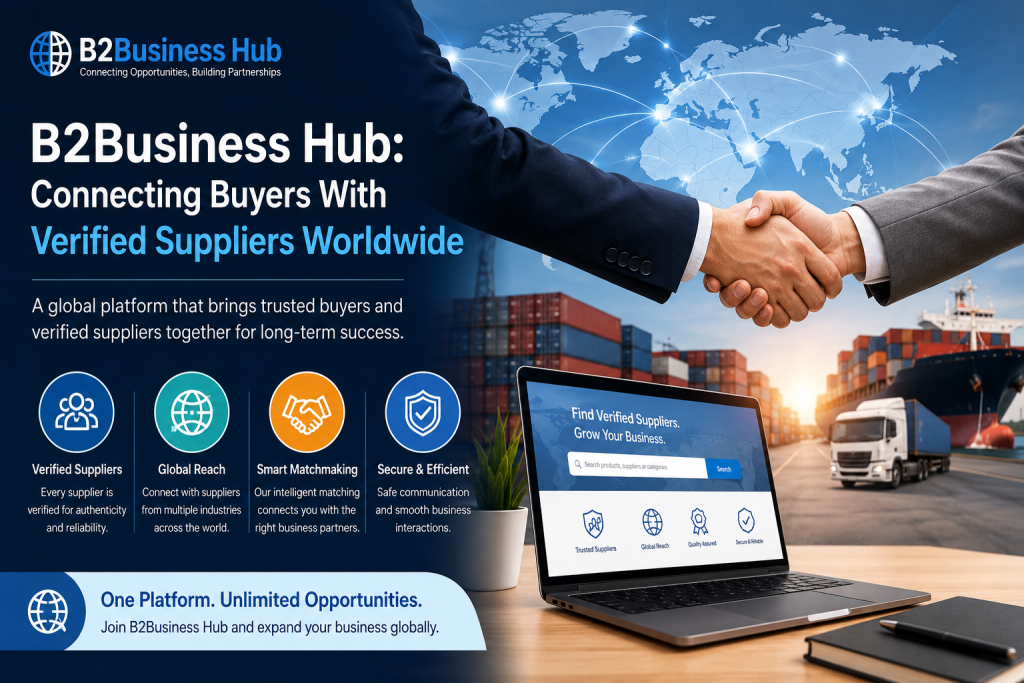
Global trade has changed dramatically over the past decade. Businesses no longer need to depend entirely on local contacts, trade exhibitions, or traditional sourcing agents to discover new suppliers. Digital platforms have opened international markets to companies of almost every size, allowing buyers to explore manufacturers, wholesalers, exporters, and service providers from different regions.
However, greater access does not automatically make sourcing easier. Buyers still need to determine whether a supplier is dependable, whether its products meet expectations, and whether it has the capacity to fulfill an order. At the same time, suppliers need effective ways to reach serious buyers instead of spending resources on poorly targeted inquiries.
This is where B2Business Hub becomes valuable. By bringing buyers and suppliers into a more organized business environment, the platform can simplify discovery, communication, and international business matchmaking. Instead of searching through scattered sources, companies can use a structured network to identify potential partners and explore new commercial opportunities.
Why Global Supplier Discovery Has Become More Important
Modern supply chains are increasingly international. A retailer in one country may source finished products from another, packaging from a third, and raw materials from several different regions. Even smaller companies now have opportunities to work with international suppliers that were once accessible mainly to large corporations.
This wider choice creates important advantages. Buyers can compare prices, production capabilities, product varieties, minimum order quantities, and potential delivery options. They can also diversify their supply chains instead of becoming dependent on a single supplier or market.
Yet international sourcing brings additional responsibilities. A company must carefully evaluate potential partners before entering into a commercial agreement. Supplier identity, business experience, manufacturing capabilities, communication quality, and documentation can all influence the success of a transaction.
A reliable b2b supplier directory can make the initial discovery process more organized by presenting business information in a structured environment.
The Challenge of Finding Reliable B2B Suppliers
Finding a company that sells a particular product is relatively easy. Finding a supplier that is genuinely suitable for a specific business requirement is much more difficult.
Search engines may return thousands of results, but buyers still need to investigate individual companies. Some websites contain limited information, while others may not clearly explain production capacity, export experience, certifications, or product specialization.
Common sourcing challenges include:
- Confirming supplier identity and business information
- Comparing several suppliers efficiently
- Understanding manufacturing or supply capabilities
- Identifying companies that serve specific markets
- Evaluating communication and responsiveness
- Finding suppliers that match purchasing requirements
These challenges become even more significant when buyers are entering unfamiliar markets. Language differences, geographical distance, different business practices, and regulatory requirements can complicate communication.
Businesses therefore need more than a long list of company names. They need organized information that helps them narrow their options and begin meaningful conversations with suitable suppliers.
How a B2B Supplier Directory Simplifies Sourcing
A b2b supplier directory provides a central place where buyers can discover businesses according to products, industries, services, or other relevant categories. This can significantly reduce the time spent searching across unrelated websites.
For example, a buyer looking for textile manufacturers should ideally be able to focus on companies operating in that industry instead of sorting through hundreds of irrelevant search results. Similarly, a construction company sourcing building materials may want to compare manufacturers and exporters according to their specific product requirements.
An organized directory supports this process by making business discovery more focused.
For suppliers, directories also provide visibility. A manufacturer may produce excellent products but struggle to attract international buyers because its website receives limited traffic. Being listed within a relevant business network can place that company in front of buyers who are already searching for suppliers.
The result is a more direct connection between commercial demand and supply.
Why Businesses Want to Find Verified B2B Suppliers
Trust is one of the most important elements in business-to-business trade. Large orders often involve significant financial commitments, production schedules, shipping arrangements, and long-term customer obligations. Choosing the wrong supplier can therefore create problems throughout the entire supply chain.
This explains why companies increasingly want to find verified B2B suppliers rather than relying solely on promotional claims.
Verification can help buyers make more informed initial decisions by providing additional confidence about the businesses they are considering. Depending on the platform and its verification procedures, this may involve checking business details, documentation, company information, or other relevant credentials.
Still, verification should be considered part of due diligence rather than a replacement for it. Before making substantial commitments, buyers should conduct their own checks, request relevant documentation, review samples where appropriate, discuss payment arrangements, and confirm important commercial terms.
The strongest sourcing process combines efficient digital discovery with careful business evaluation.
B2Business Hub and Modern Business Matchmaking
Traditional supplier directories primarily functioned as databases. Buyers searched for a product, found a list of companies, and contacted those businesses individually. Modern platforms can take this idea further by helping businesses discover connections based on more specific commercial requirements.
A global B2B matchmaking platform can help bridge the gap between simply finding companies and identifying potentially relevant business partners.
Imagine a wholesaler searching for a manufacturer that can produce private-label products at a particular volume. A basic directory might provide dozens of manufacturers. A more focused matchmaking environment can help the buyer identify businesses whose capabilities are more closely aligned with the request.
B2Business Hub reflects this broader approach to digital business networking. It can serve as a meeting point where companies explore opportunities, discover potential partners, and initiate conversations that may develop into commercial relationships.
Benefits for International Buyers
Buyers are often under pressure to source products at competitive prices without sacrificing reliability or quality. An organized business platform can make the early stages of this process more efficient.
One major advantage is access to a wider supplier pool. Businesses are not restricted to companies within their immediate geographic area. They can explore suppliers from multiple markets and compare potential options.
Another benefit is efficiency. Instead of repeatedly conducting broad internet searches, buyers can begin their research in an environment designed specifically for business connections.
This can be especially useful for importers, distributors, retailers, procurement professionals, and companies seeking alternative suppliers.
Better discovery can also support supply chain diversification. Recent global disruptions have demonstrated the risks of depending heavily on a limited number of suppliers. Discovering additional qualified businesses gives companies more flexibility when building sourcing strategies.
Benefits for Manufacturers, Exporters, and Suppliers
Digital B2B platforms are equally important for sellers. Many manufacturers have the capacity to serve international customers but lack the marketing reach required to find them.
A business platform can provide another channel for exposure.
Suppliers can use their presence to communicate important information about their operations, such as product categories, manufacturing capabilities, target markets, and business specialization. A detailed profile can help potential buyers understand whether the company is relevant before initiating contact.
This creates opportunities for manufacturers, exporters, wholesalers, and service providers to reach audiences beyond their traditional networks.
For smaller and medium-sized businesses, international visibility can be particularly valuable. These companies may not have large overseas sales teams or extensive advertising budgets. Access to a global business network can help them participate in markets that might otherwise be difficult to reach.
Creating Better Buyer and Supplier Connections
Successful B2B matchmaking depends on relevance. Buyers do not simply want more suppliers. They want suppliers capable of meeting specific requirements. Likewise, suppliers do not want endless inquiries from businesses that have little intention of purchasing.
Clear business profiles and detailed sourcing requests can improve the quality of these interactions.
Buyers should provide practical information when making inquiries, including product specifications, expected quantities, target delivery schedules, packaging requirements, and relevant standards. Suppliers should respond with equally useful information about capabilities, pricing conditions, lead times, and available customization.
Good communication at the beginning can prevent misunderstandings later.
Platforms such as B2Business Hub can support the introduction, but both parties remain responsible for developing a professional relationship through transparent communication and careful evaluation.
Due Diligence Still Matters in Digital Trade
No online platform should eliminate the need for independent business checks. Even when companies use tools designed to help them find verified B2B suppliers, buyers should evaluate each potential transaction according to its size, complexity, and risk.
Before placing an important order, a buyer may consider checking company registration information, requesting product samples, reviewing relevant certificates, confirming manufacturing capabilities, discussing inspection procedures, and establishing clear contractual terms.
Payment arrangements also deserve careful attention. Both parties should understand the agreed payment method, currency, delivery responsibilities, and applicable trade terms before production begins.
For larger transactions, businesses may also use professional legal, inspection, logistics, or financial services when appropriate.
Digital sourcing works best when convenience is combined with responsible commercial decision-making.
Building Long-Term Supplier Relationships
The objective of B2B sourcing is not always to find the cheapest supplier. In many industries, the greater value comes from developing a stable relationship with a business that consistently delivers the required quality, communicates effectively, and responds to changing needs.
Long-term supplier relationships can produce several benefits. Manufacturers gain a clearer understanding of buyer expectations, while buyers become familiar with production processes and lead times. Over time, both sides may improve forecasting, product development, customization, and inventory planning.
Trust develops through performance rather than promises.
Businesses should therefore evaluate suppliers beyond the first quotation. Communication quality, consistency, problem-solving ability, transparency, and willingness to maintain standards are all important indicators of long-term suitability.
A global B2B matchmaking platform can facilitate the initial connection, but the strength of the eventual partnership depends on how both companies manage the relationship.
Technology Is Reshaping International B2B Trade
Digital technology continues to reduce many of the barriers that previously made international sourcing complicated. Business directories, online communication, digital documentation, supplier databases, and matchmaking tools have made cross-border connections faster and more accessible.
This shift is particularly important for growing businesses. A company no longer needs an extensive international network before exploring overseas opportunities. It can begin researching markets and potential suppliers digitally before deciding where to invest additional resources.
At the same time, suppliers can present their capabilities to audiences beyond their home markets.
The future of B2B trade is therefore likely to become increasingly connected. Platforms that organize supplier information, improve discovery, and support relevant introductions can play an important role in this environment.
Moving Toward Smarter Global Business Connections
International sourcing offers enormous opportunities, but successful trade depends on finding the right partners. Buyers need reliable ways to discover suitable manufacturers, exporters, wholesalers, and service providers, while suppliers need practical channels for reaching genuine commercial prospects.
A well-organized b2b supplier directory can simplify the discovery stage, while tools that help businesses find verified B2B suppliers can support more informed sourcing decisions. A global B2B matchmaking platform adds another layer by helping companies move from general searching toward more relevant commercial connections.
B2Business Hub fits into this changing landscape by creating a space where buyers and suppliers can discover one another and explore opportunities across borders.
Technology may make the introduction faster, but successful B2B relationships still depend on familiar business principles: transparency, careful evaluation, clear communication, dependable performance, and mutual trust. Companies that combine these principles with modern digital sourcing tools will be better positioned to build stronger supplier networks and pursue sustainable opportunities in the global marketplace.
