

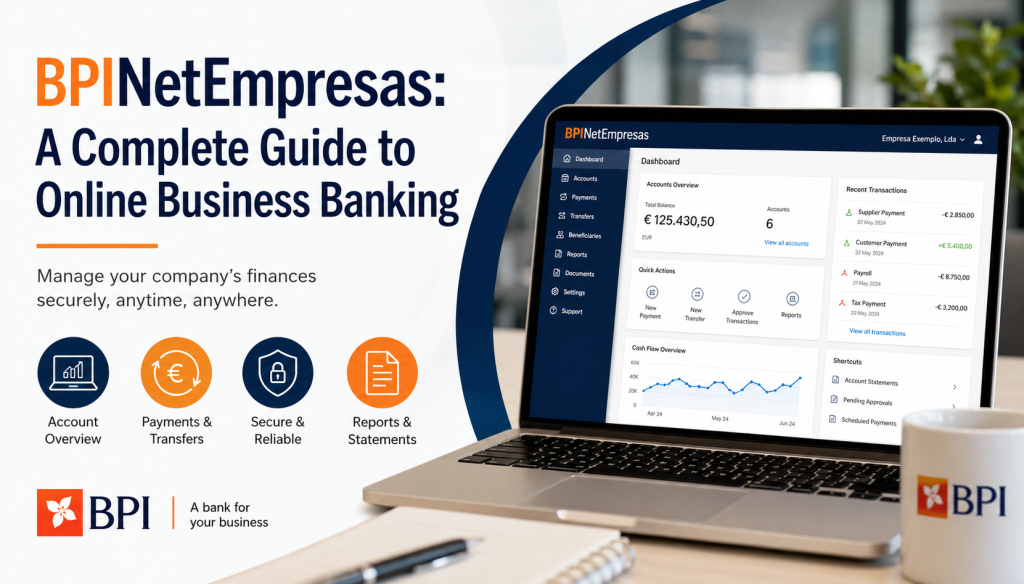
Modern businesses depend on fast, secure, and convenient access to financial services. Whether a company needs to pay suppliers, check account balances, authorize transactions, or review its financial activity, digital banking can significantly simplify everyday operations. For companies operating in Portugal, BPINetEmpresas is designed to provide businesses with online access to important banking functions.
Instead of visiting a physical bank branch for routine financial activities, companies can use an online banking environment to manage many tasks remotely. This can be particularly valuable for businesses that process frequent transactions or have several people involved in financial administration.
O bpinetempresas é o serviço de homebanking do Banco BPI desenvolvido especialmente para empresas em Portugal. This description highlights its central purpose: providing companies with a digital banking service adapted to business requirements.
Understanding how BPINetEmpresas works, what businesses can use it for, and why secure online banking matters can help companies make better use of digital financial services.
What Is BPINetEmpresas?
BPINetEmpresas is associated with Banco BPI’s online banking services for business customers. Unlike personal online banking, business banking platforms generally need to accommodate more complex financial activities.
A private customer may primarily use digital banking to check a balance, transfer money, or pay household expenses. A company can have significantly broader requirements. It may need to handle supplier payments, employee-related transactions, account monitoring, payment approvals, and financial administration involving multiple users.
BPINetEmpresas helps bring many of these banking activities into a digital environment. This allows authorized business users to access relevant financial information without relying entirely on traditional branch-based banking.
The main advantage is convenience. Financial information can become easier to review, routine transactions can be handled more efficiently, and businesses can maintain greater visibility over their banking activity.
Why Online Business Banking Matters
Business owners and financial managers often deal with several financial responsibilities at the same time. They may need to review incoming payments, manage outgoing transfers, monitor balances, and make sure important payments are completed on schedule.
Online business banking centralizes many of these responsibilities.
Instead of managing every banking activity through separate offline processes, companies can use a digital platform to perform supported operations from a computer or compatible device. This can reduce administrative friction and make financial management more efficient.
Digital access is especially valuable when a business operates from several locations or when managers need to review financial activity while away from the office.
The broader benefits of online business banking can include:
- Faster access to account information
- More convenient management of routine transactions
- Better visibility over financial movements
- Easier monitoring of business accounts
- Reduced dependence on physical bank visits
- Greater flexibility for authorized users
These advantages can help businesses organize their daily financial responsibilities more effectively.
Understanding the BPINetEmpresas Experience
A business banking platform should not simply provide access to an account. It should make financial information understandable and routine banking activities manageable.
When using BPINetEmpresas, companies should approach the service as part of their broader financial administration system. Account monitoring, payment management, authorization procedures, and security controls all contribute to effective use of digital banking.
The exact services available to a company can depend on its banking relationship, account arrangements, permissions, and the products it uses. For that reason, businesses should always consult current Banco BPI information when they need precise details about available functionality, requirements, limits, or authentication procedures.
This is particularly important because banking platforms evolve. Security systems, interfaces, available functions, and access procedures can change over time.
Managing Business Accounts More Efficiently
One of the most practical reasons to use online business banking is account visibility.
Knowing the current financial position of a company is essential for everyday decision-making. A business needs to understand how much money is available, which payments have been processed, what transactions have occurred, and whether expected funds have arrived.
Digital banking can make this information easier to access.
For example, a financial administrator may begin the working day by reviewing recent account activity. Incoming payments can be compared with outstanding invoices, while outgoing transactions can be checked against expected expenses.
This creates a more organized approach to financial monitoring.
Regular account review can also help businesses identify unusual activity more quickly. Rather than waiting for periodic statements, authorized users can monitor available digital information as part of their normal financial routine.
Payments and Transfers in Business Banking
Payments are a major part of commercial activity. Companies may regularly pay suppliers, service providers, contractors, employees, government-related obligations, and other business partners.
An online business banking service can make supported payment and transfer processes more convenient.
However, convenience should always be combined with internal controls. A business should not treat online payments casually simply because they can be completed quickly.
Before approving significant transactions, companies should verify important information such as:
- Recipient details
- Payment amount
- Invoice or payment reference
- Internal authorization
- Due date
- Purpose of the transaction
For larger organizations, separating payment preparation from final authorization can provide an additional level of oversight where appropriate and supported.
Good financial procedures remain important regardless of how advanced the banking platform becomes.
User Access and Internal Responsibilities
Business banking can involve more than one person. A company may have accountants, administrators, directors, or financial managers who require different levels of access.
This makes user management an important consideration.
Not every employee who needs to view financial information necessarily needs authority to approve transactions. Businesses should therefore carefully consider who requires access and what responsibilities each authorized person should have.
Where available, role-based permissions and authorization structures can help companies maintain stronger internal controls.
Access should also be reviewed periodically. When an employee changes responsibilities or leaves the company, unnecessary banking access should be removed promptly.
A simple principle is useful: employees should have the level of access required for their responsibilities, but no more than necessary.
Security Should Remain a Priority
Online banking involves sensitive financial information, making security an essential responsibility for every business.
Companies using BPINetEmpresas should follow the security instructions provided through official Banco BPI channels and remain cautious about phishing attempts, fraudulent messages, and fake websites.
Criminals may imitate banks through emails, text messages, advertisements, or fraudulent login pages. A message may claim that an account has been suspended or that urgent verification is required. The objective is often to pressure the recipient into entering credentials or other confidential information.
Businesses should therefore develop careful digital habits.
Users should avoid accessing business banking through suspicious links received in unsolicited messages. Login information should never be shared casually, and unexpected requests involving banking credentials or transaction approval should be treated with caution.
Protecting Login and Authentication Information
Strong authentication practices are an important part of secure online banking.
Credentials associated with business banking should be protected carefully and should not be stored in insecure documents or shared through ordinary messaging channels. Employees authorized to use company banking services should also understand their responsibility for protecting access information.
Companies can strengthen their internal security culture by establishing clear rules around banking access.
These may include using trusted devices, keeping operating systems and browsers updated, avoiding unknown public networks for sensitive banking activity, and verifying unusual requests independently.
If a user receives an unexpected request that appears to come from the bank, it is safer to verify the situation through an official communication channel rather than relying on the contact information contained in a suspicious message.
Recognizing Phishing and Impersonation Attempts
Phishing remains one of the most common threats affecting online financial services.
A fraudulent message may be designed to create urgency. It might claim that unusual activity has been detected, a payment is waiting for approval, or immediate account verification is necessary.
Urgency can cause users to act before checking whether a request is genuine.
Business users should pay attention to warning signs such as unusual website addresses, unexpected requests for confidential information, spelling inconsistencies, unfamiliar attachments, or messages demanding immediate action.
Employees responsible for company finances should receive basic awareness training so that suspicious communications are recognized before they lead to compromised accounts.
The Importance of Financial Monitoring
Digital banking is most useful when companies actively monitor their accounts rather than simply logging in whenever they need to make a payment.
Frequent monitoring can help businesses understand cash movements and identify unexpected transactions.
For smaller companies, this can support better cash flow management. For larger organizations, regular monitoring can complement accounting systems and internal financial controls.
Companies should establish a routine that suits their transaction volume. Some businesses may need daily reviews, while others may find a different schedule appropriate.
The objective is consistent financial awareness.
BPINetEmpresas and Business Productivity
Administrative efficiency can have a meaningful impact on business productivity.
Every unnecessary manual process consumes time that could be spent on customers, operations, planning, or growth. Digital banking can reduce some of this administrative burden by making supported banking activities accessible through a centralized online service.
For example, quickly checking whether a customer payment has arrived can help a company decide whether to release an order. Reviewing account activity can assist with cash planning. Efficient payment management can also help businesses maintain reliable relationships with suppliers.
The value of BPINetEmpresas therefore extends beyond simple convenience. Effective digital banking can become part of a company’s broader operational workflow.
Good Practices for Everyday Use
Businesses can improve their online banking experience by combining technology with disciplined internal procedures.
A few practical habits can make a meaningful difference:
- Access banking services through trusted and verified channels.
- Review account activity regularly.
- Keep authorized user information current.
- Verify important payment details before authorization.
- Protect authentication credentials carefully.
- Train relevant employees to recognize phishing attempts.
- Maintain updated devices and security software.
- Report suspicious banking activity promptly through official channels.
These practices are straightforward, but consistency is important. Many security incidents occur because ordinary precautions are ignored during busy working periods.
Keeping Banking and Accounting Processes Connected
Online banking should ideally work alongside a company’s broader accounting and financial management processes.
Transactions recorded through banking services need to correspond with invoices, expenses, payroll records, tax documentation, and internal accounts where applicable.
Regular reconciliation can help identify discrepancies and maintain accurate records.
A company might compare its accounting records with banking activity on a weekly or monthly basis depending on transaction volume. Larger businesses may perform reconciliation more frequently.
This connection between banking and accounting creates better financial visibility and can make reporting easier.
Choosing a Responsible Digital Banking Routine
BPINetEmpresas demonstrates how business banking has moved beyond the traditional branch model. Companies increasingly expect secure digital access to financial information and the ability to manage routine banking activities efficiently.
The technology itself, however, is only one part of effective financial management. Businesses also need clear authorization procedures, responsible user access, careful transaction verification, regular monitoring, and strong cybersecurity habits.
Companies considering or already using BPINetEmpresas should rely on current official Banco BPI guidance for specific information about available services, access requirements, transaction procedures, security measures, and account-related conditions.
When digital banking is combined with disciplined internal controls, it can make everyday financial administration simpler, faster, and more organized. For Portuguese businesses adapting to an increasingly digital commercial environment, understanding how to use online banking responsibly is an important part of modern financial management.
