

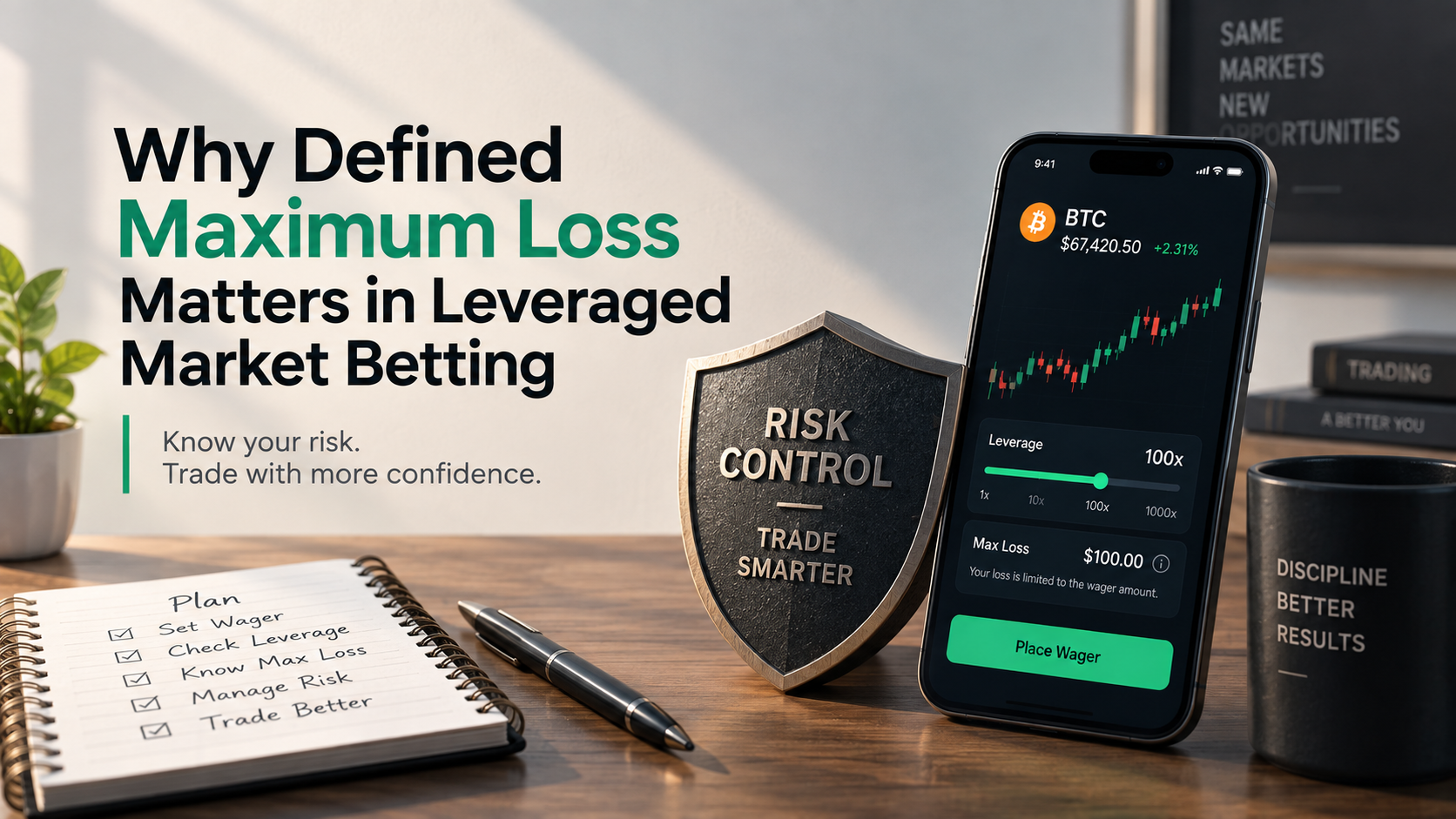
Leverage can make a small amount of money behave like a much larger position. That is what makes it attractive, but it is also what makes risk control so important. A market only has to move a little in the wrong direction for a highly leveraged position to lose value quickly.
This is why defined maximum loss has become important on some betting-style market platforms. The platform sets a clear limit before the wager opens, showing the amount at risk and the price level that may close the position.
What Defined Maximum Loss Actually Means
A defined maximum loss is the largest amount a user can lose on a particular wager. On Moon.com, the wager itself acts as that limit. If a person places a $100 wager, the platform states that the loss cannot go beyond that original $100.
Moon also calculates a max loss price when the position is opened. If the market reaches that price, the position closes automatically after the loss reaches the wager amount.
The user can identify the worst possible result before taking the position. It is still possible to lose the full amount very quickly. Defined loss does not mean low risk. It means the boundary is known in advance.
High Leverage Makes That Boundary More Important
The need for a clear loss limit becomes more obvious as leverage rises.
Moon allows leverage of up to 1000x. If someone wagers $100 at 1000x, the resulting market exposure is $100,000. According to Moon’s leverage example, a move of about 0.1% against that position can be enough to lose the entire $100 wager.
At lower leverage, a position has more room to move before reaching its maximum loss price. At extreme leverage, that distance can become very small.
This is why users should look at two numbers together: the amount they can lose and the market move needed to reach that loss. Knowing only the first number gives an incomplete picture.
Capped Loss Is Not the Same as a Safe Bet
The phrase “maximum loss” can sound reassuring, so it needs context.
A person who knows that only $50 is at risk may feel more comfortable opening a wager. However, if that $50 can disappear after a small price movement, the position is still highly speculative.
Volatile markets can move quickly, and high leverage magnifies those changes. A defined maximum loss protects the user from losing more than the chosen wager on that position, but it does not protect the wager itself.
The practical question is not only, “How much can I lose?” It is also, “How easily can the market reach that loss?”
It Makes Position Sizing Easier to Understand
A defined loss can make position sizing more straightforward.
Suppose a user has $500 available but decides that no single wager should put more than $25 at risk. If the platform caps the loss at the wager amount, that person can set the wager at $25 and know the dollar amount of the worst-case result.
That does not replace a broader risk plan. Several losing wagers can still reduce an account quickly. The value of a defined limit is that it gives the user a fixed starting point for each decision.
Fees Still Need to Be Included
The wager is not the only number to check before opening a position.
Moon currently charges a 1% opening fee based on the wager amount rather than the full leveraged exposure. A $100 wager therefore has a $1 opening fee, even when leverage creates a much larger position.
Positions held for longer periods can also face holding fees, while profitable closed bets can have a performance fee. A clear loss cap tells someone how much of the wager is exposed to the market, but fees still affect the final cost and return.
Promotions Should Never Replace Risk Checks
Referral offers are common across crypto and wagering products, but they should come after the basic risk questions.
TradeOnMoon publishes information around a promo code for Moon users, while also describing itself as an independent referral site rather than the operator of Moon.com.
That distinction matters because a referral offer does not change the mechanics of leverage. A reward, rebate or account-linked benefit may affect the overall cost of using a platform, but it cannot stop a highly leveraged wager from reaching its maximum loss price.
TradeOnMoon also explains on its promo code material that its own cash rewards are separate from Moon promotions. Users should check who provides an offer, what conditions apply, and whether the benefit is confirmed before including it in any decision.
Maximum Loss Price Can Improve Decision Making
One useful part of a defined-loss system is being able to see the closing level before entering the wager.
Moon says the max loss price is displayed in the wager summary and can also be viewed on the chart. That gives a user a concrete price to compare with current market conditions.
For example, someone considering 1000x leverage may notice that the loss level sits extremely close to the entry price. Reducing leverage changes that calculation and can give the position more room to move.
It does not tell the user which leverage level is right, but it makes the consequence easier to see.
Simple Interfaces Still Require Careful Decisions
Betting-style platforms often remove some of the complexity found on traditional futures screens. A user may only need to choose a market, wager amount, leverage, and direction.
That simplicity can be useful, but it can also make a high-risk position feel ordinary.
Before opening a wager, users should understand the amount at risk, leverage multiplier, max loss price, applicable fees, and the source of the market price. They should also confirm whether the service is available in their jurisdiction.
A TradeOnMoon promo code page may help readers understand referral-related information, but TradeOnMoon itself also warns that leveraged wagering can result in the entire wager being lost quickly.
Conclusion
A defined maximum loss gives leveraged market bettors one important piece of information before they act: the worst-case dollar loss on that wager. It can make position sizing clearer and remove uncertainty about losses extending beyond the selected stake.
It does not make high leverage safe. At very high multipliers, a small market move can still erase the full wager. The strongest use of a defined-loss feature is as a tool for understanding exactly what is at stake before a position is opened.
