

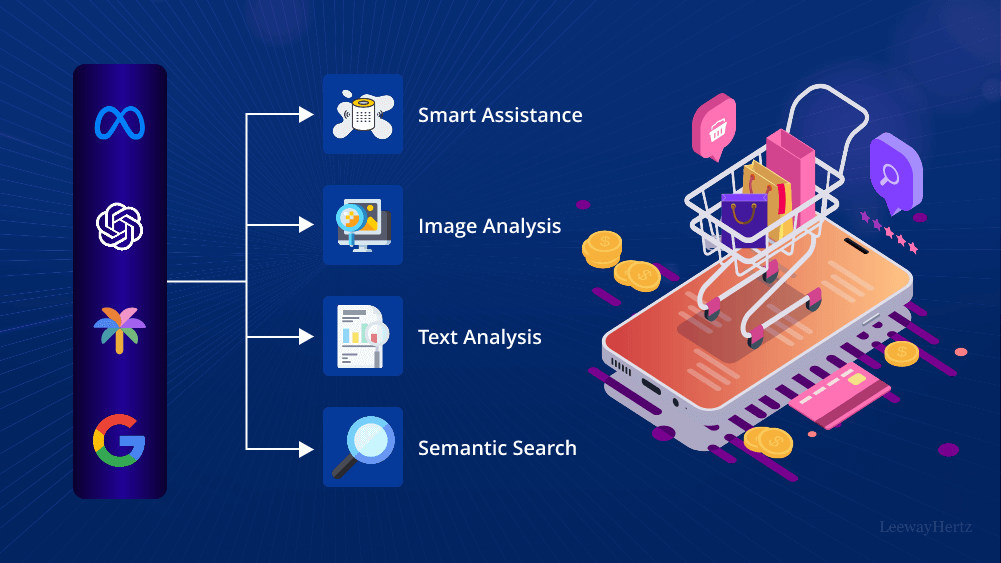
Online companies might benefit greatly from selling via many e-commerce platforms. In addition to selling via marketplaces, social commerce platforms, and other online shops, a merchant may have its own website. Although this increased reach may draw clients with a variety of buying preferences, it also makes the working environment more challenging.
The accuracy of product information must be maintained, inventories must be regularly monitored, consumer expectations differ depending on the platform, and marketing initiatives produce a lot of data. These moving components may be brought together by AI-powered workflows, freeing up e-commerce personnel to spend more time making important choices and less time doing tedious tasks.
The Intricacy Of Multichannel Online Shopping
An extra stream of information is introduced with each new sales channel. Prices may fluctuate, orders may come from various platforms, product descriptions may need to be modified, and stock levels need to be closely watched. Employees might easily spend hours manually comparing data and moving between dashboards in the absence of a coordinated procedure.
As order volume increases, this fragmentation becomes more difficult. When the same product is provided across many channels, a tiny inventory mismatch that seems reasonable for a small company might turn into a more serious customer service issue.
Workflows driven by AI provide a means of more effectively organizing these tasks. Businesses may employ intelligent systems to analyze data and enable coordinated actions across their e-commerce operations rather than treating each platform as a separate operation.
Including Product Management In A More Intelligent Process
Managing product information is one of the trickiest parts of multichannel marketing. Expectations for titles, descriptions, categories, photos, and other listing data may vary throughout marketplaces.
Businesses may increase the effectiveness of product management by using AI tools for ecommerce, which can help with listing development, content optimization, categorization, and data analysis. Teams may avoid repeated labor by using organized processes instead of manually preparing every piece of product information from the start.
Human supervision is still crucial. Ecommerce workers still need to check information for quality, brand consistency, platform requirements, and consumer relevance, even if AI may speed up mundane tasks.
Increasing The Visibility Of Inventory
When many channels draw from the same product pool, inventory becomes more complex. Inadequate visibility may lead to overselling, needless stock buildup, or lost chances to advertise easily accessible products.
Workflows with AI assistance may examine sales trends and assist teams in determining shifts in product demand. Unusual movement in a certain item, for instance, can be a sign of increasing interest in one channel while demand is rather steady elsewhere.
Retailers may use this information to make better choices regarding product availability, promotions, and restocking. The goal is to provide teams with relevant information more quickly rather than just automating inventory management.
Organizing Marketing Through Various Channels
Additionally, multichannel e-commerce poses a marketing difficulty. Consumers who arrive via social media or an online marketplace may act differently than those who find things via search.
Businesses may use AI to analyze performance across various touchpoints and see trends that would otherwise be hard to spot. To identify areas that can benefit from more focus, teams can examine campaign results, customer behavior, conversion activity, and product engagement.
As a result, marketing becomes more integrated. When determining their next course of action, e-commerce managers may take into account data from many channels rather than relying just on one dashboard.
Cutting Down On Repetitive Administrative Tasks
Numerous e-commerce tasks are tedious yet essential. It might take a lot of working hours to check product details, examine performance statistics, spot low stock, arrange reports, and keep an eye on regular adjustments.
By collecting data, pointing out irregularities, and assisting staff in setting priorities, AI-powered processes might lessen part of this administrative load. Removing humans from e-commerce processes is an advantage. They will have more time to engage in tasks that call for strategic thinking, creativity, judgment, and negotiation.
Instead of constantly executing routine administrative tasks, staff members may focus on enhancing client experiences, creating merchandising strategies, assessing suppliers, and investigating new development prospects.
Building A More Networked E-Commerce Business
The potential of AI-powered processes to link tasks that have hitherto been handled independently may be their biggest benefit. Product management affects marketing, marketing influences demand, demand influences inventory, and the customer experience is ultimately shaped by inventory availability.
Instead of addressing each problem separately, a linked process enables teams to comprehend these linkages.
Operational complexity will continue to rise as e-commerce companies broaden their sales platforms. Workflows driven by AI provide a useful method for organizing data, cutting down on tedious activities, and facilitating quicker decision-making. Businesses may create multichannel operations that are simpler to run while still being adaptable enough to react to shifting client demand by combining clever automation with rigorous human control.
