


Blackjack basic strategy card sounds like something only serious players bother with, but it is closer to a cheat sheet that anyone can pick up in an afternoon. Blackjack is the one casino game where your decisions genuinely change the outcome, and the card tells you the mathematically correct move for every situation you will ever face. Played well, the house edge drops to around 0.5%. Played on instinct, it climbs past 2%. Tables on Rikvip show the dealer rules right on the felt, which is the first thing the card depends on. This guide covers what the card is, what it decides, and how to use it.
What a blackjack basic strategy card actually is
At Rikvip , Before you start reading rows and columns, it helps to know where the chart came from and why it can be trusted.
Printed chart showing the full layout of a blackjack basic strategy card
How the chart was built
It was not guesswork. In the 1950s a group of mathematicians worked out the optimal play for every hand by hand, and Edward Thorp later refined it with early computers. Every square on a blackjack basic strategy card represents millions of simulated hands, and the recommended move is simply the one that loses the least money over time. That is worth remembering when a square tells you to do something that feels wrong.
How to read the rows and columns
Your hand runs down the left side. The dealer’s face up card runs across the top. Find where they meet, and that square tells you what to do. The whole process takes about 2 seconds once you are used to it. There is no interpretation involved, which is exactly the point.
The 3 sections you will see
Most charts split into 3 blocks. Hard totals are hands with no Ace, or where the Ace counts as 1. Soft totals contain an Ace counting as 11, which means you cannot bust on the next card. Pairs are 2 matching cards, where splitting becomes an option. A complete blackjack basic strategy card covers all 3, and mixing them up is the most common beginner error.
The 4 decisions every blackjack basic strategy card covers
The chart only ever tells you 1 of 4 things. Knowing what each one means, and roughly when it applies, makes the card far easier to memorise.
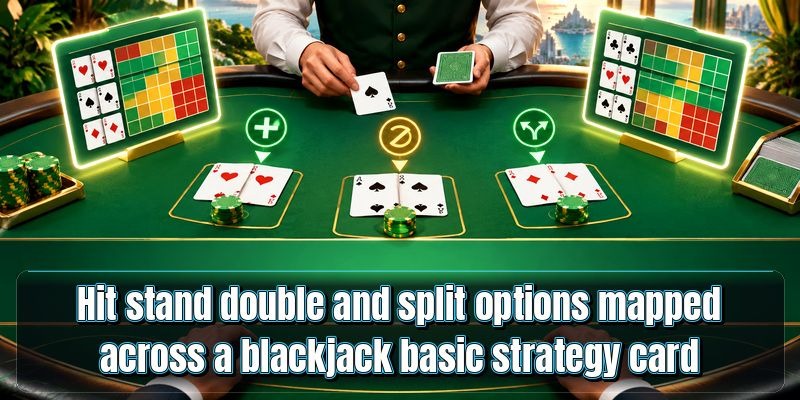
Hit stand double and split options mapped across a blackjack basic strategy card
Hit, stand and double down
Hit means take another card, stand means stop. Double down means you double your bet and take exactly 1 more card, which is the most profitable move on the table when the conditions are right. The classic case is holding 11 against a dealer showing 2 through 10. Anyone following a blackjack basic strategy card doubles there every single time, without exception.
Splitting pairs
Split turns 1 hand into 2 and matches your original bet. The rules here are short enough to memorise outright. Always split Aces and 8s. Never split 10s or 5s. A pair of 10s is already 20, which is close to the best hand available, and splitting it is throwing away a near certain win.
Those 4 moves cover roughly 95% of hands you will be dealt. Some charts add surrender, where you fold and recover half your stake, though many tables do not offer it. A blackjack basic strategy card built for the specific table you are sitting at will tell you whether that column applies, and Rikvip lists the available options before you join.
How to use a blackjack basic strategy card at the table
Owning the chart and actually using it are 2 different things. These 4 habits are what make it work in practice.
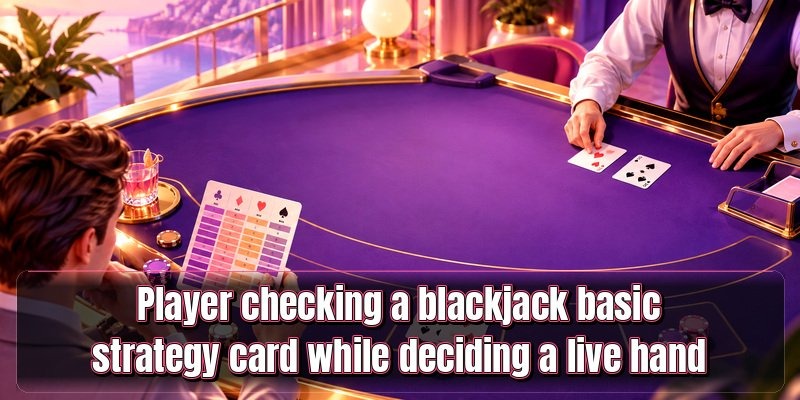
Player checking a blackjack basic strategy card while deciding a live hand
- Keep it visible while you play. Print it, screenshot it, or open it in a second window. There is no prize for memorising it on day 1, and glancing at it costs you nothing. Having the reference nearby also reduces hesitation when unfamiliar hands appear. Over time, repeated decisions become easier to recognise naturally without forcing yourself to memorise every possible combination at once.
- Start on single deck or double deck tables. Fewer decks means a simpler chart and a lower house edge, usually by around 0.5% compared with 8 deck games. Always check the table rules before starting, however, because deck count is only one factor. Dealer actions, doubling restrictions, and payout rules can also change the appropriate decision in certain situations.
- Never deviate because a hand feels different. Standing on 16 against a dealer 10 feels terrible and loses often, but hitting loses more. The chart already accounts for that. Short losing streaks can make the recommended move seem ineffective, but individual outcomes do not change the underlying probabilities. Focus on applying the same rule consistently rather than reacting emotionally to previous hands.
- Practise in demo mode before betting real money. Run 50 hands following the chart exactly, and the common situations will start to stick. Pay particular attention to borderline hands, pairs, and soft totals because these are usually harder for beginners to remember. Repeating them without financial pressure makes it easier to build a consistent decision-making routine.
The hardest part is the third point. Most players abandon the blackjack basic strategy card during a losing streak, right when it is doing the most work for them. The chart is built for long run results, so judging it over 20 hands is like judging a season on 1 match.
One more thing worth knowing is that insurance is never on the chart. When the dealer shows an Ace and offers you insurance, the correct answer is always no, because the house edge on that side bet runs above 7%. It sits outside the blackjack basic strategy card entirely, and that is deliberate.
Conclusion
Blackjack basic strategy card use comes down to 3 simple commitments: keep the chart where you can see it, follow it even when a hand feels wrong, and skip insurance every time it is offered. Doing those 3 things pulls the house edge down to roughly 0.5%, which is about as good as a recreational player can get anywhere in the casino. If you are starting out, load a low stake table on Nổ hũ Rikvip , keep the chart open beside you, and play 50 hands without deviating once.
