

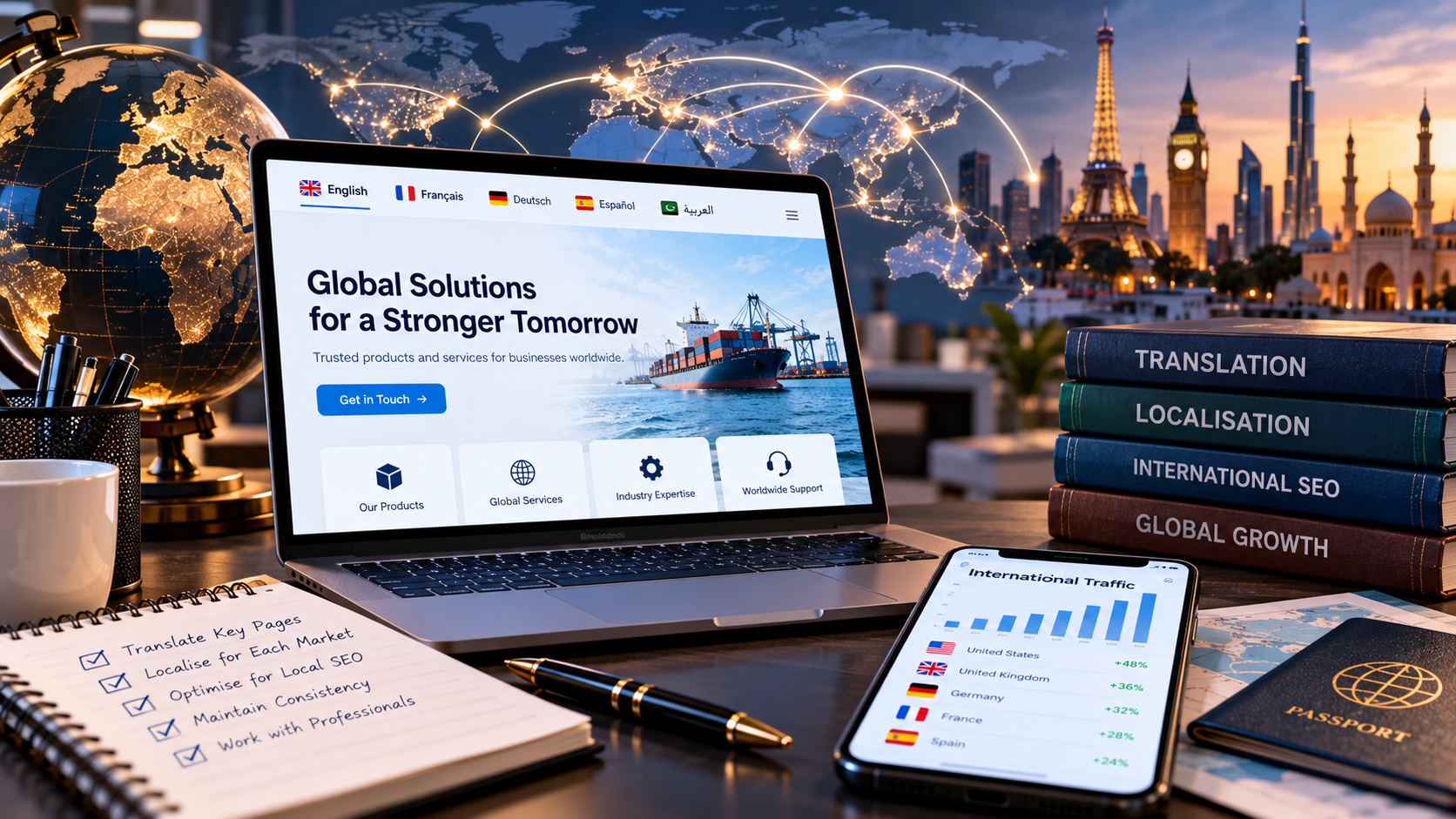
Companies often imagine global expansion as a deliberate event. Management chooses a country, prepares a strategy and launches into the market.
Reality can be much messier.
A foreign customer discovers a product through Google. A distributor sends an unexpected enquiry. A blog post starts attracting traffic from another country. Someone recommends the company to a colleague overseas.
Suddenly, people from markets the business never actively targeted are visiting its website.
This is where the website starts doing more work than many companies realise.
A new visitor has to figure out what the business does, whether it looks credible, what exactly it offers and how to take the next step. If that process becomes difficult because important information is unavailable or unclear, the company may never know an opportunity existed.
There is no complaint and no failed sales call.
The visitor simply disappears.
A Website Can Be Technically Translated and Still Feel Wrong
Poor translation isn’t always obvious.
Sometimes every sentence is grammatically acceptable, yet the website still feels as though it wasn’t written for the person reading it.
A headline sounds unnatural. A call to action uses an expression nobody would normally use locally. Measurements haven’t been adapted. The tone is strangely formal. A product description answers questions that matter in the company’s home market but ignores the ones customers elsewhere actually ask.
These details are easy to dismiss individually.
Together, they shape the customer’s impression of the business.
This is where translation starts to overlap with localisation. Translation deals with what the words mean. Localisation considers whether the overall experience works in the target market.
That can include language, terminology, currencies, measurements, dates, cultural expectations and even website layout.
Arabic websites are an obvious example because the language reads from right to left. But localisation issues exist in every market, even when they are less visually apparent.
AI Has Made Translation Cheap. Judgement Is Still Expensive.
AI has fundamentally changed multilingual communication.
For everyday use, that is a good thing.
A salesperson can understand an overseas enquiry immediately. Teams can get the gist of documents without waiting for a translator. Businesses can communicate with people they might previously have struggled to reach.
There is little reason not to take advantage of that.
The mistake is assuming that because AI can translate almost anything, everything should be treated the same way.
An internal email and a legal agreement do not carry the same risk.
Neither do a rough product note and the homepage of a company’s website.
The useful question is no longer, “Can AI translate this?”
Of course it can.
The better question is, “How important is it that this is exactly right?”
For low-risk communication, speed may matter more than polish. For a contract, medical document, technical specification or major marketing campaign, subject knowledge and human judgement become much more important.
That distinction will probably define how businesses use translation technology over the next few years.
Growth Creates a Different Problem: Consistency

Translation is relatively easy to manage when a company needs it twice a year.
It becomes more complicated when international business becomes routine.
Now the website changes every month. Sales teams need presentations. Marketing launches new campaigns. Contracts arrive. Product descriptions are updated. Customer support needs multilingual material.
Different people begin handling different pieces of content.
That is when inconsistencies creep in.
The same service gets different names on the website and in a proposal. Technical terminology changes between documents. A new translator has no idea how previous material was written. Nobody is quite sure which version is current.
At that stage, companies often move from finding someone to translate individual documents to working with a professional translation company that can maintain terminology and previous work across projects.
For organisations operating in several markets, a translation agency can also coordinate different languages and specialist fields through one workflow rather than requiring the business to manage a collection of unrelated suppliers.
The benefit is operational as much as linguistic.
Specialist Knowledge Matters More Than People Expect
One of the easiest mistakes to make is assuming that fluency is the main qualification for translation.
It isn’t always.
Consider three documents: a medical report, a construction specification and an advertising campaign.
All three might need translating from English into French, but they require very different knowledge.
The medical translator needs to understand medical terminology. The technical translator needs to know what the engineering language actually refers to. The marketing translator has to preserve the intention and personality of the campaign rather than mechanically reproduce its vocabulary.
This is why businesses should pay attention to who is handling their content, not simply which languages a provider offers.
A translation can be linguistically correct and professionally useless.
International SEO Creates Another Layer
There is another problem that appears when businesses start translating websites: customers in different countries don’t necessarily search using literal versions of the same keywords.
Imagine a company ranking well in the UK for an important commercial phrase.
It would be tempting to translate that phrase directly into German, French or Arabic and optimise the corresponding pages around it.
But local customers may describe the same service differently.
They may use another term entirely.
That means international SEO requires some understanding of local search behaviour, not just language.
The distinction matters because a perfectly translated page can still attract very little traffic if it is built around terminology that real customers rarely type into Google.
The same applies increasingly to AI-powered discovery. Search engines and AI systems need clear information about what a business does, while customers need language that actually reflects how they talk about the problem.
You Probably Don’t Need to Translate Everything
Businesses sometimes make internationalisation more intimidating than it needs to be.
A company with a 300-page website does not necessarily need 300 pages translated before testing a new market.
Start where commercial intent is highest.
That might mean the homepage, major service pages, key products, contact information, frequently asked questions and material needed to make a purchase or enquiry.
Then watch what happens.
Which pages attract visitors?
What questions do customers ask?
Where are enquiries coming from?
Which products generate interest?
The answers can guide the next stage.
The same principle applies to languages. Supporting a large number of languages can be valuable for a mature international organisation, but a growing company should normally follow genuine market demand rather than translate content simply to collect flags in the website header.
The Best Multilingual Experience Often Goes Unnoticed

Customers rarely congratulate a company because its localisation is excellent.
They simply use the website.
They understand the product.
They find the information they need.
They submit the form.
They make the purchase.
That’s actually the point.
Good international communication removes obstacles instead of drawing attention to itself.
And this may explain why businesses sometimes underestimate its value. The cost of doing it is visible. The opportunities lost through confusing communication are much harder to measure.
Analytics can show how many people arrived on a page.
They cannot easily tell you how many left because the company felt difficult to deal with.
Global Business Is Becoming Easier. Global Trust Isn’t Automatic.
Technology will continue removing barriers between markets.
AI translation will improve. International payments will become simpler. Businesses will discover overseas customers earlier in their development. Teams will become more geographically distributed.
None of that changes the basic expectation on the other side of the screen.
People want to understand what they are buying and who they are buying it from.
They want important information to be clear.
And when significant money, risk or commitment is involved, they want confidence that nothing important has been lost between languages.
The companies that handle this well won’t necessarily be the ones translating the most content.
They’ll be the ones that know what needs translating, what needs adapting, what can be automated and what deserves human attention.
That is a much more useful definition of multilingual business in 2026.
Add a clear reader-focused takeaway
