

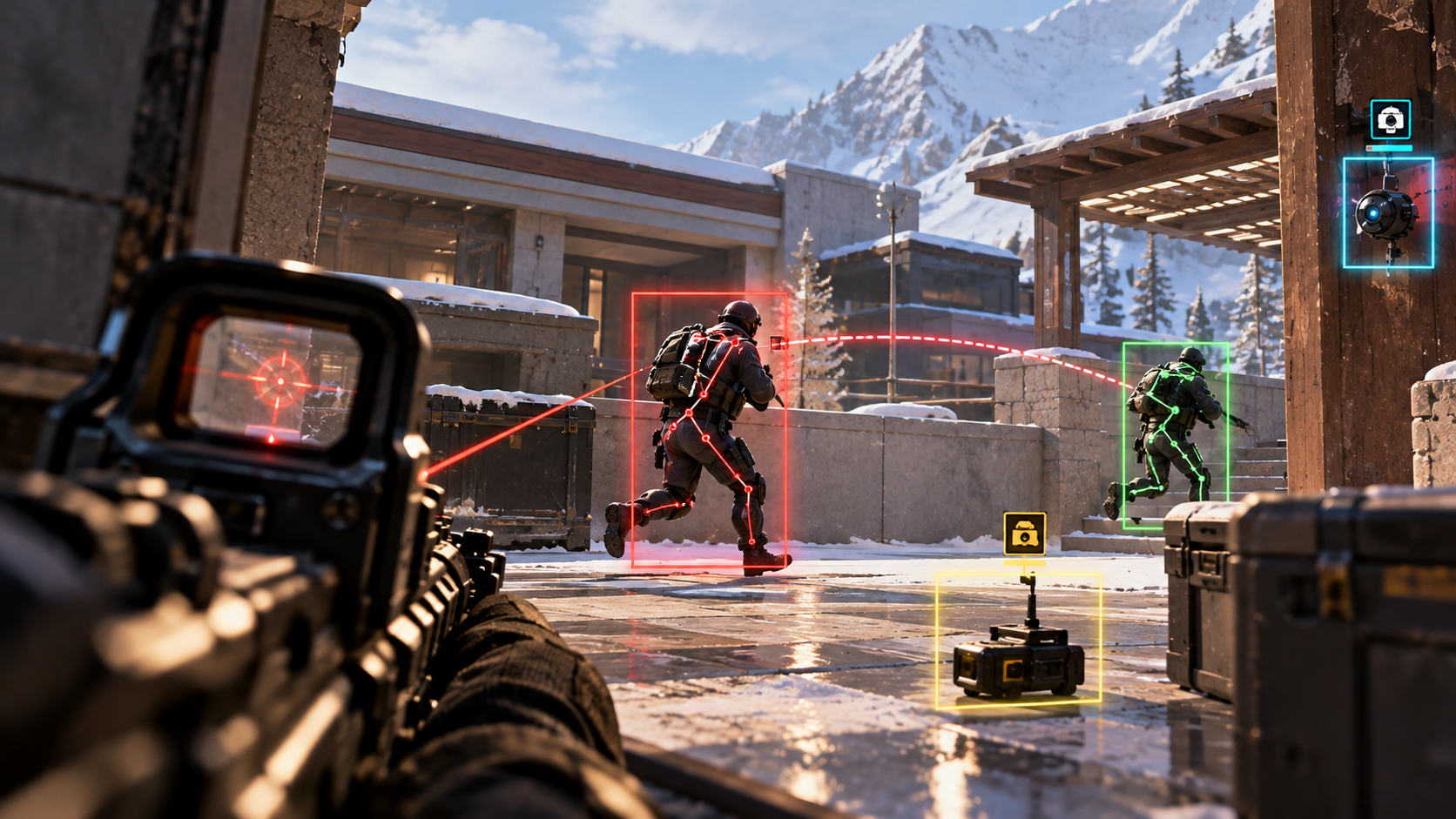
A player crossing an open gap is an aiming problem that changes from moment to moment. Their position when you first notice them is not necessarily the position that matters when you fire. A change of direction, a stop at cover or a second player entering the scene can all make a simple description such as following the target incomplete.
The listed controls for WARDOGS Aimbot from DisconnectCheats include prediction, target-bone selection, smoothing and Visible Check. Each describes a different part of the aim feature. Prediction is the movement-related control, but it should be understood alongside the selected player and the area being aimed at.
Prediction concerns where the target is moving
Prediction is intended to assist with anticipating target movement. It is relevant because a moving opponent is not a stationary point. Their direction can matter as much as their present position, especially when they continue across the view rather than stopping in front of you.
The feature name does not disclose the calculation behind it. Disconnect’s public menu does not publish a formula for every weapon, distance or movement pattern. There is no sound basis for inventing a universal value or claiming that prediction removes every source of missed shots.
A sudden reversal illustrates the limitation of broad promises. The situation has changed, and the result still has to account for that change. Treat prediction as a supported aim feature with a specific purpose, not as a guarantee that every moving player will be hit.
The chosen body area still matters
Disconnect names head, chest and pelvis as target-bone choices. Prediction and a target bone answer different questions. One concerns movement, while the other identifies the area on the selected player that the aim feature should use.
That distinction is useful when a player turns or moves across uneven surroundings. A body-area selection is not the same thing as choosing which enemy to follow. Nor does enabling prediction mean that the selected target bone has become irrelevant.
Read the target choice directly from the current menu. Avoid describing a product as supporting additional bones or automatic body-area rules unless its own instructions confirm them. A broader list of advertised aim features is not evidence for an unlisted targeting option.
Smoothing describes the movement you see
Smoothing concerns the progression of regular aim movement. It can make that movement more gradual. Prediction concerns anticipating the target’s movement. The controls can be present together because they address different parts of the same aim feature.
If the crosshair seems slow to follow, that observation alone does not establish which control is responsible. First identify the selected player, then consider their direction and the movement of the aim reference. Looking only at the final miss loses much of the information needed to describe what happened.
There is no single smoothing value that this article can honestly prescribe for every player or weapon. The useful point is to recognise what the control is meant to change, rather than treating every aim setting as another version of prediction.
Cover changes the question
A player moving across a gap may become hidden a moment later. Visible Check is the named visibility control in Disconnect’s aim menu. Player ESP also has visible and hidden colours, but a visual colour and an aim eligibility test serve different purposes.
Seeing a marker behind cover does not prove that the weapon has a clear shot. Equally, an aim feature listing prediction does not mean that shots can pass through whatever blocks the target. Anticipating movement and establishing a usable line of sight are separate concerns.
This is why an explanation of moving-target aim should include the surroundings. A player can be easy to follow visually while remaining obstructed. The display may provide information without turning that information into a sensible shot.
Distance and selection complete the picture
Maximum Aim Distance gives the aim feature its own distance control. The ESP render distance and the radar render distance are listed elsewhere. A player appearing in a visual display does not establish that all three features are using the same limit.
Lock Target and the target line provide further selection context. If several opponents cross the view, first work out which player the aim feature references. An apparent tracking problem may involve a change of selection rather than the movement of the original opponent.
The clearest way to understand moving-player aim is to give each control a defined job. Prediction concerns movement anticipation, the target bone identifies an area, smoothing concerns regular aim movement, and visibility and distance add conditions. Together they describe a menu that can be examined carefully, without promising perfect tracking or a guaranteed hit.
