


Asian handicap 1.5 places a one-and-a-half-goal adjustment on the selected team, creating a market with no possibility of a push. At bảng xếp hạng bóng đá, the favourite may appear at -1.5, while the underdog receives +1.5. The negative side needs a convincing victory, whereas the positive side can still win the wager after losing by exactly 1 goal. Correct selection therefore depends on projected winning margins, not simply identifying the stronger team.
Settlement map for Asian handicap 1.5
Bảng xếp hạng bóng đá ensures that the adjusted score cannot finish level. Every ticket is settled as a full win or full loss, making the result easier to calculate than a whole or quarter handicap.
The favourite at -1.5
Backing a team at -1.5 means subtracting 1.5 goals from its final score. It must win by at least 2 goals for the adjusted result to remain in its favour.
| Actual score | Adjusted score | -1.5 settlement |
| Favourite wins 3–0 | 1.5–0 | Win |
| Favourite wins 2–0 | 0.5–0 | Win |
| Favourite wins 2–1 | 0.5–1 | Loss |
| Match finishes 1–1 | -0.5–1 | Loss |
| Favourite loses 0–1 | -1.5–1 | Loss |
The favourite can win the actual match while the handicap wager loses. That distinction is the main reason this line pays more than the standard match-winner market.
The underdog at +1.5
Adding 1.5 goals to the underdog’s final score allows it to lose by exactly 1 and still cover the line. A draw or outright victory also creates a successful settlement.
The +1.5 position loses only when the selected team is defeated by 2 or more goals. This makes it useful when the underdog appears competitive, even if its chance of winning the match is limited.
Suppose the underdog loses 2–1. After adding 1.5 goals, the adjusted score becomes 2–2.5, so the +1.5 selection wins.
Why no refund occurs
An adjusted difference containing half a goal cannot end level. Unlike -1, there is no refund when the favourite wins by exactly 1. The ticket loses because the required margin has not been reached.
Likewise, a +1.5 selection does not push during a 2-goal defeat. It loses fully. Players applying Asian handicap 1.5 should calculate the adjusted score before considering the potential payout.
Choosing an Asian handicap 1.5 position
The line creates 2 distinct questions. Can the favourite win convincingly, or can the underdog prevent a heavy defeat? Research should be organised around the expected margin.
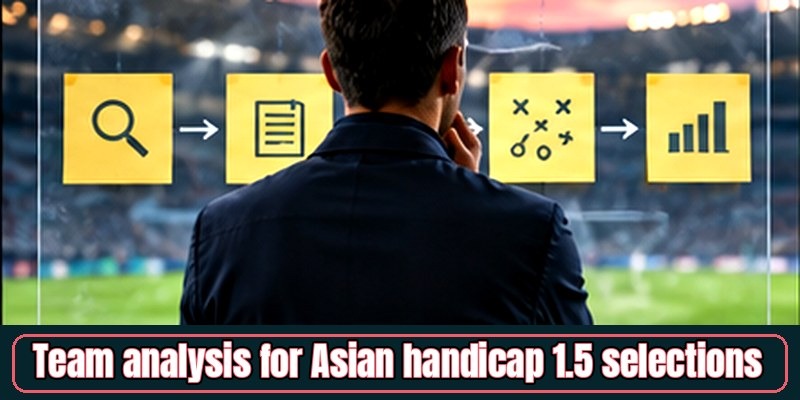
Team analysis for Asian handicap 1.5 selections
Profile the favourite’s winning margins
A team may win frequently without covering -1.5 often. Clubs that protect narrow leads, control possession conservatively, or struggle against deep defensive blocks can be poor choices at this line.
Review how often the favourite wins by:
- Exactly 1 goal.
- Exactly 2 goals.
- At least 3 goals.
- Different margins at home and away.
- Different margins against stronger or weaker opponents.
The data must be connected to current tactics. Historical 3-goal victories may have occurred under another manager or with attackers who are unavailable for the upcoming fixture.
Examine chance creation after the first goal
The favourite needs more than an early lead. It must continue creating enough pressure to score again.
Some teams become more dangerous after scoring because the opponent pushes forward, leaving space for transitions. Others slow the tempo, retain possession, and prioritise defensive control.
This behavioural difference is central to Asian handicap 1.5 analysis. A team that regularly stops attacking at 1–0 may win the match but fail to cover the line.
Assess the underdog’s defensive resistance
The positive handicap can suit teams that defend compactly, concede few high-quality chances, or remain organised when trailing. A strong goalkeeper can also reduce the probability of a heavy defeat.
However, an underdog with respectable average defensive numbers may still be vulnerable in particular matchups. A narrow shape can struggle against width, while a high defensive line may be exposed by fast forwards.
Consider whether the underdog can respond after conceding. Teams that lose structure while chasing an equaliser may allow the favourite to extend the margin.
Account for competition context
A strong side may need only a victory rather than a large score. Before a demanding midweek fixture, it could conserve energy after taking the lead.
In a knockout second leg, the aggregate position changes the required approach. A team already leading comfortably may accept a slow match, while one needing several goals must attack aggressively.
League position, goal difference, schedule, and motivation should influence the projected margin rather than being treated as background information.
Comparing Asian handicap 1.5 prices
A larger required margin produces higher odds, but the price must still exceed the realistic probability of success. Comparing neighbouring lines shows how much compensation the market provides.

Price comparison for Asian handicap 1.5
Compare -1, -1.25, and -1.5
A favourite may be listed at the following example prices:
| Handicap | Price |
| -1 | 1.62 |
| -1.25 | 1.82 |
| -1.5 | 2.05 |
At -1, a 1-goal win returns the stake. At -1.25, it creates a half loss. At -1.5, the full stake loses.
Moving to the higher line increases the return but removes protection around the most common narrow victory margin. Select the line that matches the projected distribution rather than automatically preferring odds above 2.00.
Compare +1 and +1.5
The underdog at +1 receives a refund when losing by exactly 1. At +1.5, the same result wins fully, though the listed price will be shorter.
The additional half goal can be valuable when a narrow defeat appears highly plausible. If the analysis suggests the underdog is more likely to lose heavily or avoid defeat entirely, another line may provide a better balance.
Convert odds into required probability
Odds of 2.00 require a break-even success rate of 50% before accounting for margin. A price of 1.80 implies approximately 55.56%.
Estimate how often the favourite wins by at least 2 or the underdog avoids that margin. Compare that percentage with the listed odds available through bảng xếp hạng bóng đá.
A team being “capable” of a large win is insufficient. The wager needs the required result often enough to justify the price.
Monitor the line, not just the odds
The favourite may move from -1.25 to Asian handicap 1.5 while the price remains similar. This signals stronger market expectations, but later entrants must accept a more demanding condition.
Record both the handicap and price. Saying a selection moved from 1.90 to 1.85 is incomplete if the underlying line also changed.
Keep stakes proportional
The higher potential return can encourage oversized wagers. Yet -1.5 loses during every draw, defeat, or 1-goal victory.
Use a consistent bankroll percentage and include all wagers on the same match when calculating exposure. A match-winner bet combined with -1.5 creates correlated risk because both depend on the favourite winning.
Conclusion
Asian handicap 1.5 should be selected only after the likely victory margin, tactical response to scoring, and underdog resistance have been assessed together. Compare nearby lines, calculate the adjusted KQBD Iraq, and reject prices that offer insufficient compensation for a demanding condition. Visit bảng xếp hạng bóng đá to review upcoming handicap markets, confirm team news, and choose the side that best reflects the expected score difference.
