

There have been substantial advancements in workplace learning during the last decade due to technological innovations, changes in job requirements, and continuous professional development demands. Beyond classroom learning, other options, such as digital learning, enable learners to access educational programs at different times and in different places. This change has been facilitated by artificial intelligence, which is used for content development, personalized learning, analytics, and administration. According to Grand View Research, the global corporate e-learning market was valued at USD 104.3 billion in 2024 and is expected to reach USD 335.0 billion by 2030.
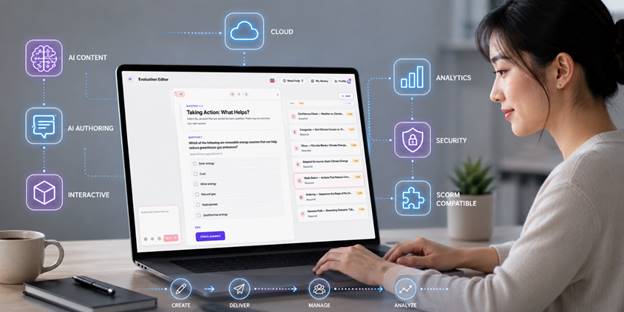
The growth of enterprise learning platforms has also influenced expectations regarding software. Enterprises want the software to support, not separate, aspects of the learning process but all of them. Such aspects include course creation, learner management, analytics, compliance training, and reporting. Artificial intelligence has promoted the development of such solutions, enabling software automation of content creation while maintaining human review. Within this broader landscape, Mexty represents one example of an AI-native learning platform designed for workplace education. Founded in 2024 by Hubert Maupas and Fabien Sabatié, with computer scientist Soumya Banerjee serving as a board advisor, the company develops software that combines authoring, delivery, learner management, and governance within a cloud-based platform.
One of the platform’s notable concepts is what Mexty describes as “vibe-coding for learning.” Rather than relying on traditional authoring tools that require extensive manual development, users describe a learning activity in natural language, and the platform generates a fully editable interactive experience. According to the company, this process can produce branching scenarios, assessments, quizzes, simulations, flashcards, learning paths, and other educational materials. Users can then revise and expand the generated content before publication. The company presents this workflow as a way to reduce repetitive development tasks while keeping instructional designers and subject specialists responsible for reviewing the final learning experience.
Corporate learning departments increasingly require more than content generation alone. Training programs often involve onboarding, compliance education, technical instruction, product knowledge, and continuing professional development. Managing these activities requires software capable of organizing learners, distributing courses, measuring progress, and adapting content over time. Mexty’s platform combines AI-native authoring with integrated course management so organizations can create, deliver, assess, and monitor learning through a connected workflow. The company also includes AI tutoring and adaptive learning capabilities that support personalized learning experiences based on learner activity rather than static course structures.
Learner analytics have become another important element of enterprise education. Organizations increasingly seek measurable information about participation, completion rates, assessment outcomes, and competency development. According to Mexty, its analytics tools monitor engagement, learner progression, completion, and assessment performance across different users, groups, and organizational structures. These functions are intended to help learning teams evaluate training activity while supporting future improvements. Academic researchers have also identified the growing relationship between learning analytics and artificial intelligence, suggesting that AI can contribute to hybrid approaches that combine automated analysis with human decision-making in educational settings.
Interoperability remains an important consideration for organizations that already operate established learning systems. Many companies continue to use existing Learning Management Systems and require new software to integrate with those environments rather than replace them. Mexty addresses this through SCORM-compatible exports and built-in Learning Management System capabilities introduced with Version 3. According to the company, organizations may deliver learning through the integrated platform or export content for deployment within external LMS environments. This flexibility reflects a wider practice across enterprise learning, where compatibility with existing infrastructure often influences software adoption decisions.
Enterprise learning platforms also operate within an expanding regulatory environment. Organizations increasingly evaluate software according to privacy, governance, and information security requirements, particularly when artificial intelligence is involved. Within Europe, the General Data Protection Regulation establishes rules governing personal data, while the European Union AI Act, adopted in 2024, introduces a risk-based framework for artificial intelligence systems. Mexty states that its platform supports GDPR compliance, AI Act readiness, European hosting options, and a Source of Truth governance framework intended to ground AI-generated content in approved organizational knowledge. The company also states that ISO 27001 and SOC 2 Type II certification processes are underway.
The platform’s governance model reflects broader discussions about responsible AI within workplace learning. Recent academic research has highlighted the importance of balancing automation with human oversight, particularly where learning outcomes, privacy, and organizational knowledge are involved. Rather than treating artificial intelligence as a replacement for instructional expertise, researchers have increasingly emphasized hybrid approaches that combine automated systems with human judgment. Mexty is said to present a similar concept through its Source of Truth framework, where AI-generated learning materials remain connected to validated organizational information and continue to support manual review before deployment.
The trend of corporate learning continues to develop, with more focus on digital skills, lifelong learning, and an integrated learning ecosystem. Studies show that there is going to be a rise in demand for AI-powered enterprise learning platforms as part of the greater investments in digital transformation and workforce development. Under these circumstances, Mexty can be regarded as one of the companies that seeks to offer AI-first content creation and vibe coding for learning, learner analytics, adaptive learning, SCORM compliance, governance, and enterprise integration all in one cloud-based platform.
