

The binder problem nobody talks about
A binder can be full of great cards and still leave its owner with a basic question: what, exactly, is in here? A familiar-looking Charizard might come from one of several releases. Two cards with nearly identical artwork can have different collector numbers, finishes, or editions. That matters when you are trying to determine a reasonable value. The slow method is to type each name into a search engine, open a pile of listings, and hope you have chosen the right version. For someone sorting a few hundred cards, that gets old quickly. A phone scanner changes the first step: instead of starting with a guess, you start by identifying the card in front of you.
Start with the exact printing
When you scan a Pokémon card, check the result rather than looking only at the headline number. Look at the set, card number, language, and finish. A reverse holo is not interchangeable with a regular copy; a first-edition vintage card is not the same as an unlimited printing. CardPrice’s iPhone app is designed to recognize cards through the camera. Its continuous scanning workflow lets collectors move through a stack instead of restarting a search for every card. Matches the app is confident about can be saved automatically, while less-certain matches can be reviewed with a tap. That small confirmation step matters because an incorrect match can throw off the value of an entire collection.
A market estimate is a starting point
After identification comes pricing. CardPrice displays market estimates and historical price information, including different printings and graded-card values. Those figures are useful, but they are not an offer to buy your card. Real selling prices depend on condition, recent transactions, demand, fees, and how accurately a listing describes the card. A lightly played copy with whitening on the edges should not be treated as equivalent to a clean near-mint example. When a price appears unusually high, compare recent sales and review the specific variant. A single ambitious asking price is not proof that collectors are paying it.
Why the card number matters
A good stress test is Magikarp #203/193. The Paldea Evolved illustration rare sold for $266.69 on October 14, 2026, according to PriceCharting’s completed-sale record. But the 30th Celebration Classic Collection also has a Magikarp #203/193: a copy sold for $89.99 that same day. Searching “Magikarp 203” without checking the set would put two materially different collectibles into the same bucket. A scanner can narrow the search, but the collector still needs to confirm the printing before saving a price to the collection.
Market evidence: Completed-sale record 1 · Completed-sale record 2
The practical lesson is to identify a printing before making a decision. For a closer look at the catalog and pricing tools, explore CardPrice.com. To scan cards and save them while sorting a collection, the CardPrice iPhone app provides the mobile workflow.
Put the scan to work
The practical advantage of scanning is not just getting an answer once. It is building a record you can return to. After identifying a card, add it to your digital collection, then continue to the next one. CardPrice combines scanning with a collection tracker, so the cards you identify become part of a portfolio rather than disappearing into your browsing history. The platform also provides a value chart for the collection. If you record what you paid, its profit-and-loss view can help distinguish what you spent from an estimated current market value. That is much more useful than remembering what a particular card cost three years ago.
A real example: two Umbreon listings are not the same card
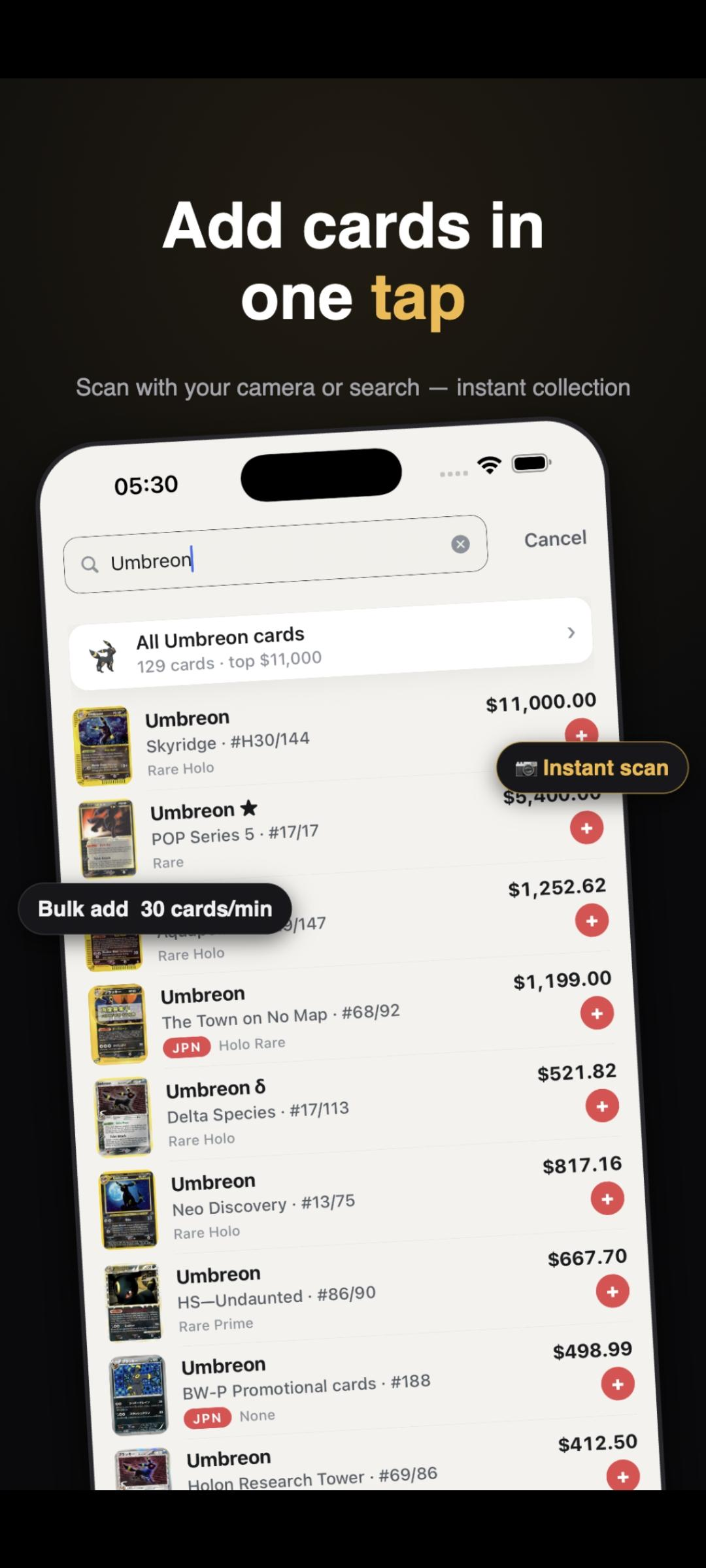
The CardPrice search screen makes the point using Umbreon. One result is Umbreon from Skyridge, numbered H30/144; another is Umbreon ★ from POP Series 5, numbered 17/17. Both show the same character, but they are different releases with different scarcity, condition considerations and price histories. The result list also includes Japanese printings and older holo cards. Before saving an Umbreon, compare the printed collector number and set on the physical card with the result. A scan is a shortcut to finding candidates, not permission to ignore those details.
A quick routine for a better scan
Work in decent, even lighting. Keep the card flat, avoid glare from sleeves, and pause when the app asks you to confirm an uncertain match. For expensive cards, double-check the number printed on the card and any grading-label details yourself. Sorting by set before scanning can also help you catch an odd result. If you own multiple copies, make sure the quantity is correct. A scanner is a helpful assistant, not a substitute for your own eyes. Spending an extra few seconds on unusual variants usually pays off in a cleaner collection record.
Website or iPhone app?

Figure: Actual CardPrice app screen provided by CardPrice. Prices displayed in the interface are screenshots, not live quotes.
What a price checker cannot tell you
A scan also cannot tell you the full story of a card’s physical condition. Two copies of the same printing can look identical in an app while selling at very different prices in person. Consider taking clear photos of unusually valuable cards and keeping notes about visible wear. For a graded slab, verify the certification details through the grading company rather than assuming a label is authentic. The more valuable a card is, the more important it becomes to combine app data with careful inspection. This is especially true when you are making a purchase or deciding whether grading fees make sense.
Research before taking action
Not every difference in an estimated price calls for a decision. Before buying, selling, or grading, review multiple data points and inspect the card carefully. A familiar-looking card may turn out to be a different printing, and the condition on a screen cannot stand in for the condition of the copy in your hand. A good scanner makes research faster; it does not remove the judgment that goes into collecting.
The real payoff
A collection becomes easier to enjoy when you can actually see what you own. Knowing the difference between two printings, watching how estimated values change, and finding a missing card in a set are all easier with a consistent catalog. If you want to try this approach, browse the database at CardPrice.com or use the CardPrice iPhone scanner. Start with ten cards from one binder page. Verify each match, save them, and see whether the process fits the way you collect.
How to check a match before saving it
Consider a common mix-up: two cards show the same Pokémon, have similar artwork and even belong to the same general era. A photo-identification tool might narrow the search quickly, but the collector still has to verify the exact card. Start with the collector number printed near the bottom edge. Compare the set symbol, then check whether the card is a standard holo, reverse holo, alternate artwork or promotional printing. If a result looks close but not quite right, do not force the match merely because its listed value is higher.
Once the identity is right, decide what information is worth preserving. The number of copies you own is useful, but purchase cost, condition notes and storage location can save future detective work. A seller trying to price a binder six months later will be grateful for notes that distinguish a clean near-mint card from one with whitening on the back. CardPrice lets collectors save identified cards and follow estimated collection values, while the underlying physical assessment remains the collector’s responsibility.
A sensible test is to scan ten cards of different types before processing an entire collection: a modern common, a reverse holo, a numbered full-art card, an older card, a Japanese card and several promos. Review the matches on each one. This small trial reveals where lighting, sleeve reflections or similar card artwork might need extra attention. A reliable collection starts with a few careful checks, not with the fastest possible scan count.
What to check before acting on a number
For a quick binder audit, choose ten cards at random, confirm the set and number for each, and compare the app identification against the printing in your hand. It is a small experiment that exposes most cataloging mistakes before they reach a spreadsheet or sale listing.
For collectors who want to follow up rather than rely on a single price screenshot, these tools help keep research and ownership organized. For a closer look at the catalog and pricing tools, explore CardPrice.com. To scan cards and save them while sorting a collection, the CardPrice iPhone app provides the mobile workflow.
