

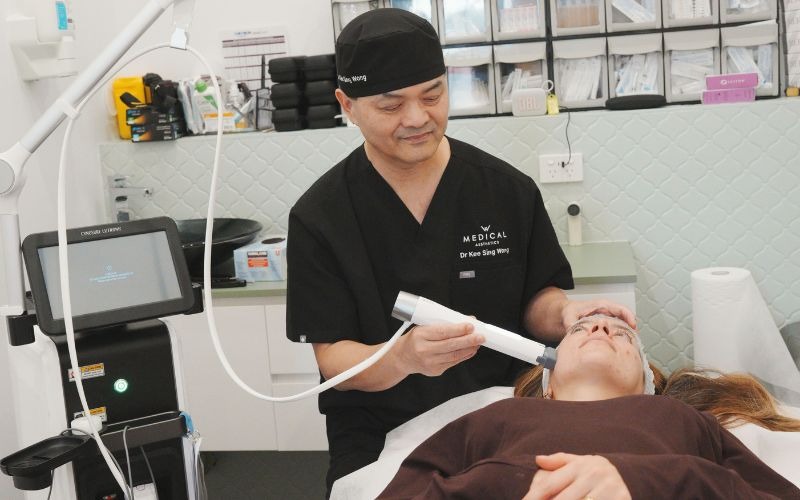
XERF is a newer radiofrequency treatment now entering Adelaide’s non-invasive aesthetics market. The platform combines 6.78 MHz and 2 MHz monopolar RF, adjustable treatment depths and integrated surface cooling, with treatment commonly considered for concerns involving skin firmness and mild laxity.
For people comparing XERF treatment providers, the device itself is only one part of the decision. Suitability depends on factors such as tissue thickness, the cause of the visible concern and the treatment settings considered during clinical assessment.
XERF uses two radiofrequency frequencies at adjustable depths
XERF is a monopolar radiofrequency system rather than a laser. It uses 6.78 MHz and 2 MHz radiofrequency energy, with three depth settings and ten intensity levels that allow treatment parameters to be adjusted according to the area and tissue being treated.
The device delivers controlled heat beneath the skin while its handpiece remains on the surface. Cynosure Lutronic also incorporates Wave Fit pulse delivery, integrated cryogen cooling and impedance feedback designed to help manage energy delivery and skin-surface temperature.
RF and laser technologies act on the skin in different ways. Laser treatments use light energy and may be selected for concerns such as pigmentation, surface texture or resurfacing, depending on the device. XERF uses radiofrequency to create controlled heating below the surface, with collagen remodelling and firmness as the main treatment focus.
Skin laxity is only one part of treatment suitability
XERF is generally discussed for mild to moderate skin laxity, particularly around areas such as the lower face, jawline and neck. Australian clinics also describe its use for changes in firmness, facial contour and selected fine lines.
A less-defined jawline can reflect several factors, including laxity, localised fullness, volume change and facial structure. Identifying the main contributor helps determine whether RF treatment is appropriate.
A clinical assessment helps identify which factors are contributing before a treatment device is selected. A pre-treatment assessment may consider:
- the degree and location of laxity
- tissue thickness and facial anatomy
- previous cosmetic procedures
- medical history and relevant risks
- expected recovery and treatment goals
More substantial laxity may fall outside what a non-invasive RF treatment can reasonably address. Higher energy settings do not make XERF equivalent to a surgical procedure.
What to know about recovery time
XERF does not involve incisions or needle penetration, so recovery is generally lighter than with invasive procedures. Mild redness, warmth or swelling can occur after treatment and may settle within hours or around the first day.
Immediate appearance does not reflect the full treatment response. Radiofrequency heating is designed to support collagen remodelling, with changes developing gradually over time. Temporary swelling can also alter appearance shortly after an appointment.
When comparing clinics, patients may want to ask about downtime, review timing and how the practitioner decides whether another treatment is clinically appropriate.
What to compare between XERF providers
As more clinics offer XERF, patients have greater treatment choices. At W Medical Aesthetics, Dr Kee Sing Wong assesses anatomy, skin condition, medical history, previous procedures and treatment goals before discussing recovery, risks and suitability, rather than offering a fixed treatment package.
This assessment matters when several factors contribute to the same visible concern. Someone seeking firmer-looking skin may actually have a combination of laxity, volume change or localised fullness. In those cases, selecting XERF based on device novelty alone may not address the main concern.
W Medical Aesthetics also offers other light, laser, radiofrequency and skin-focused treatments, allowing the consultation to consider alternatives to XERF where appropriate. Dr Wong may discuss another treatment, or no treatment, when that is more appropriate for the concern being assessed.
Patients considering XERF treatment may want to ask what is contributing to the visible concern, which tissue depth is being targeted, what level of change is realistic and what alternatives are available.
Dr Wong discusses these questions during consultation before deciding whether XERF is appropriate for the treatment plan. Consultation may also determine that another approach, or no treatment, is more appropriate.
Clinical assessment remains central to XERF suitability
XERF is one of several non-invasive technologies now available in Adelaide for concerns involving skin firmness and mild laxity. Its dual-frequency RF, adjustable treatment depths and integrated cooling distinguish XERF from some other energy-based platforms.
Those specifications do not determine suitability on their own. Clinic comparisons should focus on suitability, expected recovery, risk assessment and the alternatives discussed during consultation.
For patients researching XERF treatment in Adelaide, the quality of the clinical assessment matters as much as the device being used. At W Medical Aesthetics, Dr Wong discusses XERF only when the treatment, its limitations and available alternatives are appropriate to the individual assessment.
Conclusion
XERF may suit selected patients with concerns involving skin firmness or mild laxity, but suitability depends on individual anatomy, treatment goals and clinical assessment. Treatment depth, tissue characteristics, previous procedures and expected outcomes all influence whether RF treatment is appropriate.
When comparing XERF clinics, patients should consider how suitability, risks and alternatives are assessed. At W Medical Aesthetics, Dr Kee Sing Wong provides a doctor-led consultation to determine whether XERF is appropriate or other treatments may be more suitable.
