

- What Makes Copper Current Collectors Important in Anode-Free Batteries?
- Copper current collectors provide a conductive surface for lithium deposition during charging. Their surface quality, stability, and compatibility with battery materials influence lithium distribution, energy density, and cycle life.
Introduction
Anode-free batteries are attracting attention because they can potentially deliver higher energy density with fewer materials and a simpler cell structure. Unlike conventional lithium-ion batteries, they do not contain a pre-installed anode active material when assembled. Instead, lithium ions deposit onto a bare current collector during charging.
This design can reduce cell weight and improve space utilization. However, it also creates a major challenge: lithium must deposit evenly and remain stable during repeated charging and discharging.
For consumers, these technical details matter because they can affect battery life, charging reliability, safety, and the future cost of electric vehicles and energy storage systems.
Anode-free lithium metal battery technology offers an alternative approach to conventional battery design, but its performance depends heavily on the interaction between the current collector, electrolyte, and cathode.
1. How Do Copper Current Collectors Work?
In a conventional lithium-ion battery, the anode typically contains graphite or another lithium-hosting material coated onto copper foil. During charging, lithium ions move from the cathode and enter the anode material.
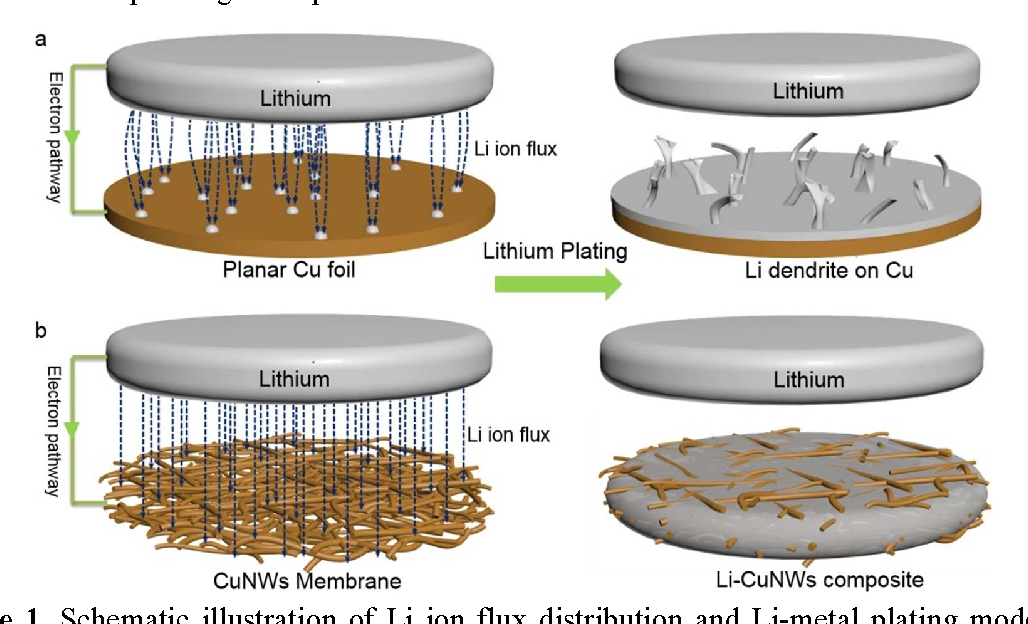
In an anode-free lithium metal battery, the negative side generally starts with a copper current collector without pre-installed anode active material. During the first charging process, lithium ions deposit onto the copper surface, forming a metallic lithium layer.
The copper foil serves three main purposes:
- Electrical conductivity: It provides a pathway for electrons during battery operation.
- Lithium deposition support: Its surface influences how lithium nucleates and grows during charging.
- Structural support: It provides a base for the deposited lithium.
Copper itself does not store lithium in the same way graphite does. Instead, its surface provides a foundation for lithium metal deposition.
For manufacturers, selecting an appropriate current collector is an important step in developing reliable anode-free cells.
2. Why Does Copper Surface Quality Matter?
One of the biggest challenges in anode-free battery development is uneven lithium deposition.
If lithium grows irregularly, it may form dendritic structures, consume active lithium, or create electrically isolated lithium that no longer contributes effectively to battery capacity. These problems can reduce cycle life and increase the risk of internal short circuits under certain conditions.
The surface properties of copper can influence lithium nucleation and deposition behavior.
Important factors include:
- Surface roughness and uniformity
- Surface cleanliness and contamination
- Foil thickness and mechanical strength
- Wettability with the electrolyte
- Compatibility with surface treatments
A carefully selected copper current collector can help create more consistent conditions for lithium deposition. However, surface engineering must be evaluated alongside electrolyte chemistry, separator properties, and charging conditions.
For consumers, the practical goal is straightforward: a battery that retains useful capacity for longer and operates reliably over repeated charge cycles.
3. How Can an Anode-Free Lithium Metal Battery Improve Energy Density?
One reason researchers are interested in an anode-free lithium metal battery designs is their potential to increase energy density.
Traditional graphite anodes occupy space and add mass to a battery cell. Removing the pre-installed anode active material creates an opportunity to increase the proportion of cathode material within the same cell volume.
The potential benefits include:
- Higher energy density
A more compact electrode structure may allow a greater proportion of the cell’s volume and mass to contribute to energy storage.
- Reduced material requirements
Removing the initial graphite anode can simplify part of the electrode structure. However, other components and manufacturing requirements remain necessary.
- Potentially lighter battery systems
If the cell achieves higher energy density, manufacturers may be able to develop lighter battery packs for electric vehicles and portable electronics.
These benefits are not guaranteed. The actual performance depends on lithium utilization, cathode capacity, electrolyte requirements, cell packaging, and cycle life.
Consumers should compare measured cell-level energy density rather than relying solely on theoretical material values.
4. What Should Manufacturers Consider When Selecting Anode-Free Battery Materials?
Copper foil is only one component of a successful battery. Other materials must work together to maintain electrochemical stability and mechanical integrity.
The main anode-free battery materials include:
| Material | Main function | What to evaluate |
| Copper current collector | Conducts electrons and supports lithium deposition | Surface quality, thickness, cleanliness |
| Cathode materials | Supply lithium during charging | Capacity, stability, cost |
| Electrolyte | Transports lithium ions | Ionic conductivity, interfacial stability |
| Separator | Separates electrodes while allowing ion transport | Mechanical strength, thermal stability |
| Protective coatings or interlayers | Modify interfaces and lithium deposition behavior | Compatibility, durability, added cost |
For buyers and battery developers, material selection should reflect the intended application. Electric vehicles may prioritize energy density and cycle life, while stationary energy storage may emphasize service life, safety, and total ownership cost.
Xiaowei Material Shop is a resource for exploring battery materials and comparing specifications during early-stage material evaluation. Before purchasing, manufacturers should confirm material grades, technical data, sample availability, and compatibility with their experimental cell design.
5. Can Copper Current Collectors Solve the Main Challenges?
Copper current collectors can contribute to better battery performance, but they cannot eliminate every limitation of anode-free technology.
Three challenges remain particularly important.
- Lithium inventory loss
Some lithium is consumed by side reactions or becomes electrically disconnected during cycling. This causes usable capacity to decline over time.
- Dendrite formation
Uneven lithium growth may damage the separator or increase the risk of short circuits. Surface engineering can help influence deposition, but it is not a complete solution.
- Manufacturing consistency
Small variations in foil cleanliness, surface properties, electrolyte composition, or cell assembly can affect experimental results and production yield.
Researchers are investigating surface modifications, artificial interphases, electrolyte additives, and three-dimensional current collector structures to address these issues.
Xiaowei New Energy focuses on lithium battery manufacturing equipment and production processes. For companies developing anode-free cells, precise process control and repeatable testing are important steps toward translating laboratory results into scalable manufacturing.
6. What Do These Developments Mean for Consumers?
Anode-free battery technology could eventually offer lighter battery packs, improved driving range, or more compact energy storage systems. However, these benefits depend on whether manufacturers can maintain adequate cycle life, safety, production yield, and cost competitiveness.
When evaluating an anode-free lithium metal battery, consumers should look beyond energy density alone.
Consider these questions:
- How much capacity remains after repeated charging cycles?
- How quickly does the battery lose capacity over time?
- Has safety performance been validated under relevant operating conditions?
- Does the claimed energy density refer to the active material, cell, or complete battery pack?
- Is the technology ready for commercial production, or is it still at the research stage?
These questions provide a more realistic basis for comparing battery technologies than headline performance figures.
Anode-free batteries remain a developing technology. Their commercial success will depend on improvements across the entire cell system, not just one material.
7.FAQs
1. What is an anode-free lithium metal battery?
It is a battery design that does not contain pre-installed anode active material during assembly. During charging, lithium ions deposit onto the negative-side current collector to form a lithium metal layer.
2. Why is copper used instead of graphite?
Copper provides electrical conductivity and supports lithium deposition. Graphite, by contrast, stores lithium within its structure in conventional lithium-ion batteries.
3. Can copper foil prevent lithium dendrites?
No. Copper surface engineering may influence lithium deposition, but dendrite formation also depends on electrolyte chemistry, current density, temperature, and other cell-design factors.
4. Are anode-free batteries commercially available?
Commercial readiness varies by manufacturer and application. Many designs remain under development, and performance claims should be assessed using validated cell-level data.
5. What is the most important factor when selecting copper foil?
There is no single universal specification. Surface quality, thickness, cleanliness, mechanical properties, and compatibility with the cell chemistry should all be considered.
8.Conclusion
Copper current collectors play an important role in anode-free battery development because they provide electrical conductivity and a surface for lithium deposition. Their properties can influence lithium distribution, capacity retention, and cell reliability.
For consumers, the potential benefits include higher energy density and more compact battery designs. However, these advantages must be balanced against cycle life, safety, manufacturing cost, and commercial readiness.
As research progresses, improvements in copper surface engineering and other anode-free battery materials may help bring this technology closer to practical applications.
