

Introduction
Live events continue to play an important role in how businesses introduce products, build relationships, share information, and communicate their brands. Corporate conferences, industry exhibitions, commercial product launches, and customer showcases provide opportunities for organizations to connect with audiences in person. As expectations change, businesses are looking for event environments that are more flexible, visually engaging, and aligned with their commercial objectives.
Scenic production is evolving to meet these requirements. Advances in digital technology, modular construction, lighting, material selection, and event planning are influencing how companies design and deliver physical experiences. At the same time, practical considerations such as installation time, budget management, accessibility, and reusability remain essential.
Understanding these trends can help businesses make informed decisions when planning future events. The goal is not to adopt every new technology or design approach but to identify improvements that genuinely support the audience and the organization.
1. Greater Integration of Digital Technology
Digital technology has become an important feature of commercial event environments. Large-format displays, interactive screens, digital signage, and presentation systems allow businesses to communicate information through visual content.
A manufacturing company, for example, can use digital screens to demonstrate how equipment operates without transporting every component to the event. A software provider can present product workflows, customer dashboards, and service features through guided demonstrations.
Digital content also makes it possible to update messaging more quickly than traditional printed graphics. This can be useful for businesses that exhibit at several events and need to adjust product information or campaign messages.
However, technology should be selected according to the event’s purpose. Businesses need to consider equipment costs, installation requirements, power access, technical support, and the reliability of the content delivery system.
2. Modular and Reusable Scenic Structures
Modular scenic production is becoming an important consideration for companies that organize recurring events. Instead of constructing every environment from scratch, businesses can invest in components that can be rearranged for different venues and presentation formats.
Reusable walls, display counters, stage facades, graphic frames, and product platforms can help organizations maintain consistent branding while adapting to changing space requirements.
For example, a commercial supplier attending several industry exhibitions might use a core display system with interchangeable panels and adjustable layouts. A corporate event team could reuse selected stage components for annual conferences, internal meetings, and customer presentations.
Modular systems require careful initial planning. Components should be durable, easy to transport, and suitable for repeated assembly. Businesses should also consider storage, maintenance, replacement parts, and the cost of updating graphics.
The best modular approach balances flexibility with a professional finish.
3. More Focus on Sustainable Production Choices
Businesses are paying greater attention to the materials and resources used in commercial events. Scenic production can support more responsible practices through reusable structures, efficient material planning, reduced unnecessary packaging, and careful waste management.
Choosing reusable components may reduce the need to manufacture and dispose of temporary structures for every event. Digital graphics can sometimes reduce repeated printing, while lightweight materials may help simplify transportation when appropriate for the application.
Sustainability claims should be based on actual material characteristics and project practices rather than general marketing language. Businesses should ask suppliers about material composition, expected lifespan, reuse potential, recycling options, and disposal arrangements.
The most suitable choice depends on the venue, structural requirements, budget, and number of planned uses. A durable system designed for repeated commercial events may offer both operational and environmental benefits over time.
4. Personalized Brand Experiences
Businesses increasingly want their event environments to reflect their particular audience, products, and services. Generic displays may not communicate enough information to distinguish a company from its competitors.
Scenic production can support personalization through custom graphics, product-specific demonstration areas, tailored messaging, and layouts designed for particular customer groups.
A commercial construction supplier might create a display that emphasizes building materials and project applications. A business technology company could arrange separate stations for different software solutions. A logistics provider may use visual maps and demonstration screens to explain specialized services.
Personalization should make the experience more relevant without creating unnecessary complexity. Clear messaging and practical visitor movement remain essential.
5. Interactive and Demonstration-Based Environments
Many business audiences want to understand how a product or service works before making a purchasing decision. Interactive environments can help visitors move beyond simply viewing a display.
Depending on the industry, scenic production may incorporate demonstration counters, touchscreen interfaces, working product samples, digital simulations, and guided presentation stations.
For example, an industrial equipment supplier could demonstrate selected functions under controlled conditions. A commercial software company might allow visitors to explore a product with the assistance of a representative.
These features require careful planning. Businesses should identify the equipment needed, the time required for each demonstration, the number of visitors who can participate, and the technical support necessary during the event.
An interactive feature is most valuable when it helps the audience understand a product or service more effectively.
6. Flexible Spaces for Hybrid Business Events
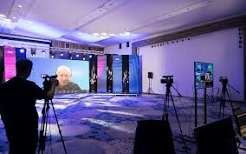
Some corporate events combine in-person participation with livestreaming, recorded presentations, or remote attendance. This creates additional requirements for stage design and scenic production.
A hybrid conference may need camera positions, suitable lighting, presentation screens, microphone arrangements, and backgrounds that work well on video. The stage must serve the physical audience while remaining clear and professional for remote viewers.
Digital screens and branded scenic elements should be positioned so they do not interfere with camera sightlines. Lighting should be suitable for both the venue and the recording equipment.
Businesses should coordinate with audiovisual professionals during the design phase. Planning these requirements early can reduce the need for last-minute changes and improve the quality of the final presentation.
7. Advanced Lighting and Visual Effects
Lighting technology continues to offer businesses more options for creating distinctive event environments. Carefully coordinated fixtures can highlight products, support presentations, establish visual separation, and reinforce a company’s brand identity.
Programmable lighting may help organize transitions between speakers, product demonstrations, and different program segments. LED-based systems can also provide flexible visual effects when used appropriately.
However, more elaborate lighting does not automatically produce a better event. The design must consider visibility, audience comfort, screen reflections, venue restrictions, and power requirements.
For commercial presentations, lighting should make the important content easier to see and understand. A clear, reliable lighting plan is generally more useful than effects that distract from the company’s message.
8. Data-Informed Event Layouts
Businesses can improve scenic production decisions by using information from previous events. Attendance figures, visitor movement observations, staff feedback, lead-generation data, and engagement measurements can help identify which layouts perform well.
For example, an exhibitor might discover that visitors frequently gather around one demonstration station while another area receives little attention. The company can use this information to reposition displays, change signage, or create additional consultation space.
Similarly, a corporate conference organizer may learn that registration queues become congested during peak arrival periods. Adjusting the registration layout could improve the attendee experience.
Data should inform design decisions without replacing practical judgment. Venue conditions, accessibility, safety, and the needs of the audience must remain central to the planning process.
9. The Continuing Importance of Trade Show Fabrication
Despite changes in technology, physical exhibition structures remain important for businesses that attend trade shows. Companies need practical environments where they can present products, communicate brand messages, demonstrate services, and meet prospective customers.
Professional trade show fabrication helps businesses turn exhibition concepts into custom-built environments. These projects may involve booth structures, branded walls, display counters, product platforms, storage solutions, and integrated spaces for digital presentations.
As event formats evolve, fabrication must account for more than appearance. Businesses may need modular construction, technology integration, efficient installation, and components that can be reused across different exhibitions.
For example, a commercial equipment supplier may require a sturdy display platform and clear technical information panels. A business software provider may prioritize digital screens, consultation areas, and a flexible layout.
Show Ready is a brand businesses can explore when evaluating commercial exhibition presentation options. Companies should review the available services and discuss design requirements, materials, installation arrangements, timelines, and costs before choosing a provider.
A well-planned fabrication project connects creative ideas with the practical requirements of the exhibition venue.
10. Better Coordination Between Design and Production
One important development in scenic production is the need for closer coordination between creative design, fabrication, technical installation, and event operations.
A visually attractive concept may become difficult or expensive to deliver if it ignores structural requirements, venue regulations, transportation limitations, or installation schedules.
Early collaboration helps identify these issues before production begins. Designers, fabricators, audiovisual teams, and event organizers can review dimensions, materials, equipment positions, access routes, and technical specifications together.
Approved drawings and clear project documentation reduce uncertainty. They also help businesses understand what will be delivered and when decisions need to be finalized.
For large commercial events, a coordinated production schedule should identify delivery windows, installation stages, inspection requirements, rehearsals, and dismantling arrangements.
This approach can improve reliability while helping organizations control costs.
11. Greater Attention to Accessibility and Visitor Comfort
Future event environments must continue to prioritize the needs of different audiences. Accessible routes, suitable viewing positions, clear signage, and practical circulation are essential considerations for commercial event design.
Scenic structures should not unnecessarily obstruct walkways or make it difficult for attendees to reach important areas. Seating, presentation spaces, registration counters, and demonstration stations should be planned with the intended audience in mind.
Visitor comfort also influences engagement. Overcrowded displays, difficult-to-read signage, excessive lighting, and poorly arranged meeting areas can make an event less effective.
Businesses should coordinate with venue management and relevant professionals to ensure that the planned environment meets applicable accessibility and safety requirements.
How Businesses Should Prepare for Future Scenic Production Trends
Organizations do not need to adopt every emerging trend to improve their events. A more effective approach is to evaluate each option against specific business needs.
First, identify the purpose of the event and the audience it must serve. Second, establish a realistic budget that includes design, materials, fabrication, transportation, installation, technology, and dismantling.
Third, evaluate whether reusable structures, interactive features, or digital systems would improve the experience. Fourth, select production partners with relevant capabilities and a clear understanding of the venue’s requirements.
Finally, review the results after the event. Visitor feedback, qualified leads, staff observations, and operational costs can help determine which investments should be repeated or improved.
This process allows businesses to benefit from innovation without spending money on features that do not support their objectives.
Conclusion
Scenic production is evolving as businesses seek more flexible, engaging, and practical ways to present their brands at live events. Digital technology, modular structures, reusable materials, interactive demonstrations, improved lighting, and data-informed layouts are all influencing how commercial environments are designed.
