

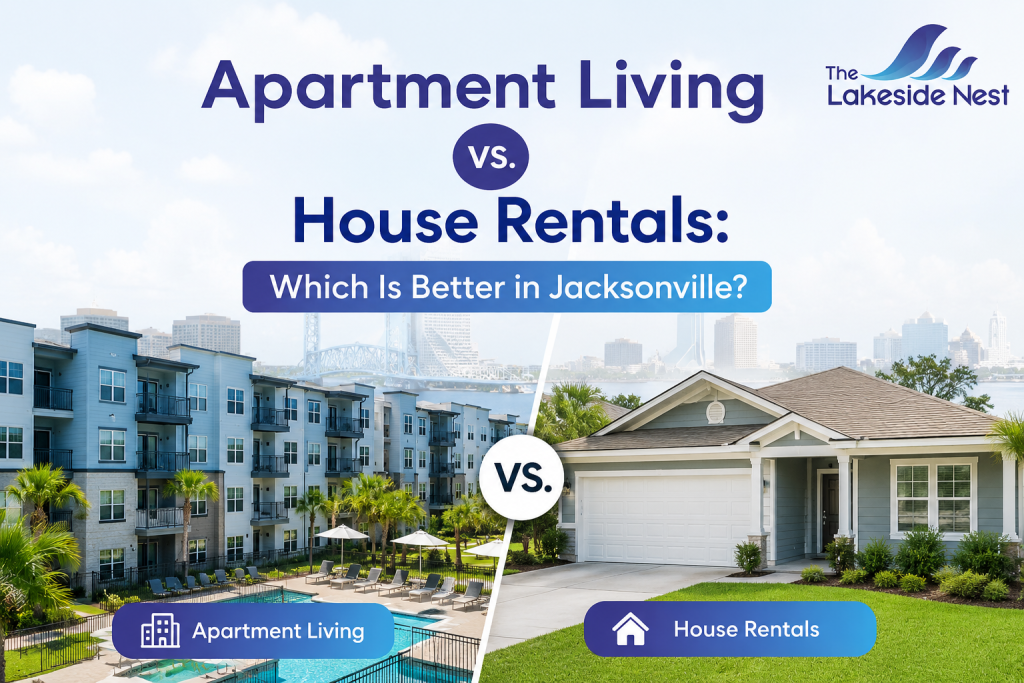
If you’re comparing an apartment vs. house rental in Jacksonville, the decision usually comes down to three things: how much space you actually need, how much upkeep you’re willing to take on, and how much flexibility matters for your next move. Both options can work well, but they solve different problems — one trades space for convenience, the other trades convenience for room to spread out. Rather than starting from what’s simply available on a listing site, it helps to start from how you live day to day. This guide walks through the practical differences between the two — cost, space, amenities, and maintenance — so you can figure out which setup fits your budget and lifestyle before you sign a lease.
Why Renters Choose Apartment Living
Apartments tend to appeal to renters who want predictable costs and less hands-on responsibility. A few reasons this style of renting works well for a lot of people:
- Lower move-in costs: Security deposits on apartments are typically smaller than what’s required for a single-family rental.
- Maintenance is handled for you: A leaking faucet or a broken garbage disposal is a call to the office, not a trip to the hardware store.
- Shared amenities: Pools, fitness areas, and common spaces are available without the upkeep or cost of maintaining them yourself.
- Shorter lease terms: Many apartment communities offer 12-month leases, which suits renters who aren’t ready to commit to one location long-term.
The downside here is square footage. Apartment layouts typically feature a maximum of three bedrooms; shared walls result in some noise passing between units, plus, outdoor space is typically restricted to a balcony or patio rather than an actual garden. Some communities also have breed or weight restrictions for pets, so it’s worth checking before you fall in love with a floor plan.
What a House Rental Offers Instead
Renting a house flips several of those trade-offs. You typically get more square footage, a private yard, and often a garage or driveway — features that matter if you have kids, pets, or simply more belongings than a standard apartment can hold. There’s no shared wall with a neighbor, so noise and privacy work differently, and houses usually come with more storage in the form of attics, garages, or larger closets.
The responsibility shifts too. Renting a house often means you’re mowing the lawn yourself, and depending on the lease, some smaller repairs may fall to you before a landlord gets involved.
Comparing the Real Costs
On a straightforward monthly basis, apartments generally cost less than a comparably sized house rental — that gap is usually more noticeable for one- and two-bedroom setups. According to RentCafe’s 2026 market analysis of Jacksonville, FL (based on Yardi Matrix listings and U.S. Census Bureau housing data), two-bedroom apartments in the city rent for noticeably more per month than one-bedroom units on average, so unit size alone can shift your monthly cost as much as choosing between an apartment and a house does. Single-family apartments for rent in the Jacksonville FL area typically list at a premium over comparable apartment square footage, partly because renters are also covering more exterior maintenance and larger utility loads.
A few cost factors worth checking on either path:
- Utilities: Larger homes generally carry higher electric and water bills, especially during Florida’s hot summer months. Some apartment communities bundle water or trash service into the rent, which simplifies monthly budgeting.
- Move-in costs: Apartment deposits often run from a half-month to a full month’s rent. House rentals frequently ask for one-and-a-half to two times the monthly rent upfront.
- What’s bundled in: Apartment rent often includes several extras in one payment. With a house, rent, utilities, lawn care, and minor repairs are usually separate line items that add up faster than renters expect.
Amenities and Lifestyle Differences
This is where apartment communities often pull ahead. Many include amenities that would be costly to maintain on your own — pools, fitness equipment, playgrounds, or dog parks. The Lakeside Nest, an apartment community on University Boulevard North in Arlington near Jacksonville University, is one example: the property includes two swimming pools, a playground, a bark park with pet sanitation stations, a basketball court, outdoor fitness equipment, and dedicated Pick-N-Play and Chalk Zone areas, along with on-site laundry. Features like these are worth comparing directly against what a house rental would require you to build or maintain on your own.
House rentals, by contrast, offer a private yard and more flexibility to shape the outdoor space yourself — better suited to renters who want a dedicated area for gardening, a dog run, or outdoor entertaining without shared common areas.
Which One Fits Your Needs?
Use this quick checklist to narrow things down:
An apartment may be a better fit if you:
- Want fast maintenance response without handling repairs yourself
- Don’t need more than one to three bedrooms
- Want access to amenities like pools or fitness equipment without owning them
- Expect you might relocate again within a year or two
- Are comfortable with a shorter commute to campus, work, or nearby destinations
A house rental may be a better fit if you:
- Need extra bedrooms or storage space
- Want a private yard or outdoor area
- Plan to stay in one place for several years
- Don’t mind handling yard work or minor repairs yourself
Key Takeaways
- Apartments generally cost less per month than comparable house rentals and come with lower move-in costs.
- House rentals offer more space, privacy, and outdoor area, but shift more maintenance responsibility to the renter.
- Bundled amenities — pools, fitness equipment, playgrounds — are a meaningful cost and convenience factor when comparing the two.
- The right choice depends on your household size, how long you plan to stay, and how much maintenance you want to take on.
Final Thoughts
There isn’t a single right answer between an apartment and a house rental — it comes down to how much space you need, how long you plan to stay, and how much maintenance you want to take on yourself. If low-maintenance living with built-in amenities fits what you’re looking for, The Lakeside Nest in Arlington offers one- two- and three-bedroom floor plans near Jacksonville University, along with pools, outdoor fitness equipment, and pet-friendly spaces. You can explore available floor plans, review community amenities, or schedule a tour to see whether it fits what you need.
FAQs
Q: Are apartments cheaper than houses in Jacksonville?
Generally yes, particularly for one- and two-person households. Larger households sometimes find more value in a house rental once you account for the number of bedrooms needed.
Q: Do house renters typically handle their own yard work?
It depends on the lease. Some landlords require it; others include lawn service as part of a higher monthly rent. Confirm this before signing.
Q: What should I check about safety and security features before signing a lease?
Ask about entry systems, lighting, and whether the property has on-site staff or security patrols, and review any available local crime data independently so you can make an informed decision.
Q: How far in advance should I start looking for a rental in Jacksonville?
Starting 30 to 60 days before your move date gives you more options, particularly in higher-demand areas near universities or major employers.
Q: What amenities come standard with most apartment communities?
It varies by property. Common features include pools, fitness areas, on-site laundry, and outdoor recreation space — it’s worth checking a property’s specific amenity list rather than assuming.
