

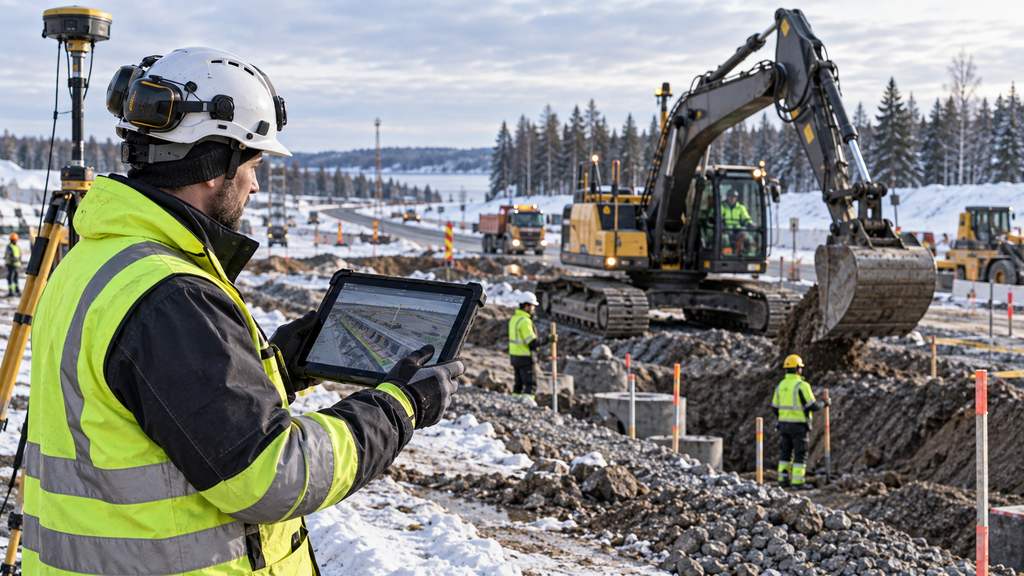
Walk past a large infrastructure project in Finland today and there is a decent chance you will see an excavator moving with a precision that looks almost too smooth to be entirely human controlled. Autonomous and semi autonomous construction machinery has moved from pilot projects to genuine daily use on a growing number of Finnish sites over the past few years. This shift is not happening for novelty reasons, it is driven by real pressures the industry faces, including a persistent shortage of skilled operators, tight seasonal working windows and a strong national focus on workplace safety. This article explains what these machines actually do, why contractors are adopting them, what makes Finland a particularly interesting or difficult environment for the technology, and where things are likely headed over the next five years.
What autonomous excavators and machines actually mean in practice
The term autonomous covers a wide range of real world setups, and it is worth being clear about what is actually happening on most current sites. Fully driverless machines with no human oversight at all remain rare outside of controlled testing environments. What is far more common, and what most people mean when they talk about autonomous construction equipment today, is machine guidance and semi autonomous operation, where a digital model of the finished design is loaded into the machine’s control system and the equipment then executes precise movements automatically, with an operator present to supervise, intervene when needed and handle situations the system was not designed for.
In practice this might look like an excavator that digs to an exact depth and slope specified in a 3D design file without the operator manually judging depth by eye, or a compactor that automatically adjusts its passes based on real time soil density readings rather than a fixed number of runs regardless of actual ground condition. The underlying technology combines GPS positioning, inertial sensors and increasingly detailed digital site models, all feeding data back and forth in real time between the machine and the central project software.
Benefits: safety, precision and schedule
The safety argument is often the strongest one made for this technology, and it holds up well under scrutiny. Removing a human operator from direct physical proximity to a dangerous excavation edge or a machine working near unstable ground reduces exposure to some of the most serious accident risks on a construction site. Even when a human remains present and supervising, machine guided precision reduces the kind of repetitive manual judgment calls that lead to fatigue related mistakes over a long shift.
Precision is the second major benefit, and it compounds across a project. When a machine consistently executes a design to within a few centimeters of specification, rework drops sharply, and the cascading effects of an early error, which in traditional construction can ripple through weeks of downstream work, are largely avoided. Companies covering Finnish construction and home improvement topics, including Marulla, have noted that this precision advantage becomes especially valuable in Finland, where the working season is short and there is little slack in the schedule to absorb the delays that come from redoing work that was not done correctly the first time. The Finnish Institute of Occupational Health has also studied how reduced manual repetition affects operator fatigue and long term musculoskeletal strain, finding that guided operation tends to lower physical stress on operators compared with fully manual control over a full shift.
Challenges of adoption in Finnish conditions
Finland presents a genuinely demanding testing ground for this technology, and not every system designed elsewhere transfers smoothly. Winter conditions are the most obvious challenge. Snow cover can obscure the reference markers and terrain features some guidance systems rely on, extreme cold affects battery performance and hydraulic fluid behavior in ways that require specific cold weather engineering, and low light during the darkest months adds another layer of difficulty for systems that depend partly on visual sensors.
Beyond climate, Finland’s relatively long distances between major population centers and construction hubs create logistical challenges for specialized technical support. When something goes wrong with a sophisticated autonomous guidance system on a remote infrastructure project, getting a specialist technician to the site quickly is a genuinely harder problem in Finland than it would be in a densely populated country where every major city sits within a short drive of the next. This has pushed several Finnish contractors toward building in house expertise rather than relying entirely on manufacturer support, which adds upfront training cost but reduces downtime risk over the life of a long project.
Examples of solutions already in use
Several large infrastructure projects across Finland have already integrated machine guided excavators and compactors as standard equipment rather than experimental additions. Road construction and rail projects, which involve large volumes of earthmoving over long, relatively predictable stretches of terrain, have proven to be a natural fit for the technology, since the repetitive nature of the work plays directly to the strengths of automated precision.
VTT Technical Research Centre has been involved in testing and validating several of these systems under genuine Finnish winter conditions, providing independent data on how well different guidance technologies actually hold up rather than relying solely on manufacturer claims. Meanwhile Rakennusteollisuus RT, the industry confederation representing Finnish construction companies, has documented case studies from member firms showing measurable productivity gains on projects that adopted machine guidance systems, which has helped build broader industry confidence in the technology beyond the largest and most well resourced contractors.
Where things are heading over the next five years
The near term trajectory looks like gradual expansion of current semi autonomous capabilities rather than a sudden jump to fully driverless sites. More contractors, including mid sized firms that previously saw this technology as accessible only to the largest players, are expected to adopt machine guidance as equipment rental and leasing options make the technology available without requiring full ownership of expensive specialized machinery.
Integration between autonomous machinery and broader digital project management systems is also likely to deepen, meaning the data collected by a guided excavator will increasingly feed directly into the same systems used for scheduling, quality control and eventual building documentation, rather than sitting in a separate silo. Full autonomy without any human supervision remains further out, both for technical reasons and because Finnish workplace safety regulations currently assume human oversight of heavy machinery, but the direction of travel is clear enough that operators entering the industry today should expect working alongside these systems to be a standard part of the job within a few years rather than an unusual specialty.
Frequently asked questions
Is autonomous construction equipment actually safe to work around?
When properly implemented with current safety protocols and supervised operation, machine guided equipment has generally improved site safety outcomes rather than reduced them, since it removes some of the riskiest manual judgment calls from the equation.
How much more does autonomous or machine guided equipment cost compared with conventional machinery?
Upfront costs are typically higher due to the guidance hardware and software involved, though rental and leasing options have made access more affordable, and the reduction in rework and schedule delays often offsets the extra cost on larger projects.
Do operators need special training to work with this equipment?
Yes, operators need training specific to the guidance systems they are working with, and this training requirement has become a standard part of onboarding at many Finnish construction firms as adoption of the technology has grown.
