

A shoe that fits comfortably at breakfast can feel surprisingly tight by late afternoon.
For people whose feet swell, that change is more than an inconvenience. Extra volume around the forefoot, instep or ankle can turn an otherwise reasonable shoe into a source of pressure and rubbing. The instinctive response is often to buy a larger size, but increasing length does not necessarily create space where the foot actually needs it.
The better approach is to think about volume, width and adjustability separately.
NHS guidance for oedema, the medical term for swelling caused by fluid in the tissues, recommends wide, comfortable footwear with a low heel and soft sole. Swelling can arise for relatively ordinary reasons such as prolonged sitting or standing, but it can also occur with pregnancy, certain medicines, injuries and underlying health conditions.
When choosing the best shoes for swollen feet, the goal is therefore not to “treat” the swelling with footwear. It is to accommodate the foot safely and comfortably while leaving room for the changes that can occur during the day.
Why Do Swollen Feet Need a Different Type of Fit?
Swelling changes the dimensions of the foot.
Sometimes the difference is concentrated around the ankle. In other people, the forefoot becomes broader, the top of the foot rises against the upper, or the toes feel crowded even though the shoe length has not changed.
That last point is important. Traditional shoe sizing focuses heavily on length, but a swollen foot may need additional width and depth without needing any extra length at all.
Moving from a size 6 to a size 7 simply because a shoe feels tight can create an awkward compromise. The extra length may leave unused space in front of the toes and allow the heel to move, while the upper can remain restrictive across the swollen part of the foot.
Good footwear should instead accommodate the three-dimensional shape of the foot.
South Tees Hospitals NHS Foundation Trust advises that footwear should have enough length, width and depth, particularly around the toe box. It also recommends securing shoes with laces, Velcro or a buckle rather than relying on an unsupportive loose fit.
That combination, space plus control, is the foundation of a better shoe for fluctuating swelling.
Extra-Wide Does Not Simply Mean “Bigger”
A useful extra-wide shoe gives more room across the foot while keeping the overall length appropriate.
Width categories can vary between manufacturers, so labels should be treated as a comparison tool rather than a universal measurement. A shoe marked “wide” by one brand may feel very different from another carrying the same description.
The shape of the last, the mould around which the shoe is built, matters as well.
A broad forefoot may need considerable width near the ball of the foot but not around the heel. Someone with swelling across the instep might need additional vertical volume more than a dramatically broader outsole.
This explains why a person can try an apparently wide shoe and still feel squeezed.
Guys and St Thomas’ NHS Foundation Trust makes another useful distinction: wide-fitting footwear gives more space across the ball of the foot, but the front should also be round or square enough that it does not compress the toes.
Width and toe-box shape work together.
For shoppers who regularly find standard footwear restrictive, collections of extra wide fit shoes for swollen feet can make comparison easier because the current range includes women’s medium/D, wide/2E and extra-wide/4E categories rather than treating all wider feet as a single fit.
The correct category is still the one that fits the individual foot, not automatically the widest option available.
Why Adjustable Closures Matter So Much
A swollen foot does not always stay the same size from morning to evening.
That makes adjustability one of the most practical shoe features.
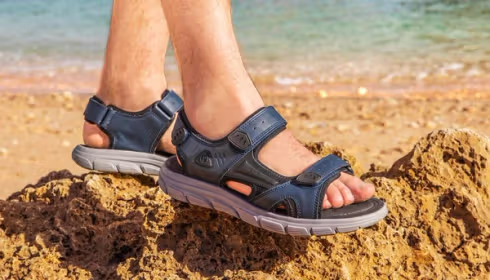
Laces can be loosened across a particular part of the foot. Hook-and-loop straps can provide a larger opening and allow quick changes during the day. Some multi-strap designs can be adjusted in more than one location.
Compare that with a rigid slip-on. If the foot becomes noticeably fuller after several hours of standing, the shoe has very little ability to respond. The upper either stretches, compresses the foot or becomes difficult to remove.
Adjustability also prevents another common mistake: choosing a shoe so loose that it stays comfortable at maximum swelling but provides poor fit the rest of the time.
Footwear advice published through MyHealthLondon recommends a properly fitting shoe, boot or trainer with laces or strap fastenings, noting that the fastening helps keep the foot in place and can reduce rubbing.
The ideal closure creates flexibility without turning the shoe into an unsecured slipper.
Toe Room Is About Shape as Well as Space
When feet become swollen, toes can end up pressed against each other or pushed against the upper.
A broad, rounded or squared toe box generally accommodates this better than a sharply tapered front.
The term “toe box” refers to the front compartment of the shoe surrounding the toes. Its usefulness depends on both width and depth.
A shoe may look broad from above but remain too shallow for someone whose toes or forefoot have increased in volume. Conversely, a deep shoe can still be narrow from side to side.
A simple fitting check is to stand naturally in the shoe and pay attention to where the edges of the forefoot sit. The widest part of the foot should rest comfortably within the widest portion of the shoe.
The American Orthopaedic Foot & Ankle Society also advises that shoe shape should resemble foot shape and that buyers should not purchase uncomfortable shoes on the assumption they will eventually stretch enough to fit.
Swollen feet are particularly poorly suited to the “break them in” approach. A shoe that is already pressing firmly on a swollen area at purchase is starting with the wrong geometry.
Soft Uppers Can Reduce Pressure, but Structure Still Matters
Stretch or softness in an upper can be helpful when foot volume fluctuates.
Materials that do not have hard edges directly over prominent or swollen areas are less likely to create obvious focal pressure. South Tees NHS podiatry guidance recommends soft upper materials and advises avoiding bulky seams or stitching inside footwear.
That does not mean the entire shoe should collapse like a sock.
A shoe still needs enough structure to stay on the foot during walking. The heel area should provide reasonable security, and the sole should be appropriate for the activity.
Extremely loose footwear may initially feel accommodating because nothing presses against the foot. After several hundred steps, however, sliding can produce its own rubbing.
The better design combines a forgiving upper with a stable platform and an adjustable way of securing the foot.
Shoe Depth Is Easy to Overlook
Width tends to dominate conversations about swollen feet, but depth may be just as important.
Swelling over the top of the foot can make laces feel tight even when there is sufficient room across the sole. A high instep creates a similar problem.
Deep footwear gives the foot more vertical space. It can also be useful when an orthotic or specialist insole needs to be accommodated.
If a removable insole is replaced with a thicker device, the foot sits higher inside the shoe. A pair that originally fit well can suddenly press across the toes or instep.
This is why anyone using prescribed orthoses should try prospective shoes with the actual device installed rather than assuming it will fit because the shoe is labelled wide.
Internal volume is every bit as real as external size.
Should You Buy Shoes in the Morning or Afternoon?
For feet that swell as the day progresses, later is generally more informative.
FootCareMD recommends trying shoes toward the end of the day, when feet are typically at their largest. NHS Borders footwear guidance similarly advises afternoon shopping for people whose feet tend to swell.
A morning fitting can underestimate the amount of space required.
There is still a balance to strike. Buying only for peak swelling can produce a shoe that becomes excessively loose when swelling subsides.
Adjustable closures help bridge that difference.
It is also worth measuring both feet. Human feet are rarely identical, and swelling can make asymmetry more noticeable. Fit the larger foot rather than choosing a shoe that feels comfortable on one side and compressed on the other.
The Best Walking Shoe for Swollen Feet Is Not Necessarily the Softest
Cushioning can be useful, especially for someone spending long hours on hard floors, but softness alone tells very little about fit.
An exceptionally soft midsole does not create toe room. It does not accommodate a high instep. It cannot stop a restrictive upper from pressing against the forefoot.
The sole should provide comfortable cushioning while remaining stable enough for the intended activity. Walking shoes also need to flex appropriately as the body moves over the forefoot.
For everyday use, a low heel is generally easier to accommodate than a high heel, which shifts more load toward the front of the foot. NHS oedema guidance specifically recommends wide, comfortable shoes with low heels and soft soles for swollen ankles, feet and legs.
Comfort should be judged while walking, not by pressing a thumb into the foam.
Workdays Can Expose Fit Problems That a Short Trial Misses
Someone who spends eight hours standing may experience much greater changes in foot volume than someone trying shoes for ten minutes.
Work footwear should therefore be evaluated for the end of the shift, not merely the beginning.
Adjustable shoes can be particularly useful because the closure can be changed if pressure increases through the day. A broad toe area also leaves some tolerance for changes around the forefoot.
Occupation still matters.
If protective footwear is required for the workplace, the shoe needs to satisfy the relevant safety requirement as well as fit the foot. Extra width cannot substitute for mandatory toe protection, slip resistance, puncture resistance or another site-specific requirement.
Workers dealing with persistent swelling may need to search specifically within appropriate occupational footwear rather than replacing safety shoes with ordinary trainers.
Pregnancy Is One Situation Where Fit Can Change Quickly
Foot and ankle swelling is common during pregnancy, particularly later in the day and later in pregnancy.
The NHS advises comfortable footwear and socks, specifically cautioning against tight straps or anything that pinches when the feet swell.
In practical footwear terms, this makes adjustability particularly valuable.
Buying a much longer shoe to compensate for temporary swelling may leave a poor fit once the swelling decreases. A roomier width, more accommodating upper and adjustable fastening can often handle changing volume more sensibly.
Sudden or severe swelling during pregnancy, however, is a medical issue rather than a footwear-selection problem and needs appropriate assessment.
Heat, Travel and Long Days Can Change How Shoes Fit
Some people notice swelling mainly under particular conditions.
Hot weather is one example. Long journeys are another. Hours of sitting on a flight or in a car may leave the feet and ankles fuller than usual.
NHS diabetic foot-care travel guidance notes that long journeys and hot weather can make feet swell and warns against footwear becoming too tight.
That has a practical implication when packing.
Do not take a trip with only one pair that fits closely under ideal conditions. A second, more adjustable option can be useful for travel days or periods when the feet are more swollen.
The same principle applies to people attending long events, spending an entire day shopping or returning to prolonged standing after a period of inactivity.
Footwear should reflect what happens to the foot over the whole day.
Extra-Wide Shoes Can Be Too Wide
Going wider is helpful only until the shoe actually matches the foot.
An unnecessarily wide shoe can allow side-to-side movement. The heel may lift, and the foot can slide forward during walking. Friction from movement is not an improvement over friction from compression.
That is why someone comparing extra wide fit shoes for swollen feet should ideally try more than one width rather than immediately choosing the maximum available. The current women’s collection, for example, separates 2E and 4E options, allowing shoppers to compare degrees of additional width.
Look at the fit when swelling is present and when it is less pronounced.
A good shoe should be capable of being secured comfortably in both situations. If tightening the closure still leaves the heel moving dramatically, the shoe may simply be too wide.
Check the Inside, Not Just the Size Label
Swollen skin can be sensitive to pressure from surprisingly small details.
Run a hand around the inside of a prospective shoe. Look for raised seams, stiff edges, folded lining or decorative components that press inward.
The insole should lie flat.
Also check the upper after fastening the shoe. Deep creases over a swollen area can sometimes become pressure points of their own.
A clean, smooth interior is particularly important for anyone who also has reduced sensation from diabetes, neuropathy or another condition because rubbing may not always be noticed immediately.
Footwear can accommodate swelling. It cannot make unnoticed skin damage harmless.
When Swelling Should Not Be Treated as a Shoe Problem
There is an important line between adapting footwear to familiar swelling and assuming that all swelling is ordinary.
The NHS advises urgent assessment when swelling is severe, painful, begins very suddenly, occurs in only one leg without an obvious reason, or is associated with redness or heat. Swelling accompanied by shortness of breath, chest pain, coughing blood or significant breathing difficulty requires emergency attention.
Persistent swelling also deserves assessment when its cause is not known.
Footwear may make day-to-day movement more comfortable, but it does not explain why fluid is accumulating.
For someone who already knows why the feet swell and has received appropriate advice, better-fitting shoes become one useful part of living with the change.
FAQs About Best Shoes for Swollen Feet
Should swollen feet be fitted with a bigger shoe size?
Not automatically. If the main change is width or depth, increasing shoe length can create heel movement without solving the pressure problem. Try the correct length in a wider, deeper or more adjustable shoe first.
Are slip-on shoes good for swollen feet?
They can be convenient, but a fixed slip-on provides limited adjustment when foot volume changes. Laces, straps or other adjustable fastenings generally offer more control over fit throughout the day.
Is a wide toe box enough for swollen feet?
Not always. Toe-box width helps when swelling affects the forefoot, but some people also need more depth across the toes or instep. The whole foot shape should be considered rather than one measurement.
When is the best time to try shoes if my feet swell?
Late afternoon or later in the day is often useful because swelling may be greater then. Try both shoes, walk in them and use the same type of socks or orthotics you expect to wear regularly.
The Best Fit Leaves Room for Change
Swollen feet make shoe buying more complicated because the target is not completely static.
A shoe has to fit a foot that may be smaller in the morning, fuller after hours of standing and different again during hot weather or travel. That is a difficult job for footwear that offers only one fixed amount of internal space.
Extra width can provide room where a standard shoe compresses the foot. Toe-box shape determines whether that room actually reaches the toes. Extra depth matters when swelling affects the top of the foot. Adjustable closures then tie those features together by allowing the fit to respond as foot volume changes.
The aim is not the largest shoe possible. It is controlled space.
A well-chosen pair should give the foot somewhere to expand without leaving it sliding around when the swelling eases. That balance is what turns “extra wide” from a label into a genuinely useful fit.
